Are you not not entertained???!!!!

Robert Vermeulen 13/08/25

On the 9th of August 2025 the last rites of the 50 over Topklasse were served. VOC survived to fight another year and the Topklasse lost Excelsior ’20 and Sparta. Kampong are the champions. Apart from a few details, mostly surrounding the relegation, the cards were more or less dealt by mid-July. Now the T20 circus will form the fag end of the cricket season. Hurrah? Nah.

Whatever some people might say about the rising importance of T20 for Dutch cricket, the clubs see the 50 over competition as the most important competition. You are the national champion if you win your 50-over league. T20 is nice, but a bit of a side show. Nobody will shed a tear if the first team does not do well in the T20 league. Clubs will primarily invest in the 50-over competition; for glory or survival.
The way this year was structured was highly conducive to gaming the system as far as overseas players were concerned. Less scrupulous parties could fly in players on a tourist visa for a maximum of 90 days to play the first round on 27 April 2025 and leave after the 17th round on the 20 July 2025. They would only have missed one round. In this case that would only have had any relevance for the relegation and play off matches. The rest was already settled. Fly in (say) 4 players on a tourist visa, see to it that they make you champion or at least that you survive and off they go again after 90 days. No need for costly fees for permits, visa and other bothersome formalities. After July nothing really matters anyway. Needless to say that this is illegal as well.

The T20 Cup opens the door to European cricket — lots of fun — and possible cash that the Wise would invest in their youth development. I have the idea that not all clubs and players are that keen on the T20 part of the year. As the T20 has limited consequences for TK clubs for next season as relegation is slightly unlikely, you can just have some fun and see where and when the ship runs aground.

Personally I find all this very frustrating and, frankly, boring. The month of August has nothing to offer with any consequences other than the T20 Cup and junior matches (for those clubs who actually have juniors). No teams have to either fight for the championship or survival until September. No clubs have to hang on to their pro’s and show that they possess the debt of player resources that they can survive until September. Nothing of this. You will see some teams who enjoy T20 have some fun. The rest will just go through the motions slowly ambling towards the winter recess. I am for sure not entertained!!!

We will be best served to rethink this set up. The season should be relevant until September, for it is then that the strongest teams with supporting club structures show their mettle. Mix the T20 in during the season.

In September 2026 I really hope to be able to watch some nailbiters again with all of my fellow cricket lovers…. But not this year.

KNCB faces pushback on domestic structure overhaul

Bertus de Jong 12/03/2025

The beleaguered KNCB board headed by Guido Landheer will face further tribulation tomorrow, as they look to face down opposition to the overhaul of the domestic one-day competition structure that was announced in January. A number of clubs from various divisions, including Sparta 1888, VRA, Dosti, Hercules, Rood en Wit, Salland CC, VVV, Quick 1888 and Qui Vive among others, moved last month to request a Bijzondere Algemene Ledenvergadering (Special General Members Meeting) to reconsider the proposed changes, and that meeting has been duly scheduled for tomorrow (March 13th).

Perhaps unsurprisingly Hoofdklasse clubs comprise a substantial proportion of the remonstrants, more than half the current competitors in the second division adding their voices to the call. Under the current proposal the Hoofdklasse will see fully half of the current field relegated at the end of the coming season, with five teams dropping down to an enlarged Eersteklasse for 2026, to make room for three relegated Topklasse teams and the promotion of the 2025 Eersteklasse champions.

Speaking on behalf of the clubs appellant, former national team captain and sometime KNCB vice chair Steven Lubbers stressed that the appeal for a BALV was a move of last resort, but the group saw no other option. Lubbers, who has long advocated a broader pyramid with expedited promotion especially at the lower end of the ladder, told TKcricket that the remonstrant clubs felt there were significant deficiencies both in the process and that led to the new structure revealed in January, as well as the outcome.

Lubbers argues that the relegation of half of the Hoofdklasse would leave those clubs in an appreciably weaker position vis-a-vis local councils and rival sports when it came to Topsport subsidies and competition for facilities. Lubbers also echoed an observation which several commentators have raised regarding the board’s proposed promotion/relegation scheme for 2025/26, namely that the absence of any relegation playoffs means that sides in lower divisions enjoy a perverse advantage in jockeying for position for 2026. A team now in the Eersteklasse, for example, need only win that division (effectively placing 21st on the ladder) to win promotion to the Hoofklasse for 2026 while a team starting in the Hoofdklasse would have to place in the top five (essentially 15th in the full rankings) to retain their place.

Lubbers had previously championed and alternate plan which had come to be known as Voorstel Salland, which envisioned broadening the pyramid structure substantially all the way up to the Hoofdklasse, which under the Salland plan would be split into two pools and expanded to 16 or more teams, while lower divisions would also be expanded and slip into more pools – a format which Lubbers argues would both alleviate competitive pressure on clubs while allowing for expedited promotion.

Former VRA chair John Wories, who has played a leading role in the opposition to the new structure, observed in a memo circulated to clubs early last month that “expanded relegation will increase the pressure on clubs for extra reinforcement with foreign players/coaches” further crowding out homegrown youth talent on the field while limiting other expenditure “if only because financial resources would be used for [overseas recruitment] rather than for improving facilities (including grass wickets), strengthening participation and developing (young) players.” Indeed while early indications suggest that we may be on course for record spending on overseas talent for the coming season, at least in the Hoofdklasse. That in and of itself may however generate resistance to the remonstrants’ proposals from clubs that have already invested heavily ahead of what is currently slated to be a cut-throat season.

The remonstrating clubs are arguing for a postponement of any substantial restructure, either maintaining the same format as 2024 for the coming season or, in deference to the difficulty of overhauling the calendar at this late stage, at least postponing the envisaged transition to the planned 2026 structure and the numerous relegations that it would entail. Pointing to perceived deficiencies in the consultative process followed by the KNCB, which saw a nine-member working group headed by Reinout Scholte and Adriaan van der Dries arrive at the current restructure plan, the dissenting clubs propose a new committee be set up to consider the question.

Scholte, KNCB board member with the High Performance portfolio who has acted as point-man for the board on the issue, stepped down last month citing in part the increasingly fractious nature of the controversy, but the board shows little sign of throwing in the towel. Regretting the departure of Scholte, KNCB chair Guido Lanheer said in a previous statement, “The reasons for his departure give rise to thought and reflection on the way we deal with each other within cricket Netherlands. Differences of opinion will always exist, but the way we currently deal with each other and with these differences of opinion does not lead to the best result for cricket Netherlands in our view.”

Speaking to TKcricket, Landheer defended the process that produced the restructure plan, which included wide consultation with clubs across various divisions. While conceding that it was regrettable that the subject could not be discussed at the December ALV (which was busy with other matters), an extra virtual meeting was scheduled in January to address the issue specifically. “There were 45 clubs represented at the January (8th) meeting, and all clubs were afforded the chance to comment up until January 24th.” Landheer said, observing that neither Salland nor VRA did so at the time.

Referring to the alternate proposals first tabled two years ago, Landheer insists they were not dismissed out of hand. “The so-called Voorstel Salland was considered in depth, and several aspects of it have been incorporated into the new structure.” Landheer told Tkcricket, “a broader pyramid, and regionalisation at lower levels, for example, the latter especially has been made easier by the new scheduling software.” Landheer explained. “We’ve sought to give more attention to T20 and recreational cricket, while providing for more predictable and stable scheduling compared to the previous system.” The board is not entirely blind to some of the problems the upheaval expected at the end of the 2025 season may throw up, and aspects of the “Big Bang” transformation are less than ideal as Landheer concedes. “Transition is difficult but it is a necessary investment in the future.”

Following several bruising meetings focusing on the KNCB’s now well-documented financial woes, the board may even be relieved to be back on the familiar ground of wrangling about domestic structures, and it has been noted that the ALV’s role in questions of domestic structure is, constitutionally speaking, purely advisory. Nonetheless it is doubtful that the board will be afforded an easy time of it tomorrow, though with the first ball of the season now just weeks away it is late in the day to be changing course…

The points system and the finals

Robert Vermeulen

21/11/2024


In May I posted an article about the delicate future of our beloved Game in The Netherlands. The vast majority of the feedback I received was positive. In this polarised digital world and a quite tribal Dutch cricket community, that is a remarkable thing. It stands to reason that there are several ways to solve the issue I tried to address. The most important thing is that we acknowledge the problem and try to formulate a strategy to face it.

You might think that I, as a lawyer, would propose strict rules and regulations. That is only partly true. Sure, I salivate by the thought of drafting such documents, but rules are more effective if they are broadly supported, are seen as ‘obvious’ and, finally, reflect an internal moral belief. The reason one does not steal is -hopefully- not that it is illegal, but that is ‘not right’. It goes against your moral fabric and would make your mother very very disappointed in you.

Breaking the trend

A rough estimate by ‘those-in-the-know’ is that we collectively, as clubs, might have spent as much as half a million Euro’s this year on players. If true, and I am afraid it might be, that is a shocking amount of money. At best one would hope that this money was spent on a lot of junior coaching hours…. if there were any juniors to coach.

I would suggest that it is time to start the (long) process towards addressing our unhealthy habits that have crept into our top leagues. We must stop spending resources on things that not evidently ensure the long term survival of the Game as a whole. A club will truly survive a relegation. Trust me, I have been there. Healthy clubs that invest in their home-grown stock and the health of their own club organisation and culture, will survive and return. Take VCC as an example, they went through a major lean patch some years ago but now they were (again) in contention for a championship. Good on them!

Only if the club does not have a strong foundation, the players might move on. That is the risk of those clubs who are ‘a bank account with a first team’. Mercenaries follow the money.

If we are to survive, a collective action is needed to stop ‘stupid money’ and encourage ‘smart money’. In my very humble opinion, a points based system as suggested by me in May, would stimulate that and see to it that clubs are forced to make the right choices. We must break the arms-race.

Let’s have a look at our semi-finalists in the Topklasse of this year: Punjab Ghausia (Punjab), VRA, VCC and HCC.

When I speak of local players, I mean those players that are either home-grown players or are players that are here for other reasons than cricket. This last group are those that moved here for work, study or other non-cricket related reasons like marriage/relationships/family reunion or refugee status. Home-grown players are players that learned their cricket here. Overseas players are players whose main reason for being in The Netherlands is to play cricket.

In this piece I will add the distinction between home-grown players by the club itself and home-grown players that came from other clubs. Why keep things simple?

Semi-finalists

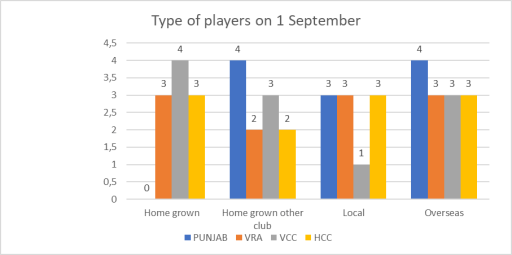
On 1 September 2024 I partly watched VCC 1 beat my beloved HCC 1. No complaints there: they were the better side, especially on the day. If one breaks down the makeup of the teams, HCC fielded 3 home-grown HCC players, 2 home-grown players that moved from other clubs, 3 local players (players who live here but are not home-grown) and 3 overseas players. VCC fielded 4 home-grown VCC players, 3 home-grown players that moved from other clubs, 1 local player and 3 overseas players. The home-grown players on a whole were quite influential, so cheers all round!

Punjab, a powerhouse in the last years, was in the Grand Final. Again, good on them. VRA had a sniff at victory but fell just short. A breakdown of these teams is as follows. Punjab fielded 0 home-grown Punjab players, 4 home-grown players that moved from other clubs, 3 local players (if Belgium is deemed local / plus a player I could not place in the other columns) and 4 overseas players. VRA fielded 3 home-grown VRA players, two home-grown players that moved from other clubs, 3 local players and 3 overseas players.

The differences between the clubs are not extreme.

The main reason Punjab does not have Punjab home-grown players is their recent rapid rise to prominence. Their efforts in junior cricket will reap benefits in due time. VCC fielded 4 VCC home-grown players on Sunday and 3 home grown players that came over from other clubs (two HCC raised and one ACC). 7 home grown players in total. Well done. Fair play!

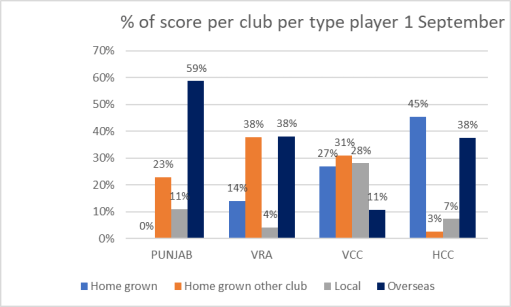
Breakdown of relative influence of types of players in last Sunday’s games:

This is only one game but it should be interesting to make a broad analysis over the whole season. Certain retired CBS statisticians might be interested to have a go at this…

Second teams

In the Eerste Klasse VRA 2 beat Punjab 2 in the Grand Final. Punjab 2 beat HCC 2 in the semifinal. The fact that all-but-one player in HCC 2 are HCC home-grown players, delights me. They beat Qui Vive 1 in the elimination final and are clearly a tight group that have a boat load of fun together. That is what it is all about.

VCC 2 might have relegated to the Eerste Klasse, but that might only be healthy for the team as a whole so that they can rebuild and play at a level that might be more fun for younger players. I would say that VCC and HCC, for now, have a bright future. The strength of VRA 2 and Punjab 2 is very promising as well, albeit that the latter team contains not a lot of home-grown players and even overseas players.

The point that I am trying to make here is that the second teams of all the semi-finalists in the Topklasse are vibrant as well. That shows a broader basis of playing talent than just the flagship team. These second teams are usually not stacked with ringers, albeit that they might have potential first team players that were pushed out by overseas players acquired for the first team. If you would add to that picture the line up of these clubs in the U17 and U15 leagues, these Topklasse semi-finalists are largely healthy clubs. They are not an empty shell.

Points system

field competitive teams with the back up of strong second elevens and talented youth. VCC survived a drain from the Dutch XI and pro’s leaving home by fielding a slew of home-grown players; so did VRA. Again, cheers all around. The four finalists had enough depth in their selection to fill the gaps.

I would say all potential champions this year were clubs with a role to play in the future of our local Game.

If we would be able to reduce the amount (and influence) of overseas players in these (and other) teams, the further development of home-grown players could be stimulated and create a more level playing field for all clubs with good intentions. I am sure that these four clubs would support that idea (as they live in relative luxury). Others might be more reluctant, but it has to be done!

Clubs have limited resources that could and should be used wisely. The club members should demand transparency from their committees regarding the finances surrounding players. Depending on sugar daddies and non-recurring donations (even in kind) is no basis for long term policy. If they suddenly leave, you are done for.

The introduction of a points system results in a reduction of overseas players, this would reduce the need to spend money on everything surrounding overseas players and could free up resources for other, more productive, causes.

I hope that this autumn and winter will provide us with ample time to develop ideas to improve the future of or local Game.

Things aren’t always what they seem

Rod Lyall 20/09/24

‘I saw it on TV!’ is a phrase which is likely to go down in history as a monument to the unreliability of what we see in these days of AI, and the growing body of ‘alternative facts’ with which we are increasingly surrounded.

Not everything we see on the screen, whether on television or a computer, can necessarily be taken at face value, and journalists have an obligation to try to distinguish the apparent from the real, and to tell their story as accurately as they can.

So this is by way of being a ‘mea culpa’, an acknowledgement that my first reaction to the regrettable if brief events which followed the Topklasse grand final between Punjab-Ghausia and VRA Amsterdam last Saturday did not do sufficient justice to the complexity of what took place, in those moments and in the hours which preceded them.

As I write this, I am conscious not only of the fact that what I have to go on is mostly images from a live stream, a single camera situated at some distance from the events, but also that the whole issue is  in a certain sense sub judice, in that the KNCB has disciplinary procedures which need to be allowed to run their course.

Not to mention the laws of defamation, which require one to be extremely careful in what one says about any individual.

Like the semi-final between the same two teams two weeks earlier, the grand final was a hard-fought, tense battle which went all the way down to the wire.

Unlike the semi-final, however, this was something of a gala event, with VIP tents, music, and a relatively large crowd of supporters.

It was also a game of fluctuating fortunes, VRA fighting back towards the end of their innings with a fine knock from Shariz Ahmad, and Punjab needing nearly eight an over from the last seven with six wickets down.

The hosts’ sensational victory with two deliveries to spare was a tribute to their resilience, and it came as a huge relief to their supporters and as an equally great disappointment to the visitors.

Which doubtless goes a long way towards explaining what happened afterwards, although it cannot be said to justify it.

The Spirit of Cricket preamble to the Laws and the Code of Conduct are there to ensure a fair and respectful contest, and it is the task of the onfield umpires to ensure that that is how the game is played.

And the match referee and the KNCB’s disciplinary procedures are there to take appropriate action should further measures prove necessary, as I remain convinced they are following those regrettable scenes.

What I do feel obliged to do, however, is to acknowledge that by initially focusing on  one side of the case I gave too much emphasis to the crowd’s invasion of the ground immediately following the conclusion of the game, and too little to the tensions which had built up in the course of the day.

The façade of success

Robert Vermeulen

23/05/2024


It was more than 15 years ago that I last gave an online opinion on a cricket-related topic, at the time regarding identification of players during games following a few then recent incidents in which teams had fielded players under false or fake names. A mildly controversial matter at the time. I would now like to express my opinion on a more fundamental issue that will hit a few more nerves within our small community. I avoid naming names in this piece as that would not be right, but every person who has a more than fleeting knowledge of the Dutch cricket world can come up with their own examples.

Introduction
This piece was brought on by a quote from my friend Rod Lyall in his piece of 21 April 2024 for this website:

For the first time in the 134-year history of the Dutch competition, more overseas-produced players took the field in top-flight games than those who had learned their cricket in the Netherlands – the actual figure was 57%.

This remarkable statistic is perhaps skewed a little by the fact that three teams did not play, the triple-header at Thurlede having been called off on Friday night after a week of heavy rain, but nevertheless the trend is clear: the leading Dutch clubs are relying ever more heavily on imported players in their quest for silverware.

Of the seven teams who did play, only three fielded a majority of Dutch-produced players, and one, Salland, actually put out a side without a single member who had learned their cricket in this country.

What are we talking about?
For the sake of clarity I would like to present you with a few definitions. When I speak of local players, I mean those players that are either home-grown players or are players that are here for other reasons than cricket. This last group are those that moved here for work, study or other non-cricket related reasons like marriage/relationships/family reunion or refugee status. Home-grown players are players that learned their cricket here. Overseas players are players whose main reason for being in The Netherlands is to play cricket. There are ample examples of hybrid situations or evolving situations. The fact that I bumped into Lindon Joseph (former WI and Gandhii (Dosti) fast bowler) last year, shows that some former overseas players can end up very local players in time. Great to see one of the all-time greats still in action!

Players with a Dutch passport (like in the Dutch XI) who are non-local players, are overseas players. For the purpose of my argument, their nationality is a coincidence.

I have been told multiple times that certain overseas players are not paid by the clubs or just small amounts for coaching etc. That is not the point. The reason why overseas players come over to play in The Netherlands is irrelevant for this discussion. It might be relevant to the debate about the allocation of limited funds within the Dutch cricket community. That is a matter for a different day.

Points system
I must point out that, during my stint within the KNCB Board, the Bureau, Rod and myself did look into a system to regulate the influx and use of overseas players. For me the main reasons for that would be:

  1. to stimulate the development and use of home-grown players, especially junior players;
  2. to prevent the (further) escalation of the perceived necessity for overseas players to either prevent relegation or ensure championships;
  3. to create a level playing field for clubs, whereby long term success is not determined by the depth of the pocket, but by the quality of the club structure.

We had a look at the Victoria (Australia) ‘points method’ whereby teams were only allowed to field a maximum amount of 24 (player) points per match. Based on their status (home-grown by the club, home-grown, local or overseas) players are allotted a certain amount of (player) points. Home grown-players would count for 1 point, but test players for 7, with many variations in between.

We played around with a few KNCB specific variants at the time, but it never really caught on. The last version was produced in October 2020. I re-read it and I still feel that it has significant merits, not in the least as a basis for a more fundamental discussion about our collective future as a cricketing nation.

Lets be brutally honest. The number of clubs that can say that they have a plan to create their own home-grown player pool can be counted on the fingers of one hand, maybe two. One only has to look at the current junior competitions to see which Topklasse and Hoofdklasse clubs are absent in most of the age groups. There is no natural succession there. Those clubs will have to rely on either an influx from within the current local player pool or procurement of overseas players.

Would a point based system be legal?
In the past we played around with a few types of systems to limit the amount of overseas players in our top leagues. The most recent regulation limiting the amount of overseas players was (long) upheld by a mutual understanding between the clubs. The most potent legal point against this regulation was not EU regulation, but the Dutch Wet Gelijke Behandeling (the Equal Treatment law). One cannot make any distinctions between people based on nationality. It was because of that the regulation was scrapped and never replaced by anything other than the players list requirement.

The points system would, in my humble opinion, not be problematic as it categorises players based on their (cricketing/club) status and only places a restriction on the team total. Everybody as an individual can play, the club must balance their points per match.

Make or buy?
The player-tombola we saw this winter was a nice example of destructive forces at work. 20 years ago, when I chaired HCC, we would receive calls from players after every season to see what ‘deal’ they would be able to get. We never were interested. This type of players is notoriously fickle. At the time it was only a small group of nomadic players.

Now it is worse. The rumours were rife this winter of whole groups of players hawking their services to the highest bidder. Everybody was talking to everyone it seemed. Even players that one would regard as ‘club people’ were clearly willing to hop around.

Just like in business the question is clearly: Make of Buy? Most clubs can’t make, so they buy. I suggest to you that this will be our collective undoing in the long run. Both for the clubs and for Dutch Cricket.

Recent growth
It is not only doom and gloom though. In the last few years we have been blessed by a significant increase of local players, mainly from India. This means that the sport grows. That is really great on the face of it, but will be highly dependent on the stability of growth. Will these players, especially the juniors that rise through the ranks, permanently commit to Dutch cricket?

For now we must enjoy the broadening of our players base and welcome all to our fields. We can even see a few local players, non-home grown, playing in our top leagues. It is early days.

Topklasse / Hoofdklasse
The more pressing issue is that of the population of our top leagues. As stated, the clubs compete for a very limited amount of local players. Apart from the usual journeyman players who have no clear club affiliation at all, I was shocked to see a few transfers of some real club people. This is a zero-sum game, whereby the gain of one club is a real loss for the other. This hurts clubs. If this happens at junior level, it is even worse. If, as a club, you invest effort and resources in building a junior program and juniors are constantly poached by clubs that put in less effort, you undermine the future of the whole community. What is the point of putting in the effort when others can just wait until you have produced a ‘poach-able’ player? These centers of youth development should be protected and cherished.

And then there is the issue of what I have coined ‘the bank accounts with a first team’. The only apparent current reason for their existence is the survival in a certain league. It is an empty shell for the rest. There is no junior development, hardly a club structure and most definitely no long term strategy other than: next year we will still play at this level. What is the point? If the bank account runs out of funds, the team vanishes. There is no added value to the long term development or even survival of our Game. It can even be argued that it damages the Game. A championship is meaningless if you can simply buy it. It is nice to boast that you were champions, but lets be honest, what is the point if you implode like a soufflé after that.

I understand that the introduction of overseas players has on the one hand beneficial effects on the level of play, but, on the other hand, could take the place of a home-grown player that would like to play and evolve. We need the home grown and local players for the long term. They are the ones that will play when the pro is not available, they will play second XI, they are the parents of the next generation. They are the club.

A junior who feels or knows that he/she can (and will) be replaced by any overseas player in a blink of an eye, might lose their motivation and stop competing. It is potentially utterly corrosive.

Nederlands XI
The Dutch XI has done very well the last few years and we were all delighted to play on the big stage. But, apart from a few home-grown players, most of the players are overseas players (with a few hybrid players). The current success is not necessarily the result of an increase of level of play within The Netherlands. The current group is very talented and has shown ample character. It is certainly not a matter to take for granted; Cricket is a funny game.

Strong clubs
I have previously advocated that our local cricket community will only survive when we have healthy clubs with healthy long-term goals. The current situation just thinly papers over the big cracks. It is a truly fragile situation. We need to extend the pool of local players, preferably through long-term growth.

The French situation with regard to phantom Women Cricket leagues shows how risky rules could be to make youth or women teams mandatory in order to play top cricket. Although I was previously in favor of such ideas, this made me reconsider a bit. A better first step could be regulations to promote the direction of limited resources towards better choices, like home-grown players.

We need to turn the balance away from buy towards make. That can only be done by dis-incentivizing buy by introducing a system whereby clubs are rewarded for make. If you can’t field a team without exceeding the maximum, you might want to reconsider your future as a going-concern top cricket club in The Netherlands. Such systems would need an implementation period of a few years to give teams the chance to adapt.

I would like to call upon the members of the KNCB to consider a version of the points system and, even slowly, steer clubs back towards make. We can still turn the tide.

A lot of clubs are in some kind of survival mode, with a lack of active volunteers, constant financial issues, nonsense with their facilities and low member participation. Few shoulders bear most of the weight. An effort should be made to assist these clubs. That is a better way to spend your resources than trying to hang on to success that you know you cannot sustain in the long run.


The false promise of league restructuring

Rod Lyall 28/01/24

The siren-call of grade inflation is once again being heard in Dutch cricket.

For those who don’t know, grade inflation is the process by which students are given higher marks than their work justifies in order to make them feel better and to make it look as if the system is stronger than it is.

Its cricketing form is currently circulating in relation to the Dutch competition, where a group of clubs led by Salland are pushing for a restructuring which would double the number of pools in the Overgangsklasse (really the fourth division) from two to four, or from 16 teams to 32.

Not content with this, the proponents of the scheme are proposing that the third division (a.k.a. the Eerste Klasse) should be doubled from ten teams to 20 from 2025, with the Overgangsklasse then renamed the Tweede Klasse.

The effect of all this is to push teams which are not good enough to gain promotion by their own efforts on the field up the competition tree, so that they have the illusion that they are playing at a higher level when in fact all they are doing is lowering the overall standard.

It was a mistake which was made by the previous Board – full disclosure, of which I was a member – in 2016 when, against all advice from players and senior administrators, it increased the number of teams in the Topklasse from eight to ten.

The argument then was that it would relieve clubs’ fear of relegation, that it would encourage bringing more young players into sides, and that it would, feeding down the divisions, enable clubs to claim that they were playing at a higher level than they otherwise would have been.

But the truth is that it reduced the playing standard in the top divisions, and with a few notable exceptions, it has not increased clubs’ willingness to develop younger sides – you only had to watch last year’s Hoofdklasse final between Hermes-DVS and Quick Haag to register how few promising young players they have been able to produce.

The bogus claim in the new proposals that they are needed to enable talented cricketers to play at their true level conveniently ignores the fact that the KNCB has for decades operated a promotion-and-relegation system which means that if a team is good enough it can work its way up the divisions.

And that now goes double, with the separation last year of the promotion-and-relegation systems for 50-over and T20 cricket, which already meant that different sides (Salland and ACC respectively) dropped down to this season’s Hoofdklasse in the two formats.

So what is to be gained by elevating half the teams in last season’s Tweede Klasse into a new-look, four-pool Overgangsklasse?

Would Pool C, for example, really be stronger for the presence of Centurions 2, Kampong 4 and Salland 2, none of whom was able to finish higher than fourth in their Tweede Klasse group last year?

And what is the benefit to anyone, including the teams themselves, of saving from relegation Den Helder, Zwolle, Olympia and Wanica Star, all of whom finished bottom of their pools in last season’s Tweede Klasse?

The one positive thing which can be said about the scheme is that more teams in a division means that the pools can be structured to reduce travelling times, which is no inconsiderable factor in the lower levels of recreational cricket, which is, to be honest, what we’re talking about here.

Domestic cricket competitions in serious cricket nations – which, for the sake of argument, let us suppose the Netherlands to be – serve two purposes: they enable as many people as possible to enjoy a regular game of cricket at the appropriate level for their talent and skills, and they provide a framework for the most talented players to hone their skills, equipping them for the step up to the international stage.

It’s a fair question whether the Dutch domestic competition does the latter at all well.

Yes, more locally-produced players have made the grade recently than for a few years, with the likes of Bas de Leede, Vikram Singh and Aryan Dutt establishing themselves successfully in the national team, but overall the Topklasse competition contains too few local players of genuine quality to sustain ten teams: Salland were able to stay up for as long as they did by shipping in German internationals, other clubs have drawn in talent from Belgium, and still the average number of players capable of achieving a modest average of 20.00 with the bat or 25.00 with the ball is about eight per team.

That means that there are 30 or so players in the Topklasse every week who are basically making up the numbers, and it’s not as if there battalions of young cricketers in lower-division clubs being prevented from joining their ranks.

An ideal structure is a pyramid, attuned to the amount of talent available: in the Netherlands, with barely 2000 adult male players, that would probably be three top divisions of eight, two fourth-division pools of eight, and below that divisions of perhaps four pools, geographically organised as far as possible.

Roughly the system, in other words, we had between 2011 and 2016, before the Board listened to the siren’s first haunting cries.

Oh, and to that a sensible governing body would add a proper regional competition of, say, three teams, enabling the best players to strut their stuff in contests tougher than most matches in the club league are capable of being.

But one thing should be absolutely clear: you can’t turn a broom cupboard into a splendid dining room by changing the label on the door, all you do is re-emphasise the fact that it’s a broom cupboard.

Topklasse 2022: The case for a two-pool solution

Rod Lyall 11/09/21

Trying back in March-April to get an elite competition up and running, and faced with the reluctance of the Topklasse clubs to run the risk of relegation and the wish of the Hoofdklasse clubs, should pandemic conditions permit the lower divisions to play at all, to play for promotion, the KNCB Board decided to expand the Topklasse to 12 teams for 2022.

This understandable solution, however, would run for only one season, and it brought with it considerable problems: 2022 is likely to be one of the busiest in the history of Dutch cricket, with home Super League series against Pakistan, England and the West Indies, and this will put great pressure on the fixture list in a year in which at least two, and possibly three, sides would be facing relegation as the Topklasse reverted to ten teams.

[This pre-empts, of course, the ongoing discussion about the optimal competition structure, where there are powerful arguments for going still further, and ultimately reducing the top division back to eight sides.]

A full twelve-team double round robin, which last applied in the Netherlands in 1997, would require 22 playing dates, plus any finals which might be agreed – and that’s without considering any demand that rained-off matches should be replayed.

Even if the competition started on the unprecedentedly early last weekend of April and observed no traditional ‘free weekend’ in late July, it would still take until the first Sunday in September to complete the round-robin phase, although it could be compressed if clubs were prepared to agree to some double weekends.

And on the evidence of this season, that seems pretty unlikely.

If we accept that in view of the international schedule there are no more than 16-18 available playing dates, the Board therefore faced two broad alternatives: a single, home-or-away round robin followed by a further top-six/bottom-six home-or-away phase, or a double round robin in two groups followed by a Super Six and Bottom Six (both 16 matches).

Neither is without its difficulties, but the Board, on the advice of a working party which included club and player representatives as well as Competition Manager Bart Kroesen and High Performance Manager Roland Lefebvre, has reportedly opted for the latter, apparently on the grounds that it would be inequitable for some clubs to have to play only seven home games as against nine away.

My own view, in contrast with that of Bertus de Jong, is that is this on balance the better option, although I accept that it’s an issue on which legitimate disagreement is possible, perhaps even inevitable.

One objection to the group arrangement, forcefully made by Bertus, is that given the season-on-season fluctuation in teams’ relative strength the groups are very likely to be unequal , especially if there is an influx of overseas players next year.

[Again, whether the KNCB should or can take steps to limit that influx is a separate issue, but one which should not be ignored.]

This is a problem easily dealt with, though, by basing the rankings on, say, a three-year average of placings rather than simply on 2021, a season influenced not only by the relative sparseness of overseas players but also by the stramash between HCC and VOC. Such a three-year average would produce the following rankings:

Team 2021 2019-21
Punjab 1 1
HCC 4 2
Voorburg 2 3
VRA 3 4
HBS 5 5
Excelsior 7 6
ACC 8 7
Sparta 9 8
VOC 6 9
Dosti 10 10

Some shifts, then, but with the main exception of VOC, a difference of no more than a place or two in the rankings. Using the traditional seeding system, this would produce the following groups:
Group A: Punjab, VRA, HBS, Sparta, VOC, Kampong.
Group B: HCC, Voorburg, Excelsior, ACC, Dosti, Salland.

As for the problem of the transition from the first phase to the second, even a career of nearly forty years in university politics and more than a quarter-century in Dutch cricket have not equipped my mind for the sort of Byzantine intricacies Bertus de Jong envisages in his scenarios for ‘perverse’ results and competitievervalsing.

Both carrying all the first phase points through and only those from matches against the other sides which progress have both been tried elsewhere, and I am not aware of any documented cases of such willful manipulation of results in order to procure an unfair outcome.

The odds on such a situation arising are, I think, extremely long, and while I don’t in any way underestimate Dutch clubs’ capacity for finagling, I’m inclined to believe that watchful umpires and match referees are capable of dealing effectively with any such problems should they arise.

And let’s not forget that this is an arrangement which will apply for just one season in fairly extreme circumstances; it’s not a system which anyone is proposing should operate in perpetuity.

That leaves the question of relegation, where the Board has decided that the 11th- and 12th-placed sides will be relegated automatically, while the side finishing tenth will face a play-off against next year’s Hoofdklasse champions to decide who plays in the 2023 Topklasse.

This is essentially a repeat of what happened in 1997, and again in 2009 when the top division was reduced from ten teams to eight.

Once again, this seems to be the least-worst solution: no promotion at all is obviously not an option, and to have three sides going down directly would be unacceptably savage.

The scheme may not be ideal, and no doubt every aspect of it could be tweaked one way or another, but in view of all the constraints it seems to me to be a reasonable compromise as a one-off resolution of the problems as we emerge from the pandemic crisis.

Better Together – A two-pool 2022 Topklasse is a recipe for rancour

Bertus de Jong 08/09/21


With a successful 2021 season only just behind us, it may seem a bit early to start worrying about next season. But the KNCB and the clubs face a rather tricky predicament when it comes to the 2022 Topklasse, with an packed international Summer that will see ODI series against England, the West Indies and Pakistan clogging up the calendar, two new arrivals to the expanded top division in the promoted Kampong and Salland, and the prospect of a return to relegation with likely three teams dropping back down to the Hoofdklasse for 2024, devising an appropriate and equitable format for next year’s domestic fifty over competition poses a practically unprecedented challenge.

That challenge does not, as it stands, look likely to be met.

The current proposal that has been put to the clubs, TK Cricket understands, involves splitting the 12 Topklasse teams into two pools for the first phase of the season, with each pool to play a double round-robin before the field is split into a top six and a bottom six. The top three teams from each pool would then play home and away fixtures against the three top teams from the other side of the draw, with a similar format for the bottom six. Following the conclusion of this second phase the top two teams would contest a one-match final, while at the other end of the table the bottom two teams would be relgated automatically, while the tenth-placed team would play a relegation play-off against the Hoofklasse champions.

At first glance this seems a sensible enough system, condensing a twelve-team league into just 16 rounds (plus a single final and one relegation match). There are, however, significant problems with such a format both in terms of practicality and fairness.

The most obvious (if least serious) of these drawbacks is that clubs are faced with the rather regrettable prospect of playing some teams twice (or potentially three times) and some not at all. This lack of variety in fixtures is not the principal problem however. The most significant issue with this two-pool system is that the two groups will be almost by definition unbalanced. There is simply no sensible way of seeding the groups to ensure that they are equally competitive. Leaving aside the fact that the final ranking of teams this season is neither clear nor uncontroversial, there is not, nor has there been been for some time, any particular correlation between any given team’s strength from one season to the next.

Fig 1: Topklasse final league standings and year-on-year change per team

Over the past five seasons, clubs on average have finished more than three places above or below where they placed the previous season (fig. 1). This degree of deviation suggests there is barely more consistency in performance year-on-year than what one might expect from pure random chance. Moreover, this issue is likely to be exaccerbated by the return of a substantial number of overseas players as the effects of the covid pandemic wane.

Splitting the league into two groups also raises the thorny question of how to calculate points carried forward into the second phase. There is, simply put, no good solution to this question. The likelihood of unevely seeded groups means that the simplest option – carrying forward all points into the second phase – gives a considerable advantage to teams that find themselves in the weaker group, as well as substantially raising the chance of dead games at the back end of the season where a number of teams may end up safely in the top six but with no prospect of making the final. In the past this has led to such teams fielding enormously understrength sides, often in the name of giving youngsters a run-out, which gives their opponents at the back end of the season a considerable unfair advantage.

The current proposal’s preferred alternative, only carrying forward points from matches against teams who end up in the same half of the table, makes clubs’ fortunes hugely dependent on neutral results. Not only could the luck of landing in an easier group improve a club’s chances of making the top six, but who else does or doesn’t get through may appreciably affect their position once they get there. Worse still, such a system also gives rise to the possibility of perverse incentives, where in the final round of the first phase a team might be better off throwing a match in order to maximise the points they carry forward into the next phase (fig 2).* Though generally most clubs are unlikely to resort to this sort of Competitievervalsing even when it is clearly in their interests to do so, an equally possible eventuality is for a team to find itself in a situation where they need only limit their margin of victory in their final match to see their opponents progress on net run rate. It is hard to imagine any team deliberately chasing a target any faster than necessary if doing so would leave them in a worse position for the second phase of the competition.

Fig 2: hypothetical first phase results yielding a table-state where Team 2 is incentivised to throw their final game vs Team 3 (see note)

It is in fact difficult to see what conceivable advantage a two-pool double round robin system has over the simpler alternative; just playing a 12-team single round robin in the first phase before splitting the field into a top six and bottom six. A simple round-robin such as that played in 2020 would span 11 rounds, only one round longer than the first phase of the current proposal. A second phase where the top six and bottom six each play a single round robin of return fixtures would take five match days, giving a 16-round league before finals – the exact same number of match days as the current proposal. The notional equity advantage of playing home and away fixtures against each pool opponent in the current proposal seems laughably insignificant in the face of the obvious inequity of teams playing different opponents altogether in the first phase, especially given that under a simple 12-team round robin followed by return fixtures played among the top and bottom half of the table in the second phase would all but obviate this advantage. A single round robin first phase would also eliminate the potential for perverse incentives in the last round of league play and the prospect of teams finding themselves in a position where they could (and from a purely competitive standpoint should) seek to underperform or otherwise manipulate the result of a match in order to gain advantage later in the season.

Though the idea of a two-pool first phase is by a distance the worst (and most easily remedied) aspect of the current proposal, it is not the only drawback. At the bottom end of the table the automatic relegation of two teams is less than ideal, as it arguably means that surviving in the Topklasse next year is actually a tougher challenge from a competitive standppoint than gaining promotion from the Hoofdklasse. In effect one might argue that the two newly-promoted Topklasse clubs start next season from a worse position than their erstwhile Hoofdklasse rivals. If we are to return to a ten team Topklasse for 2023, however, it is difficult to envisage a more equitable solution given scheduling-constraints. Likewise it is regrettable but understandable given the limited space in the calendar that the finals play-off system that added so much tension to the back end of this past season will not feature next summer. If an extra day can be found there would surely be value in adding a 2nd vs 3rd Semi Final before the winner meets the 1st placed side Grand Final, granting the league phase winner a genuine advantage while keeping the table alive deeper into the season, though given that whatever format is agreed in the end will likely only be used for a single season such concerns are comparatively trivial.

Ultimately the finals format and relegation question are both less consequential and harder to fix than the format of the league proper. The current proposal to split the league in two is not only wrongheaded, it is entirely unnecessary. At best it will be inequitable from a competitive standpoint, at worst it may give rise to distorted incentives and needless controversy. It has little to reccomend it over an alternative that is both simpler and fairer, and which fits equally well into the constrained calendar.


*For example, say Team 2 is assured progression from its pool on 14 points after 9 rounds, and is scheduled to play it’s final first phase game against Team 3, currently in third on 12 points, who are one point ahead of Team 4 on 11. Imagine Team 2 has beaten Team 3 in their first match, but has already lost twice to Team 4. It is then clearly in Team 2’s interests to throw their match against Team 3, in order to ensure that Team 3 also progresses. They would thus ensure they carry one win from their four games against Teams 3 and 4 through to the next phase, whereas if they were to beat Team 3 they would risk Team 4 taking third place, leaving themselves one win down in phase 2.

Appeals Committee orders a replay

Rod Lyall 21/08/21

Of the two controversies which have afflicted the Topklasse over the past week, that relating to last Sunday’s abandoned match between HCC and VOC Rotterdam is clearly the more far-reaching and ultimately the more significant.

The other issue, over which of two conflicting rules about rankings on the league table should take precedence, and thus whether VOC or VRA Amsterdam should be the home side for their semi-final, is down to an unfortunate administrative error, and could perhaps best have been resolved by tossing a coin, or by playing the match at a neutral venue.

But the battle over the outcome of HCC’s walk-off at De Diepput after an allegedly racist remark made by VOC batter Dirk van Baren to HCC wicketkeeper Yash Patel, culminating in the KNCB Appeals Committee’s ruling on Friday that the match should be replayed, goes to fundamental issues which have plagued Dutch cricket for many years as well as giving rise to concerns about what may happen in the future.

Sunday’s match was inevitably highly charged: the sides went into it in third and fourth positions on the table, knowing that the winner would be guaranteed a place in the play-offs while the loser’s chances were dependent on results elsewhere.

The atmosphere was not helped by an incident in the fifth over when HCC were convinced that Van Baren had been caught but the umpires, after consulting, ruled that he was not out, but it exploded a dozen overs later, when an exchange of words between Patel and Van Baren led to the former walking off, followed by his teammates.

Twenty-five minutes later, after negotiations which also involved KNCB Match Referee Rob Kemming, HCC confirmed that they were not prepared to continue, and the match was abandoned.

Law 16.3 is quite unambiguous on the point: ‘a match shall be lost by a side which in the opinion of the umpires refuses to play. If so, the umpires shall award the match to the other side.’

This is essentially confirmed by the KNCB’s own Playing Conditions, merely adding a procedure whereby the Match Referee is the one who awards the match, but another key document, the Competitiereglement [Competition Rules], takes a more nuanced position.

Under article 8 of this document the KNCB Board may, ‘where neither team should be deemed to have lost the match’, order a replay, while ‘in exceptional cases’ it may decide not to impose any further penalty on a team which is deemed to have lost.

A note lays down that the normal tariff of penalties for a team which refuses to play shall be, for a first offence, a reduction of two points and a fine of €100.

In this case the Board accepted the Match Referee’s decision to award the match to VOC, but chose not to impose any further sanction, either in the form of a points penalty or a fine; this has now been overturned by the Appeals Committee after HCC appealed, ordering that the match be replayed.

There is no dispute that an abusive remark with racial overtones was made by Van Baren to Patel, and that is a matter which will be properly pursued through the KNCB’s disciplinary procedures.

But does it follow from this that HCC were justified in refusing to play, as the Appeals Committee’s decision appears to suggest?

That they should have walked off in solidarity with Patel is understandable, but to continue the protest even when it was explained to them that they risked forfeiting the match took the dispute to an entirely different level.

There have been instances in international cricket – the West Indies at Christchurch in 1980, India at Melbourne in 1981 – when a captain has come close to refusing to play, but only once, in the infamous Oval Test of 2006 between England and Pakistan, has the situation been allowed to deteriorate to the point at which the match was forfeited, an outcome which continued to reverberate, to nobody’s credit, for almost three years.

The strongest position HCC could have adopted, in my view, would have been to make the protest and then return to finish the game, ideally with assurances that the disciplinary matter would be pursued to the fullest possible extent.

Instead, they chose to take the moral high ground, drawing the greatest possible attention to what they described in the announcement of their appeal as a ‘unique incident’.

Unfortunately, though, the incident, though undoubtedly unsavoury, is far from unique; rather, it is the tip of an iceberg of racial prejudice and misunderstanding which runs deep in Dutch cricket, and which has done so for many years.

Nor should that be surprising: cricket reflects the societies in which it is played, and racism, and specifically anti-immigrant feeling, is a feature, and indeed an increasingly evident feature with the rise of anti-immigrant parties, of Dutch society, as it is in many other Western societies.

This is a subject which deserves much more careful attention than it can be given here, and it is one to which we shall return.

But no-one who has had anything to do with Dutch cricket in recent decades can put their hand on their heart and say that they have never heard racist comments, on or off the field, and many would, if they were honest, admit that they had themselves made for such remarks.

As for the order that the match be replayed, although it appears that VOC had no objection to such an outcome, there is a real danger that it will open the way for sides in a losing situation to manipulate the circumstances in such a way that the match has to be abandoned, especially in the many games in which there are no official umpires.

If it is not to prove a sledger’s charter then the playing conditions need to be toughened in order to ensure that there is no repetition of Sunday’s unhappy events, at the same time reinforcing the message that there will be zero tolerance of racism in Dutch cricket, and indeed of any other violation of Law 42.

New KNCB points system deserves a fair trial

Rod Lyall 28/05/21

How to deal fairly and equitably with rained-off matches has, given the nature of the European climate, long been a subject of debate in Dutch cricket.

Every year, it seems, the same questions have been asked: to replay abandoned matches or not, and if not, should points be awarded?

These questions have been answered in varying ways. There have been periods when games were replayed, leading to lots of double weekends; objections to this led to teams in abandoned matches receiving a point each, and more recently, such games being declared void and the league table being based on points average.

There are problems with all these options.

Double weekends impose considerable burdens on amateur players, especially those with families or with work commitments on Saturdays, not to mention non-availability of some grounds because of the ever-growing demands of football.

The traditional objection to giving each side a point – in the system in which two points are awarded for a win – is that weaker sides are encouraged to allow their ground to be become unplayable, on the basis that a certain point is preferable to an extremely likely zero.

Anyone who has been involved with Dutch cricket for any length of time will be aware of instances where such finagling was at least suspected, and many will actually have participated in or witnessed discussions where it was contemplated.

That’s why in recent seasons no points have been awarded for rained-off matches, and league rankings have been based on the percentage of the available points each team had earned.

This solution allows the mathematical possibility that a team could finish ahead of rivals with more points who had played more games, but more significantly, it too could encourage a team to manipulate ground conditions to protect a superior points average.

Again, there is anecdotal evidence that this is not merely a theoretical possibility.

How, then, to devise a system which as far as possible actually encourages clubs to play?

This problem is, of course, not confined to the Netherlands: other governing bodies in other countries have confronted the issue as well, and some have come up with a solution which gives some value to abandoned matches but not so much that teams are encouraged to seek a No result.

The idea of a differential between tied matches and No results is by no means unique to the new KNCB system: in Australia, it is used in premier grade competitions in Victoria, New South Wales and Tasmania (in the latter two cases, teams take three points from a tie and just one from an abandoned match), while in England, to name just two examples, the Bradford Premier League awards 10 points for a win, 5 for a tie and 3 for a No result, and the Lancashire League has an even greater differential, 7 for a tie and 3 for a No result.

Some highly intemperate public comments have been made about the new KNCB system, in some cases by people who ought to know better, but the fact is that there is a genuine problem here to which there is no perfect solution and which deserves rational debate.

There is no doubt that the changed points system was poorly communicated to the clubs, but it came out of a long consultative process in which the principle of a new system was widely canvassed.

It is also true that this is not an ideal moment to be evaluating the changes: the extreme weather of the past month, with ten out of 29 scheduled matches abandoned, has exaggerated the effect of the differential on the table, something which is likely to diminish if better conditions reduce the percentage of No results.

But even allowing for that fact, experience so far actually illustrates the value of the new system, and not merely because more games have been played out which might in previous years have been called off.

On 22 May, when three matches were abandoned without a ball being bowled, HBS and HCC played out a thrilling tie which went down to the very last ball: can any rational person argue that it would have been just for those sides to take the same points from their efforts as sides who – admittedly through no fault of their own – didn’t play at all?

At the very least, the new system deserves a full season’s trial before it is consigned to the wastebin of history.