Vibe-Coding the Rules – a look at the Player Points System

Bertus de Jong | 23-04-2026

The KNCB’s new player-points system for the Topklasse, Hoofdklasse and Eersteklasse is a welcome and arguably overdue effort to address long-standing problems in Dutch club cricket and may yet prove a model going forward, but the slapdash formulations and nonsensical categorisations set out in the new rules risk rendering it unfit for purpose. The board will need to rely on the collaboration and indulgence of clubs to make the half-baked system work, and if it proves a source of rancour, the KNCB will have only themselves to blame.


The question of regulating the participation of overseas players in domestic competition has been a perennial source of controversy and contention in Dutch cricket over the past decade at least, with past efforts to place limits on squad or team composition foundering in the face of opposition, loopholing, and even legal challenge. The board’s new player-points based approach (modelled on systems used in Australian club cricket) has much to recommend it in principle, but the final language of the regulations, which were circulated to clubs two months ago, is so vague, contradictory or perverse as to risk generating still more controversy and conflict, such that it will require a concerted and collaborative effort from all parties to avoid their implementation derailing the coming season entirely.

The new system seeks to allocate each player a points-value dependent on their national origin and level of prior cricket experience, with progressive reductions based on length of service to their current club, and then places a cap on the total points-value of a side that may be fielded in any given match. In the manual for the new system, a first draft of which was circulated late last year, the KNCB lays out the main aims:

Local Player Development—Encouraging clubs to invest in homegrown players and provide them with opportunities at the highest level.
Reducing Dependence on Overseas Players—Balancing the use of international talent with the development of Dutch players, so clubs don’t rely solely on overseas signings.
In short, the system is designed to reward clubs that develop Dutch talent while still allowing space for international players to contribute to the competition.

There are reasonable arguments to be made against the system even in principle; implicit penalties for players transferring between clubs systemically weakens the hands of cricketers vis-a-vis clubs and militates against professionalisation. As written, the rules could be seen as exacerbating the particular problem of player retention after school age, when youngsters moving away from from their home towns (and clubs) for work or study often drop cricket altogether. The system also risks undermining the policy of encouraging Netherlands-eligible players who learned their cricket abroad to play in the Dutch competition if they wish to be considered for national selection, and arguably does too little to incentivise clubs to attract or develop players likely to be called up for national selection given the ever-increasing burden the international calendar places on player availability.

Yet these are ultimately trade-offs which must be made, and debates where reasonable disagreements are inevitable. In truth, there appears to be broad consensus that a system of this sort is needed, and the model which the board has adopted ought to be sufficiently flexible to meet the needs of the club competitions that have served as the game’s foundation in the Netherlands. The Topklasse has a history stretching back well over a century. By most metrics it is the oldest extant club cricket competition in the world, and indeed it predates the Netherlands’ participation in international cricket by almost half a century. Many in Dutch cricket (including this publication) consequently regard the integrity of the club competition per se as taking precedence over its role as a production line or feeder league for the national team, a role for which it is not necessarily well-suited, and which one might hope an expanded Pro-Series may one day fulfil (on which more another time).

There are clear upsides to limiting the number of overseas players in the Topklasse; not least lessening the financial burden on clubs imposed by the ballooning expense of maintaining a competitive squad in the upper divisions. The system also rewards sides whose youth systems develop young players, and to encourages them to blood such players in the top flight. The points-based approach also affords clubs a degree of flexibility in selection, while the option to introduce bonus points allocations in future seasons for clubs that provide umpires, field women’s and youth teams or the like might also allow the KNCB to incentivise such objectives in a more flexible manner than hard and fast regulation. The board is ultimately answerable to the clubs on such questions, and it’s excusable, given that the preponderance of input has come from club administrators rather than active players, that the basic framework of the rules favours the former over the latter. What less excusable, however, is just how incredibly sloppy the final document is in its definitions and categorisations.

The definitions and category descriptions provided, along with the pair of flow charts intended as guidance, make a series of assertions and implicit assumptions which are by turns contradictory, plainly mistaken, or nonsensical – and some of which would appear to mandate distinctions on the basis of nationality which serve no obvious developmental or competitive purpose and risk running afoul of Dutch anti-discrimination or privacy law.

remember me?

The KNCB has to date provided no rationale for discriminating between EU passport-holders and players of other nationalities, a distinction which the provided flowcharts imply to be prior to any other question. There is of course a clear rationale for giving preference to players who are eligible for the Dutch national team, but no explanation is given as to why it is desirable to treat other European nationals differently to players from further afield. It cannot simply be deference to EU law, as Dutch (eligible) players are still being privileged over other EU citizens. And it’s worth remembering of course that it was not the application of EU law that saw the previous restrictions on overseas players tossed out, but rather the Dutch Algemene Wet Gelijke Behandeling, which precludes any discrimination on the basis of nationality whatsoever.

The inclusion of this EU/non-EU distinction thus seems to be not only confusing and pointless, but also prima facie illegal. In the wider cricket world the question of a player’s legal nationality is generally treated as secondary to their affiliation to (and eligibility to represent) a given ICC member board, the two obviously being not entirely unrelated but certainly not identical. The KNCB’s departure from this norm is both inexplicable and problematic – potentially legally and certainly practically.

in or out?

The needless distinction on the basis of nationality rather than eligibility leads to a number of perverse or contradictory outcomes if one were to follow the plain meaning of the document. The most glaring of these stems from an apparent misunderstanding of ICC eligibility criteria, which leads the authors of the document to assume any Dutch-eligible player must also be in possession of an EU passport. This is not the case. Any player who has been resident in the country for three years is eligible to represent the Netherlands even if they hold no EU passport – a category which in fact covers a huge swathe of those playing in the Netherlands, including at least one current Dutch international – yet the rules (which incorrectly treat Dutch-eligible players as a subset of EU nationals) makes no provision for such players.

Other categorisations are equally slipshod. A brief mention is made of “Representative U19s Competitions” but no clarification is offered as to how these are to be defined. One might guess the intended meaning is international under 19s cricket, but it is unclear whether this is meant to include only Youth ODIs, Youth Tests and Youth T20I, or any Under 19 team representing an ICC member. The rules then state any foreign Under 19 player should be classified as “international,” a plain reading of which would mean that a player that’s turned out for, say, Namibia Under19s at an African regional qualifier would attract a higher points value than one who has played Country Cricket or even IPL – a decision which, if intentional, would bespeak a remarkable unfamiliarity with the actual standard of cricket of these competitions.

Conversely a careful definition of “Expat Payer” [sic] is laid out, complete with onerous requirements for proof of employment or study. Aside from the fact that, as one captain observed, “it’s a bit much to expect a casual cricketer to throw his whole employment contract on the table,” one imagines these requirements will run afoul of all manner of privacy laws. The rules governing “expats” moreover make no provision for players not in full time paid work or study, thus excluding asylees, care-givers, home-makers, dependent minors and such, again without explanation. Equally inexplicably, the category is seemingly applicable only to non-EU players, but then given the provision that non-homegrown players must always be placed in the category attracting the highest points allocation, a plain reading of the rules renders the entire class of “Expat” functionally redundant anyway, which is perhaps for the best.
edge case?

The second-highest tier is titled “1st Class & List A”, but restricts that category to Full Members. Premier and franchise cricket outside of Test-playing countries thus fall outside either category, presumably meaning that Major League Cricket or the ILT20 (both of which have List A status) nonetheless fall into the same category as a pub league in the UK. The next tier down is something called “Provincial A team cricket” a term used throughout the document as if it were a globally recognised category of cricket, which it is not, an oversight which once again one can only assume is rooted in an extraordinarily broad ignorance of what the game outside of the Netherlands actually looks like. Whether, for example, National Counties cricket in the UK, or the Breakout League in the West Indies fall into this category cannot be discerned from the text other than by (ultimately subjective) reasoning by analogy.

It would have been comparatively trivial to supply category definitions which comported more closely with objective reality, ideally supported by a tiered list of foreign competitions ahead of time. Instead it seems likely that such questions will be left to the discretion of an ad-hoc arbitration committee. It is to be hoped said committee boasts greater expertise than apparently went into the creation of the regulations it is tasked with applying, and that clubs accept its rulings with equanimity. So far, at least, they appear to be doing so.

Yet relying on case-by-case committee decisions to flesh out the details that the rules fail to provide – a strategy which might be charitably labelled a “Common Law” (or less charitably a “vibes-based”) approach – will inevitably leave the KNCB open to allegations of bad faith or bias the moment a difficult dispute arises, as the slapdash manner in which the rules have been written all but guarantees, or lead to conflicting and contradictory standards should the committee’s rulings not be made with considerably more care and expertise than is evident in the authorship of the regulations themselves. To mangle the old adage, Bad Law makes Hard Cases, and Hard Cases make Bad Law.

It is of course too late to change the rules at this stage, the KNCB having waved off the questions and concerns of informed third parties (including your correspondent) for some months. We thus left hoping that the community pulls together and muddles through, honouring the laudable aims or at least implied intent of the provisions rather than exploiting the ambiguous or nonsensical text. Past precedent unfortunately suggests that there are few clubs entirely above rules-lawyering on questions of player eligibility where it is to their clear advantage. We are consequently reduced to hoping that a spirit of collegiality prevails, at least until the rules can be clarified and rationalised next season, but in the meantime one can’t help but feel the KNCB has laid down a rake for its own face, so to speak.

The need for this new system has been a point of rare consensus among Dutch cricket clubs, and it would be a shame if it were to founder simply due to its initial drafters’ lack of attention to detail. The goals of the system are shared by most if not all in Dutch cricket, and fundamentally a points-based model is likely the best suited to the needs of the game in the Netherlands. For all its faults, even in its current sorry state the system is likely workable if all parties strive in good faith to make it work.

Lets hope they do.

Preview Round 1

Rod Lyall & Bertus de Jong | 22-04-2026


And so we start once more, this time with eight teams in the Topklasse. There are, of course a few other changes: the Player Points system will influence team selection (though probably not very much in practice, at least this year), and the European T20 Premier League is promised for later in the summer, although with the 50-over competition scheduled to conclude on 5 July it won’t be affected. There will again be no play-offs for the title, with the team at the top of the table after 14 rounds being declared the winner. There’s a good deal more guesswork than usual involved in this initial preview, since it’s not entirely clear who among the still numerous overseas contingents will arrive in time for the season’s opening encounters.


RL: Last year’s champions, Kampong Utrecht, start the defence of their title with a trip to Craeyenhout to take on HBS. With Lehan Botha back in the Crows’ ranks and Kent Goedeke replacing Jayden Rossouw, the South African component is still central to the plans at Craeyenhout, skipper Tayo Walbrugh, ex-international Wesley Barresi and current national squad member Kyle Klein all adding a hint of the braai to HBS’s fortunes. They will have their work cut out, though, against Alex Roy’s side, which will miss only Lane Berry from last year’s winning combination. That’s admittedly quite a gap in the top order, but with Lachlan Bangs returning and Max O’Dowd and Scott Edwards available for much of the 50-over season, Kampong will still take some beating. The big question, perhaps, is whether Kampong’s attack will prove strong enough to restrict the Crows’ top order on what is frequently a runs-rich ground.

BdJ: The departure of last season’s lead wicket-taker Rossouw to Quick Haag is likely to mean there will be even more runs to be had at Craeyehout this time round, and the Crows will probably need early wickets from Klein or Botha if they’re to contain what remains an intimidating Kampong batting order. With Bangs and the ever-improving Jacod coming in as low as six and seven for the title-holders, simply looking to outscore them is a risky strategy.


RL: Runners-up VRA Amsterdam head even further south, travelling to the Zomercomplex to face the newly-renamed Rotterdam ( Punjab), who were themselves champions in 2024. The Rotterdam batting powerhouse of Musa Ahmad, Shoaib Minhas and the brothers Saqib and Sikander Zulfiqar have started in menacing form, Sikander smacking a 54-ball, not-out 126 against VOC in the final of the Rijnmond Cup a fortnight ago. Their opponents are something of an unknown quantity, with a further influx of Antipodeans to augment Dutch internationals Teja Nidamanuru, Vikram Singh and Shariz Ahmad, all of whom have plenty to play for as they try to re-establish their positions in the national side. There are more questions about the respective attacks: again, Rotterdam have a tried-and-tested combination, but with Ben Fletcher and Peter Ruffel not reappearing VRA will need to find both a new new-ball pairing and an effective spin unit, which may include the returning Udit Nashier, hardy perennial Leon Turmaine, and Australian leggie Ivan Zmak.

BdJ: The rebranded Rotterdammers have certainly shown some impressive early form in pre-season, but it’s worth noting that VRA bested them fairly comfortably in Saturday’s warm-up fixture at the Bos. Vikram Singh and Johan Smal have looked in particularly fine form for the Amsterdammers, as has new arrival Sam Cassidy. It could well be a different outcome at the revamped Zomercomplex of course, and indeed the question of the make-up of VRA’s seam attack looms large, with much resting on the shoulders of Ashir Abid. Whoever takes the new ball for them will be happy not to have to bowl at Mohsin Riaz at least, Punjab’s stand out bat last season busy with commitments in Pakistan for now, but the Rotterdam batting card is plenty stacked without him.


RL: There have been many stirring contests between Voorburg and HCC in recent years, not least in the 2022 and 2023 grand finals (remember when we used to have grand finals?). Home side Voorburg will presumably be boosted by the return of Bas de Leede, whose spell at Durham has come to an end, and that will be significant compensation for the loss of De Leede’s fellow-international Viv Kingma, who has moved to VOC, and of young allrounder Udit Nashier, who has returned to VRA. So will the advent of promising youngster Aaditt Jain, whose path has crossed that of Kingma somewhere between the Hazelaarweg and Westvliet. We probably shouldn’t read too much into the ease of Voorburg’s victory in the final of last week’s Next Communications T20 Cup, but the Lions will need the returning Zac Worden to boost their largely home-grown top order if they are return to De Diepput with the points.

BdJ: De Leede, we understand, is likely to be used sparing if at all in the early season as he comes back from injury, but the addition of Jaynul Islam may go some way to compensate – Voorburg quick to snap up the recently-arrived Bangladeshi right arm seamer. Voorburg hardly lacked for pace options even before picking up Islam and Jain, though there’s a little less competition for slow-bowling spots at Westvliet now. One will certainly be taken by dual-international Michael Rippon when he lands back in the Netherlands, but the VCC bowling card does look a tad pace-heavy as it stands. The same is true of their opponents however, looking somewhat reliant on slow southpaw Clayton Floyd, whose ten overs could well prove crucial on Saturday.


RL: Ground constraints mean that the final match of the opening round will take place on Sunday, when Hermes-DVS will make the short trek to the Hazelaarweg to take on VOC Rotterdam. They will be facing a pace attack featuring the returning former international Ahsan Malik and his erstwhile international colleague Viv Kingma, who has stepped over from Voorburg, as well as the steadily-improving Roman Harhangi. The Bloodhounds will again be looking to a useful group of overseas players, including New Zealanders Caleb Montague and Ethan Price. Such resources have not been able to disguise the fragility of their batting in recent seasons, but the early-season form of Francois Fourie may hint at better prospects this time round. With the run-getting power of Daniel Doyle Calle and Ash Ostling reinforced by that of South African David Rushmere, the Sky Blues have the potential to test VOC’s new-look pace attack to the full, while an experienced, well-balanced attack will be looking to exploit any cracks in the home side’s top order.

BdJ: Word is Kingma’s role at VOC will be focused more on coaching this coming season, though we’re also told Pierce Fletcher may be playing a more prominent on-field part for the Bloodhounds this summer. Harhangi will be the principle purveyor of youthful zip with the new ball though, and will be crucial in VOC are to find inroads into Hermes’ reinforced batting order. Breaking the prolific Ostling-DDC partnership at the top now looks like a still-necessary but perhaps no-long-sufficient condition to containing Hermes, and with several key components of VOC’s new batting card boasting overseas pedigree but little Topklasse experience, the hosts may still be unsure of what a chaseable total looks like.


RL’s tips: HBS, Rotterdam, Voorburg, Hermes.
BdJ’s tips: Kampong, VRA, Voorburg, Hermes

Topklasse Fantasy Cricket Returns

Bowing to whelming popular demand, CricketXI and TKcricket are delighted to announce the return of Topklasse Fantasy Cricket for the 2026 season.

Pit your managerial wits against your friends and team-mates, test your Topklasse knowledge against the self-styled experts.

Submissions for teams and leagues are now open over at CricketXI. Entry is entirely free, the trophy for the global winner is a rather fancy hat. (Hat still believed to be in the custody of Mr RC Campbell, county Durham)

2026 Preview | Voorburg & VOC

Bertus de Jong | 19-04-2026


2023 Champions Voorburg CC had a surprisingly poor 50-over season last year, but are widely-tipped as potential challengers again this time round. There’s been a fair reshuffle at Westvliet over the winter, especially in the seam bowling department, the headline-grabber of course being the return of favourite son Bas de Leede from England.

Injury may limit the role de Leede’s able to play early in the season though, and with Carl Mumba off to the newly-renamed Rotterdam CC (formerly Punjab-Ghausia) and the long-serving Vivian Kingma departing for VOC, young left arm quick Aaditt Jain, making the opposite switch, may slot straight into the role of pace spearhead. Also likely to feature in the first-team seam attack is new arrival Jaynul Islam, a right arm quick with List A experience in Bangladesh, alongside Mees van Vliet in an enviable stable of front line pace bowlers, backed up by part timers Michael Levitt and Ryan Klein.

Michael Rippon

The other big name arrival at Westvliet is sometime Dutch international and occasional blackcap Michael Rippon, the left arm wrist spinner “bringing not only a wealth of experience but also a much needed spin option and a very important part of our batting line up.” as skipper Noah Croes remarked to Tkcricket. Rippon will thus fill the role of lead spinner vacated by southpaw Udit Nashier, who returns to VRA, as well as bolstering an already intimidating batting card.

Young Cedric de Lange has established himself in the opening slot alongside Michael Levitt, while the middle and lower order boasts further national team talent in the form of Croes himself as well as Ryan Klein. That line-up does leave VCC particularly vulnerable to the predations of national selectors however, with de Leede, Rippon, Levitt, Klein and Croes all potential picks, while Lange is already on the Oranje’s radar too.

Voorburg are somewhat insulated from that risk by their depth of youth talent; de Lange, Alejo Nota and Tom de Leede increasingly impressive, while Luuk Kroesen also comes over from Excelsior. A deep roster was not enough for Voorburg to challenge the top last season though, in part perhaps because constantly rotating selection prevented the team from really settling. They are likely to face similar challenges this season, even if they are arguably better equipped to handle them.

Croes himself was upbeat, telling TKcricket “here at the Westvliet we’re happy with the way we are tracking … the guys are well prepared to have an impact and continue to push at the top end of the table. I think the development of our young players is going to be really exciting and hoping to see some new guys step up.”


It’s been almost a decade since VOC Rotterdam last added to their tally of Topklasse titles, most recently finishing top of the log back in 2018 – notably the freshman year of this very masthead. The Bloodhounds have spent the seven seasons since largely in the bottom half of the table, narrowly escaping relegation on a couple of occasions, including last season when they saw off ACC in the relegation play-off. Survival will be the first target this time around, though in a smaller and more competitive field dodging the drop again will be a tougher ask this season.

The Rotterdammers will have to reckon with the loss of both Jain brothers – young Aaditt switching to Voorburg and Arnav emigrating to Spain. The pair accounted for 40 wickets between them last season as well as occasional but sometimes crucial lower order runs, and leave a substantial hole to fill. Likewise the departure of overseas Scott Jannet and Christiaan Oberholzer, who along with Danish international Monty Singh provided the bulk of VOC’s runs last summer, will put pressure on the rest of the VOC line-up to deliver with the bat.

Ashan Malik

On the other side of the ledger, veteran former Netherlands international Ahsan Malik returns from Sparta, providing some welcome stability in the middle order as well as control with the ball. The indefatigable Jelte Schoonheim also signs on for another season, ensuring the seam attack certainly will not want for experience, though doubtless the hope is that young Roman Harhangi, VOC’s lead wicket-taker last season, continues to shoulder increasing responsibility as spearhead.

By way of slow-bowling additions Hazelaarweg welcomes Ethan Price, a left arm spinner recently turning out for Northern Districts A, who joins the ever-promising Siebe van Wingerden and the returning Asif Hoseinbaks in the spin section. The otherwise somewhat threadbare batting card is shored up by keeper-bat by Caleb Montague, also of New Zealand, but long-serving skipper Tim de Kok will certainly hope to contribute more with the bat personally this season. The arrival of Samir Butt from Punjab Rotterdam does take some of the pressure off the captain however, as does the pre-season form of Francoise Fourie, who missed much of last season through injury.

De Kok’s principal task will remain getting the best out of an overhauled side, and group cohesion is indeed his top priority. “Above all we’re looking to rely on players that fit well within the club and subscribe to the philosophy and overarching narrative we’re trying to build here at VOC. It’s crucial to keep working on the ethos and atmosphere within the club. So we’re also really happy to have Stephan Myburgh back as head coach, along with club legend [and former Netherlands international] Rob Vos who have both been working hard over the winter to build our programme and training philosophy. There’s a lot of people in the background who have contributed enormously to our goal of being the most welcoming family club with the stand-out development program in the top flight.”
While the on-field focus for the back end of the summer will be regaining a place in the T20 top division, consolidation is the order of the day in the fifty-over competition. “In the Topklasse the goal is to show that we can compete with a solid core of local VOC talent, and demonstrate the importance of a strong foundation for the club.”


2026 Preview | HBS & Hermes

Bertus de Jong | 19-04-2026


If survival was the first goal last season then HBS Craeyenhout had a moderately successful 2025; relegated from the T20 top flight but finishing in the top half of the fifty over table. One imagines survival will again be priority one in the one-day competition, though that assignment will arguably be even tougher this time around.

The Crows local roster is reportedly similar to that of last season, but there are some substantial changes to the overseas section, most significantly the departure of last season’s lead wicket-taker Jayden Rossouw, who has switched to local rivals Quick Haag. German-South African bat Kent Goedeke comes in to replace Selin de Beer, with HBS looking to rely more on their homegrown bowling stocks. All-rounder Lehan Botha is back however, while skipper Tayo Walbrugh is now settled in the Netherlands, and indeed becomes eligible for the Oranje this year.

Julian de Mey

Botha and Walbrugh, along with veteran Wesley Barresi, were responsible for the bulk of HBS’ runs last season, though young Lucas del Bianco also passed 400 for the season and along with Navjit Singh will likely have a key role to play in the middle order. On the bowling side, the irrepressible Mudassar Bukhari returns for a third stint at Craeyenhout, lending a couple of decades worth of experience to an otherwise youthful seam attack spearheaded by Dutch international Kyle Klein.

On the spin-bowling side the departure of Rossouw means much will depend on southpaw Julian de Mey. together with the veteran Barresi’s offspin. With Rossouw contributing 38 wickets at 19 last season there’s a substantial gap to fill though, and the slow-bowling department is arguably one of the bigger questions around the balance of the HBS side for the coming season.


Hermes DVS had an excellent start to the season last summer, making the early running in the fifty over competition before tailing off somewhat toward the end, eventually settling into a comfortable mid-table finish. Overseas opening pair Daniel Doyle Calle and Ashley Ostling were key to that early run, and both are back for 2026. Some middle-order reinforcement also arrives at Harga this season in the form of Dutch/South African bat David Rushmere, who will likely also take the gloves for the early season with Asad Zulfiqar’s availability limited to the shorter format this year.

Aryan Dutt

Seam all-rounders Olivier Elenbaas and Sebastiaan Braat will still have an important supporting role to play with the bat however, as will the evergreen Nick Statham, who finished third in the Topklasse run tallies for Hermes last year. Aryan Dutt and Sahil Kothari will again provide an enviable left-right spin combination, though Belgian leggie Hikmatullah Jabarkhail isn’t expected to be up north of the border as regularly as last season. His compatriot Oliver Harrington has signed on with the sky blues for the summer however, the imposing pace all-rounder bringing hitting power down the order as well as a useful option first change.

Skipper Braat is bullish about his side’s prospects, telling Tkcricket “With Rushmere joining we’ve a much strengthened middle order – too often when we lost last season it was down to a lack of runs on the board, and if Olivier and myself can bat well around them we should be finishing top four at least.”

With the new acquisitions the ingredients are certainly there to improve on last year’s performance, and if the Schiedammers can find some consistency a title challenge could well be on the cards.

2026 Preview | Rotterdam & HCC

Bertus de Jong | 18-04-2026


Following a creditable podium finish last year, 2024 champions Punjab-Ghausia return under a new name this season, turning the page on 30 years of tradition to rebrand as Rotterdam CC, the new name reflective of the growing club’s more expansive and inclusive ambitions. The biggest changes at the club are off field though (not least some substantial upgrades to the Zomercomplex itself) with comparatively few comings and goings among the first team at least. Former Zimbabwe quick Carl Mumba comes over from Voorburg and Samir Butt departs for VOC, but otherwise the 2026 Rotterdam squad looks much like the Punjab-Ghausia one of last year.

The core of the side is still built around two thirds of the Zulfiqar triplets, legspinning all-rounder Saqib lining up behind seam-bowling skipper Sikander, who again takes the armband this season. The pair will play a crucial role in the middle order, especially with big name bats Jonatahn Vandiar and Mohsin Riaz expected to miss much of the early season. Their absence will place greater responsibility for Musa Ahmad and Shoaib Minhas at the top of the order, with keeper-bat Fawad Shinwari perhaps pushed up the order too.

Burhan Niaz

The Rotterdammers will also be hoping for more consistent contributions with the bat from Belgian seam all-rounder Burhan Niaz, who notably played as a dedicated number four in their victorious pre-season Rijmond Cup campaign. Veteran former captain Sulaiman Tariq is also game for another season, and will likely share the new ball with Mumba. Offspin all-rounder and former Pakistan youth international Aaliyan Mahmood returns, as does veteran South African bat Rushdi Jappie, though both are expected to play more of a role in the seconds. Asif Gondal is expected to be a more regular feature in the first again however, and if Ahmad and Minhas can replicate their form with the ball from last season Zulafiqar should not be short of slow bowling options.

All told despite the infrastructural and nominative transformations at the Zomercomplex, it’s more continuity than change for the first XI, a wealth of capable all-rounders still the Rotterdammers’ key strength, coupled with an admirably consistent ambition. When asked about his ambitions and expectations for the coming season, captain Sikander Zulfiqar supplied the laconic response; “Kampioenschap.”


Continuity seems to be the keyword at de Diepput too, Haagsche CC similarly sticking with a well-tested formula that delivered a solid fourth-place finish last season. The sole significant change to the side is the return of Australian Zac Worden, who was key to HCC’s championship run did well four seasons ago. Worden relieves Oli White as batting overseas, but last season’s lead wicket-taker Josh Brown returns for another season. Skipper Boris Gorlee remarked “we’re sticking with just the two [overseas] as usual, and it’s good to have a couple of lads that know the club and what we’re about.”

Clayton Floyd

HCC’s perennial senior trio of Gorlee, Tonny Staal and Hidde Overdijk remain the foundation of the side, but there’s been plenty of youth pushing through at de Diepput too of late. Teuns Kloppenburg and Leijer will likely play a larger bigger role this season, the former back for a full season this time round while the latter has been opening the bowling with Daniel Crowley in pre-season. Likewise Shirshak Banerjeee has established a strong claim on a regular top-order spot, Mark Wolfe has looked settled behind the stumps since taking over the gloves from Yash Patel, and young Justin Trijzelaar has also been knocking on the door.

In the absence of White the slow bowling does look somewhat dependent the prodigal Clayton Floyd’s left arm spin, but the Haagsche’s seam-heavy approach could serve them well in the front-loaded fifty over season. Gorlee was somewhat circumspect in assessing their chances, telling Tkcricket “with the talent we have we know we can beat any team in the competition, though, well, we can certainly lose to anyone too. But if we’re at our best we should be mixing it in the top three.” Though not short of experience, this relatively young HCC side is probably still a few seasons away from their best, and if they can manage a podium finish this year then another title likely won’t be far away.

2026 Preview | Kampong & VRA

Bertus de Jong | 17-04-2026


Newly-promoted Kampong Utrecht made history last season by becoming the first clubs since Prinses Wilhelmina Enchede in 1939 to win the top division immediately upon their return, clinching the Topklasse title with two games to spare. The defending champions don’t look to be changing a winning formula, and the 2026 squad looks broadly similar to last season.

Kampong’s success in recent years has been in part based on shrewd past acquisitions, tempting Dutch international duo Max O’Dowd and Scott Edwards over from VOC and the veteran Lorenzo Ingram from Excelsior, and the trio are expected to play a substantial role in Kampong’s title defence again. Edwards in particular was imperious when available last year, and though O’Dowd had a comparatively quiet season, Kampong will hope a comparatively light international schedule will mean the pair will be around a bit more.

Pierre Jacod

The absence of last season’s top-scorer Lane Berry, who remains in Australia means the title-holders will be likely need a few more runs from their Dutch international pair, While the returning Lachlan Bangs along with Damien van den Berg ensure Kampong will not be short of hitting power, the Kampong top order may be left looking like something of a glass cannon if and when O’Dowd and Edwards are called away on national duty. That said, Pierre Jacod comes into the season in fine form, having followed up an excellent 2025 Topklasse season with an impressive winter in Australia, and combined with the evergreen Ingram provides not only an enviable left-right spin combination but also a degree of depth to the batting card.

The bowling attack likewise looks much the same as last season, though Kirtan Nana is understood to be taking a summer off, with young Gert Swanepoel expected to get a few more chances in the senior side, joining skipper and spearhead Alex Roy in an otherwise comparatively callow pace attack. The spin trio of Ingram, Jacod and Akhil Gopinath will likely bowl the bulk of the overs again this season, while Dutch prospect Zach Lion-Cachet is also on the Kampong list, the young offie will likely be available only when in the country with the national squad.

Roy is somewhat phlegmatic about the prospect of Kampong defending their title,
“winning was great but of course this year we’ll have a bit of a target on our backs important thing is consistency, it would be great to go back to back but really we just want to show we can keep competing at the top level. We’ll be aiming first to keep pace in the top four, but of course if we can push on for the title again then great.”

While the competition may be somewhat fiercer this season as talent concentrates into the newly streamlined top division, the defending champions established a working blueprint for success in their first season back last year, and taking the title off them will doubtless take some doing.


T20 champions and runners up in the fifty-over competition last year, VRA Amsterdam will be looking to add to their silverware collection again this time around, albeit with a somewhat reshuffled squad. The local core of the side remains largely unchanged under captain-manager Teja Nidamanuru, but the overseas section looks markedly different for the coming season.

Among the more significant personnel changes is the departure of pace pair Ben Fletcher and Peter Ruffel, who accounted for some fifty wickets between them last season, with Jersey international Patrick Gouge another notable absence from the 2026 roster. New arrivals include Kiwi bats Sam Cassidy (cousin of current keeper Jack) and Lovepreet Padda, along with seam all-rounder Devin Wilke and legspinner Ivan Zmak.

While most if not all of the newcomers will be in contention for first team spots, VRA’s fortunes will likely hinge on their trio of sometime Dutch internationals, Vikram Singh, Shariz Ahmad and skipper Nidamanuru, who collectively had a somewhat modest season last year. Singh and Nidamanuru’s limited returns with the bat left VRA rather dependent on vice captain Johan Smal, who’ ha’s looked in fine form in pre-season after an excellent 2025, and may himself may push for Dutch selection when he becomes eligible in a few weeks’ time, potentially leaving VRA vulnerable to something of an exodus when the selectors come calling.

Johan Smal

The top order looks solid on paper though, and the Amsterdammers are confident in their local bowling depth. While Shariz Ahmad has not hit the heights of past seasons, the return of left armer Udit Nashier, backed up by the veteran Leon Turmaine (VRA’s stand-out slow bowler last season) together with Nidamanuru’s own improving offspin ensures they won’t be short of spin options. The loss of Fletcher and Ruffel means responsibility for leading the seam attack will fall to left arm quick Ashir Abid, backed up by Singh’s medium pace and potentially opening up more space for youth and second-team prospects to push for more regular opportunities in the top flight.

Nidamanuru struck an upbeat tone ahead of the season on that front, telling TKcricket “We’ve some local talent coming through for sure. We’re very happy with the new guys coming in from overseas of course, but partially we’ll be looking to a couple of them to bring some stability in the seconds rather than coming straight into the first team … we’re relying on our local bowling especially this season, and I do think we’ve got the depth to go one better this year.”

The fact that VRA finished runners-up last time round despite several senior players having sub-par personal seasons does suggest there’s potential for the squad to break the silver-medal ceiling that they’ve bumped against on occassion since their last fifty-over title in 2011, if they can get a few more cylinders firing on full.

Topklasse Live | T20 Finals Day | As it Happened


   Bertus de Jong  18:10
So it’s all over, as they say, bar the regulatory challenges. Let’s hope we can do without those. VRA claim the title and it must be said it never looked like anything but paperwork or rain could deny them. HCC showed some fight with the bat after the rain break, but VRA made light work of the chase, looking more worried about the weather than the chance of losing. They needn’t have as it turns out, the sinking sun is shining here at Harga. It sets on the season too, bar the promotion clash at the Zomercomplex tomorrow. That’s a wrap for out live coverage for 2025, but we’ve plenty of reflection and retrospection content in the works, not least our 2025 Team of the Year, so do check back soon. Thanks for joining us for another summer, on behalf of all the team here at TKcricket, this is Bertus de Jong signing off – see you next season!

   HCC
  65-7 (11/11 overs)

VRA   
67-4 (6.5/11 overs)  

Gorlee brings himself on for the last rites. Shariz punches a single to midwicket first up, Cassidy takes four balls to find the gap but does so eventually, single out in front of square to seal the victory. VRA win by 6 wickets to claim the 2025 Topklasse T20 Championship!

   HCC
  65-7 (11/11 overs)

VRA   
65-4 (6/11 overs)  

Smal steps across and again goes over the man at fine leg, four more. Single tucked square, and VRA any boundary away. Shariz can’t find it, but a mishit pull brings one more square. Smal across his stumps once too often and is bowled behind his legs next ball. Cassidy to the crease. Two needed.

   HCC
  65-7 (11/11 overs)

VRA   
59-3 (5/11 overs)  

Good start from Trijzelaar, but fourth ball Smal muscles him away quare from over off-stump for another boundary. Five overs done, and not even rain can save HCC now. Eight runs to get for VRA. Banerjee gets a bowl…

   HCC
  65-7 (11/11 overs)

VRA   
53-3 (4/11 overs)  

Singh the next to perish in the cause, looks to loft Floyd over long on but it has more height than distance and HCC are holding their catches despite the slippery conditions. Shariz at five, and single out toward long on first up, then four more for Smal swept up wide of fine leg, then a gift dowd leg is swatted on it’s way bursting through the same man. Trijzelaar into the attack.

   HCC
  65-7 (11/11 overs)

VRA   
42-2 (3/11 overs)  

VRA clearly want to get these runs before the rain returns. Short ball from Leijer dispatched over backward square for four more by Singh, who like his teammates has been swinging with abandon. Lovely cover drive brings two a couple of balls later, but clear that keeping it down isn’t bringin reward on this outfield. Floyd into the attack. 25 runs to get, two more overs for a guaranteed result.

   HCC
  65-7 (11/11 overs)

VRA   
32-2 (2/11 overs)  

Nidamanuru quickly into his work, makes room to cut hard behind point for four, then twice more to the rope high over the on side. But another brief innings, another big heave to leg is top-edged and held ar deep square. Smal at four.

   HCC
  65-7 (11/11 overs)

VRA   
19-1 (1/11 overs)  

Singh off the mark galncing fine for one, Rasool top-edges the next back over third for four, then two clean connections brings him 12 in two balls over cow. Gets greedy though and next ball holes out to Overdijk on the rope at long on. Nidamanuru in at three, up over mid on burt blugs in the sodden outfield. 19 off it. White to share the new ball.

   HCC
  65-7 (11/11 overs)

VRA   
0-0 (0/11 overs)  

Singh and Rasool to open for VRA, 67 target we are indeed assured. Crowley takes the new ball.

   Bertus de Jong  17:28
DLS has not punished HCC too harshly for those pre-rain wickets it seems. Word is 67 in 11 overs will be the target for VRA.

   HCC
  65-7 (11/11 overs)

VRA   
yet to bat  

Crowley on the charge first ball, swipes at air and stumped. Trijzelaar in and off the the mark glancing fine for one, Wolfe puts the next away for four over midwicket, but holes out in the same direction two balls later. Vrolijk at nine and a hard run two to finish.

   HCC
  65-7 (11/11 overs)

VRA   
yet to bat  

Crowley on the charge first ball, swipes at air and stumped. Trijzelaar in and off the the mark glancing fine for one, Wolfe puts the next away for four over midwicket, but holes out in the same direction two balls later. Vrolijk at nine and a hard run two to finish.

   HCC
  58-5 (10/11 overs)

VRA   
yet to bat  

Shariz again for the tenth, they can’t get him away to the rope but hard running brings eight from the over. Nidamanuru to bowl the last himself.

   HCC
  50-5 (9/11 overs)

VRA   
yet to bat  

Crowley dumps the first ball on the 9th back over Singh’s head for six, and two balls later a deft late cut from Wolfe brings four more. Signs of fight from HCC.

   HCC
  37-5 (8/11 overs)

VRA   
yet to bat  

Singh completes his over tidily, just a couple of singles off it. Fletcher and Ruffel are bowled out owing to the abreviation, so Shariz Ahmad into the attack and strikes with his first ball, skidding under and ungainly mow from Banerjee and into the stumps. Overdijk in. And Overdijk out first ball! Full from Shariz and turning in, Overdijk looks to work it to leg, misses and plumb. Crowley to the crease and survives the hat-trick ball more by luck than judgement as it fizzes past his outside edge. Single, and finally something for HCC to cheer for as Shariz drags the last ball short and Wolfe creams it high and long over midwicket for six. Singh to continue.

   Bertus de Jong  16:53
But not the sort that will make a result more likely. HCC to resume batting, nine overs off each innings for now, so four overs and 4 balls left for HCC.

   Bertus de Jong  16:51
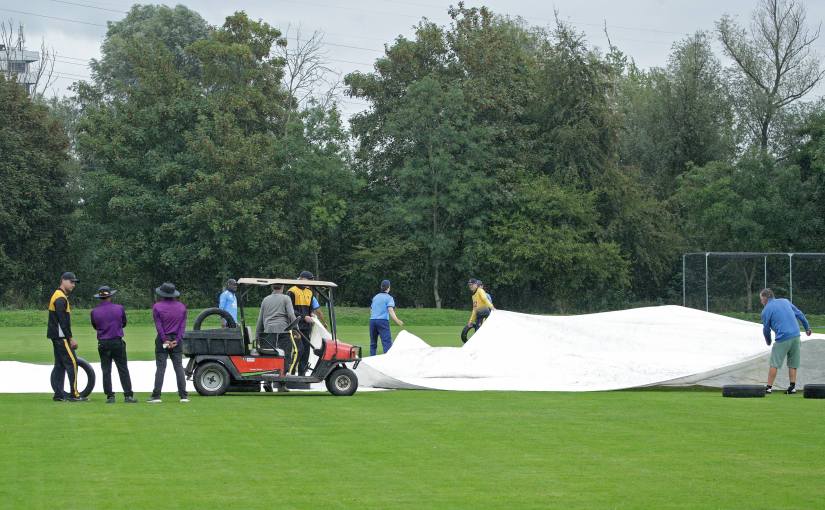
Covers on, covers off. Dark clouds on the horizon but looks like we may just get a bit more cricket.

   Bertus de Jong  16:35
It’s starting to rain again.

   Bertus de Jong  16:27
Well hope spings eternal, we’ve a brief break in the weather and they’re busy getting the water off the covers, and now the covers off the pitch. If they do get back on in the next ten minutes it’ll be HCC resuming their innings, albeit with a fair few overs off. That will of course, ironically, make a result less likely.

   Rod Lyall  15:35
Well, the radar wasn’t lying, except that the rain has arrived a little earlier than predicted. The indications are that it’s set in for the rest of the day, but Bertus will jump in if there’s any good news. For now, this is Rod Lyall saying a provisional farewell.

   HCC
  25-3 (6.2 overs)

VRA   
yet to bat  

Shirsak Banerjee under way with a boundary, and there’s time for Vikram Singh to bowl a couple of deliveries before rain drives them from the field.

   HCC
  17-3 (5.1 overs)

VRA   
yet to bat  

Peter Ruffell replaces Nidamanuru, starting with a wide. A single apiece, then four off Fletcher’s third. Then Gorlee edges Ruffell through to Cassidy, and HCC are in trouble here.

   HCC
  10-2 (3 overs)

VRA   
yet to bat  

Wolfe off the mark with a single, then Gorlee survives a very confident appeal for leg-before. He finishes the over with a single to point.

   HCC
  8-2 (2.1 overs)

VRA   
yet to bat  

And another! Fletcher digs one in, it climbs on White, who tries to cut at about shoulder height, and can only steer it to Smal at cover. Mark Wolfe joins his captain, with VRA looking very hungry.

   HCC
  8-1 (2 overs)

VRA   
yet to bat  

Gorlee works him in front of point to get off the mark, then White pushes to mid-off for a quick single.

   HCC
  6-1 (1.1 overs)

VRA   
yet to bat  

Nidamanuru from the Pavilion End. And a breakthrough off his first delivery, as Floyd drives, fails to get on top of it, and the bowler takes a very good low catch. Boris Gorlee in at three.

   HCC
  6-0 (1 over)

VRA   
yet to bat  

They’re out in the middle, Ben Fletcher opening from the Railway End to Oliver White, Clayton Floyd the non-striker. The first is in the channel outside off for the left-hander, who plays and misses. Pushes the second into the off side, looks for a single but is sent back. The next is in the slot, and lofted over long off for the first six of the game. Three dots to finish, though not for want of attempted knocking the cover off the ball by White.

   Rod Lyall  14:50
Hats off to the umpires for managing to get a result in the women’s T20 final, where after Quick Haag made 143 for five the game was cut to five overs, HCC being set a target of 36. Which they achieved for the loss of one wicket, with three balls to spare. Congratulations to them.

   Rod Lyall  14:40
It may, of course, all prove a bit academic, if the radar is to be believed. It’s been raining in Schiedam, it seems, and there’s more on the way. We should get in an hour or so’s play, but thereafter a lot may depend on the exaxt path the next lot of rain chooses. The Playing Conditions provide for one rescheduling if the match is abandoned.

   Rod Lyall  14:35
Teja Nidamanuru has called correctly for VRA, and elected to field.

   Rod Lyall  14:30
Good afternoon/evening/morning everyone, and welcome to our coverage of this year’s Topklasse T20 Cup Final. It’s been a strange old week, but it seems that after all the argy-bargy’s done it will be VRA who take on HCC. Though it wouldn’t be a huge surprise if three teams turned up at the Loopuyt Oval today. Why, one wonders, does Dutch cricket keep shooting itself in the foot with bad news stories?


Topklasse Team of the Year 2025

Rod Lyall & Bertus de Jong 20/09/25

So, as the season nears its end, it’s time for us to come up with our seventh Topklasse Team of the Year.

RL: Once again, we cannot avoid the issue of overseas players, and how many we should include. Arguably, we could name a side like:
Janett (VOC), Doyle-Calle (Hermes-DVS), Kaplan (Voorburg), Walbrugh (HBS), Melville (Voorburg), Brown (HCC), Bangs (Kampong), Shahzad (Punjab-Ghausia), Ruffell (VRA), Ralston (Excelsior) and Rossouw (HBS)
which wouldn’t be too much of a travesty, but while it might make a point, it wouldn’t be a totally fair reflection of the season so far. So perhaps the sensible course is once again to give preference to local, or at least Dutch-qualified, players wherever possible, while including a small number of the most influential imports.

So here goes:

Starting with the openers, the first name on my sheet is that of Cedric de Lange (Voorburg), still eligible to play in the KNCB’s Under-17 competition but already a Topklasse regular, with 634 runs this season at 42.27. No other locally-produced opener has shown anything like the same degree of consistency, with some, like VRA’s Vikram Singh and HCC’s Tonny Staal, having distinctly disappointing returns. Musa Ahmad (Punjab) spent most of the season at three, but his promotion to opener brought him plenty of runs, and his 621 at 42.40 earns him a place in one or other of these positions. If we were to go for an overseas to partner De Lange, then Daniel Doyle-Calle’s 711 at 64.64 (at a strike rate of 105) for Hermes, although he fell away somewhat towards the end of the season, makes him the outstanding candidate.

Cedric de Lange

BdJ: De Lange is probably the easiest pick this season for what one suspects will be the first of many TK team of the year appearances. The 17 year-old doubtless has a bright future ahead of him both in the Topklasse and indeed in Orange, his maiden international call-up coming earlier than even he might have hoped one imagines. The second opener is a tougher pick, however. Musa Ahmad indeed did well opening, but with only four appearances at the top of the order probably doesn’t qualify. It’s perhaps recency bias that summons VOC’s Scott Jannet to mind – his unbeaten 83 in the relegation play-off arguably the single most consequential innings of the season. Conversely, we perhaps shouldn’t discount Doyle-Calle’s weight of runs merely because the lion’s share came at the start of the season. DDC’s early season form was a big part of Hermes’ dominance over the first few weeks of the competition, and ensured they had a cushion of safety even as their title challenge rather sputtered out.

There’s a rather more crowded field for numbers three through five, though again overseas players feature heavily. Voorburg’s Gavin Kaplan is an obvious contender again, while strong cases might be made for Kampong’s Lane Berrry – whose 684 runs for the champions came at an average over 50 and a blistering strike rate of 124, while VOC’s Danish number 4 Monty Singh also had an excellent debut season, and had his long commute from Denmark not limited him to ten appearances the Bloodhounds’ season might have looked rather different. Among the locals Kampong’s Pierre Jacod deserves at the very least an honourable mention among the batters with 403 runs at 57.57, though he’s generally been at his best further down the order. For my money though, we should probably stretch our definition of local players to include those set on qualifying for the Netherlands again. That would make room for Tayo Walbrugh and Johan Smal who, though both still a few months from eligibility (much to the frustration of the aforementioned selectors as the injuries and unavailabilities mount up ahead of the impending Bangladesh tour) have already been training with the national side and one imagines will be donning the Orange sooner rather than later. Walbrugh once again finished top of the run tables with 831 at an average of almost 60, while Smal was just two spots behind, his 715 runs at 55 crucial to keeping VRA in the top half of the table while other senior bats at the Bos seemed to struggle all season.

RL: There’s obviously a serious danger that our final eleven might start to look very like the satirically-intended one I named at the outset! The lack of outstanding local candidates is due to a mix of factors: the tendency of the clubs to pack their sides with overseas players, thus limiting the opportunities for their own products, combines with the presence of relatively few young Dutch players of genuine quality and the fact that the top Dutch batters either played relatively few games or had disappointing seasons. Only eight Dutch-qualified players figure in the top twenty of the batting averages, and of those Scott Edwards played only nine times for Kampong (and had five innings) and Noah Croes (Voorburg) one more. If we agree that Jacod ought to bat at six or seven, and if I’m allowed to insist that we only include one overseas in the top/middle order (Walbrugh again, for my money), then I’d want to make a case for two of Wes Barresi (465 runs at 42.27), Boris Gorlee (628 at 39.25) and Noah Croes (372 at 41.33). Or perhaps . . .

. . . all three, if Croes keeps wicket. Equally, Edwards’ 260 at 65.00 from his extremely limited opportunities is a pretty strong case too. If we’re going to confine ourselves to keepers with a more frequent presence, on the other hand, then the top candidates are probably Mark Wolfe (HCC) and Asad Zulfiqar (Hermes), with 20 victims apiece. VRA’s Jack Cassidy had 28, but then we’re back with the overseas vs. locals debate again. Zulfiqar bats higher up the order than Wolfe but had a fairly disappointing campaign with the bat, while young Wolfe, batting lower down, played some useful innings when the HCC top and middle order had struggled. So on balance I’d probably be inclined to give him the nod.

BdJ: Well it seeems every year we’re destined to have the same tussle, as to whether to adhere in our Topklasse Team of the Year selection to a rule that hasn’t applied in the actual competition for the better part of a decade now, and was more honoured in the breach when it did. If we are to make current Dutch-eligibility rather than Topklasse performance the principal qualification for this exercise we may as well just name the national team and have done with it. In a similar vein, while Scott Edwards doubless does a fine job with the gloves in Orange I frankly draw the line at picking a wicketkeeper here that basically never keeps wicket in the Topklasse. Edwards and Croes have a total of 7 appearances behind the stumps between them this season, and to my mind picking either as Topklasse keeper of the year would send us deep into the realm of farce. Monty Singh scored more runs and effected more dismissals than both combined despite missing half the season, away playing for Denmark rather than the Dutch. If we must look to Dutch-eligible glovemen then I’d argue Kampong’s actual keeper Damien van den Berg has a stronger case, doing a fine job behind the stumps and setting the tone at the top of the order with some 400 runs at a run-a-ball. The Crows’ Lucas del Bianco had a comparable season with the bat, but a glaring 30 byes probably disqualifies him there.

Turning to seamers we are inevitably confronted with a familiar quandry, as the two leading quicks in the comp are likewise non-Dutch-eligible. HCC’s Joshua Brown took 34 wickets at 15.32 while VRA’s Peter Ruffel claimed 33 scalps at 16.55, and both were crucial to keeping their sides in the top half of the table. There is however a tad more local competition in the fast bowling stakes, with Hermes skipper Sebastiaan Braat’s 30 wickets at 16.67 earning him a spot in the top five, closely followed by Kampong captain Alex Roy, who picked up 29 wickets at 14.52 while leading his side to the title. TK TOTY regular Hidde Overdijk also deserves an honourable mention at the very least, his 26 wickets coming at just 13.69 apiece.

Alexander Roy

RL: Maybe we should pick two sides, one limiting ourselves to, say, two or three overseas players, and the other a No-Holds-Barred team, a bit like the one I ironically suggested at the outset? I for one hope that the KNCB finally gets a grip on the nuclear arms race of overseas player recruitment over the winter!

Turning to the spinners, we’ve already mentioned Musa Ahmad, Wes Barresi and Pierre Jacod in our discussion of the batting, and if all three make it into the final eleven we have a pretty reasonable array of slow bowling. Even I, though, would find it difficult to go past the Crows’ Jayden Rossouw, the competition’s leading wicket-taker with 38 at 19.37. With four off-spinners this attack would, admittedly, have a certain sameness about it, but we have to play with the cards we’re dealt, and left-armers and leg-spinners have not been conspicuous among the wicket-takers this year.

BdJ: I’d argue that four slow bowlers of any ilk would be a bit much in a season largely dominated by the quicks, but picking four right arm finger spinners of whom only two made the top ten wicket-takers seems entirely excessive. Nonetheless I’m going to have to give at least an honourable shout-out to one more right-arm tweaker here, namely VOC’s Arnav Jain, who may only have bagged 19 scalps this season but went at just 3.44 an over. If offspin is generally seen as a defensive art there’s a strong case to be made that that’s a better showing than the relatively leaky Barresi or the objectively expensive Ahmad. Among the purveyors of more esoteric or aggressive spin there’s only one genuine stand-out, namely Hermes’ leggie Hikmatullah Jabarkhail. His 32 wickets at 16.5 played a big part in the Schiedammers’ early dominance, and would make him a sure pick were it not for his hailing from Belgium. Similarly Excelsior stalwart Lorenzo Ingram to my mind has a better case than either Ahmad or Barresi, with more wickets at a better average than either and at an economy of just 3.29 – the best of any front line bowler in the competition – and a better batting average to boot. But Ingram of course, despite a Topklasse career spanning well over a decade, is not yet eligible to play for the Netherlands.

I will once again plead that we ought be picking a Topklasse XI rather than a Dutch development squad here, and point out that even if we were picking the latter at least those on track for eligibility should be accorded equal treatment, but will defer to experience when it comes to the final word…

RL:One might take the position that given the apparent indifference of the clubs to the fututre of Dutch cricket, our own annual selection might at least serve by contrast as rebuke or aspiration, but on the other hand there’s a strong case for reporting things as they aare. Considering the our differing positions on the overseas question, it’s remakable how little divergence there eventually turned out to be in our preferred selections. While I remain sceptical of treating palyers on the path to qualification as though they were already there, I’ll concede Smal has a marginally stronger claim than Musa to a place, at least a batting slot. While Ingram has not even comitted to that path, he is unquestionably a long-standing servant of the Dutch domestic game, and indeed would add variety to an otherwise offspin-heavy spin attack, so once again am happy to defer to my colleague there. On the keeping question, Cassidy certainly had a fine season, helped no doubt by the quality of the quick bowlers he’s kept to. Van den Berg’s fewer dismissals are balanced by fewer byes conceded, and there’s little to choose between them in terms or runs scored except the rate at which they scored them, so on balance van den Berg edges it irrespective of the overseas question. Finally it seems to me that given his side’s success and his on contibution to it, Alex Roy is the outstanding candidate to captain our team of the year.

Touch wood by the time we come to do this exercise next year the KNCB may have found a way of encouraging or forcing clubs to rectrict their use of overseas players, if not we’ll doubless again be wrestling with this dilemma, and hopefully diverting you all by arguin it out in public. For now though, here is TKcricket’s 2025 Team of the Year:

Daniel Doyle-Calle (Hermes), Cedric de Lange (Voorburg), Johan Smal (VRA), Tayo Walbrugh (HBS), Lorenzo Ingram (Kampong), Damien van den Berg (Kampong), Pierre Jacod (Kampong), Sebastiaan Braat (Hermes), Alex Roy (c) (Kampong), Joshua Brown (HCC), Jayden Rossouw (HBS).

Previous TOTYs 2024 | 2023| 2022 | 2021 | 2020 | 2019 | 2018