

Robert Vermeulen
21/11/2024
In May I posted an article about the delicate future of our beloved Game in The Netherlands. The vast majority of the feedback I received was positive. In this polarised digital world and a quite tribal Dutch cricket community, that is a remarkable thing. It stands to reason that there are several ways to solve the issue I tried to address. The most important thing is that we acknowledge the problem and try to formulate a strategy to face it.
You might think that I, as a lawyer, would propose strict rules and regulations. That is only partly true. Sure, I salivate by the thought of drafting such documents, but rules are more effective if they are broadly supported, are seen as ‘obvious’ and, finally, reflect an internal moral belief. The reason one does not steal is -hopefully- not that it is illegal, but that is ‘not right’. It goes against your moral fabric and would make your mother very very disappointed in you.
Breaking the trend
A rough estimate by ‘those-in-the-know’ is that we collectively, as clubs, might have spent as much as half a million Euro’s this year on players. If true, and I am afraid it might be, that is a shocking amount of money. At best one would hope that this money was spent on a lot of junior coaching hours…. if there were any juniors to coach.
I would suggest that it is time to start the (long) process towards addressing our unhealthy habits that have crept into our top leagues. We must stop spending resources on things that not evidently ensure the long term survival of the Game as a whole. A club will truly survive a relegation. Trust me, I have been there. Healthy clubs that invest in their home-grown stock and the health of their own club organisation and culture, will survive and return. Take VCC as an example, they went through a major lean patch some years ago but now they were (again) in contention for a championship. Good on them!
Only if the club does not have a strong foundation, the players might move on. That is the risk of those clubs who are ‘a bank account with a first team’. Mercenaries follow the money.
If we are to survive, a collective action is needed to stop ‘stupid money’ and encourage ‘smart money’. In my very humble opinion, a points based system as suggested by me in May, would stimulate that and see to it that clubs are forced to make the right choices. We must break the arms-race.
Let’s have a look at our semi-finalists in the Topklasse of this year: Punjab Ghausia (Punjab), VRA, VCC and HCC.
When I speak of local players, I mean those players that are either home-grown players or are players that are here for other reasons than cricket. This last group are those that moved here for work, study or other non-cricket related reasons like marriage/relationships/family reunion or refugee status. Home-grown players are players that learned their cricket here. Overseas players are players whose main reason for being in The Netherlands is to play cricket.
In this piece I will add the distinction between home-grown players by the club itself and home-grown players that came from other clubs. Why keep things simple?
Semi-finalists
On 1 September 2024 I partly watched VCC 1 beat my beloved HCC 1. No complaints there: they were the better side, especially on the day. If one breaks down the makeup of the teams, HCC fielded 3 home-grown HCC players, 2 home-grown players that moved from other clubs, 3 local players (players who live here but are not home-grown) and 3 overseas players. VCC fielded 4 home-grown VCC players, 3 home-grown players that moved from other clubs, 1 local player and 3 overseas players. The home-grown players on a whole were quite influential, so cheers all round!
Punjab, a powerhouse in the last years, was in the Grand Final. Again, good on them. VRA had a sniff at victory but fell just short. A breakdown of these teams is as follows. Punjab fielded 0 home-grown Punjab players, 4 home-grown players that moved from other clubs, 3 local players (if Belgium is deemed local / plus a player I could not place in the other columns) and 4 overseas players. VRA fielded 3 home-grown VRA players, two home-grown players that moved from other clubs, 3 local players and 3 overseas players.
The differences between the clubs are not extreme.
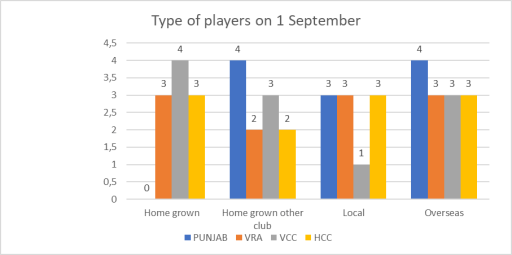
The main reason Punjab does not have Punjab home-grown players is their recent rapid rise to prominence. Their efforts in junior cricket will reap benefits in due time. VCC fielded 4 VCC home-grown players on Sunday and 3 home grown players that came over from other clubs (two HCC raised and one ACC). 7 home grown players in total. Well done. Fair play!
Breakdown of relative influence of types of players in last Sunday’s games:
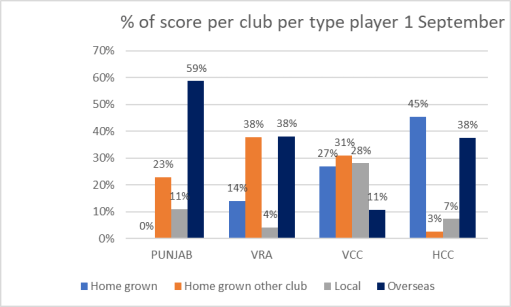
This is only one game but it should be interesting to make a broad analysis over the whole season. Certain retired CBS statisticians might be interested to have a go at this…
Second teams
In the Eerste Klasse VRA 2 beat Punjab 2 in the Grand Final. Punjab 2 beat HCC 2 in the semifinal. The fact that all-but-one player in HCC 2 are HCC home-grown players, delights me. They beat Qui Vive 1 in the elimination final and are clearly a tight group that have a boat load of fun together. That is what it is all about.
VCC 2 might have relegated to the Eerste Klasse, but that might only be healthy for the team as a whole so that they can rebuild and play at a level that might be more fun for younger players. I would say that VCC and HCC, for now, have a bright future. The strength of VRA 2 and Punjab 2 is very promising as well, albeit that the latter team contains not a lot of home-grown players and even overseas players.
The point that I am trying to make here is that the second teams of all the semi-finalists in the Topklasse are vibrant as well. That shows a broader basis of playing talent than just the flagship team. These second teams are usually not stacked with ringers, albeit that they might have potential first team players that were pushed out by overseas players acquired for the first team. If you would add to that picture the line up of these clubs in the U17 and U15 leagues, these Topklasse semi-finalists are largely healthy clubs. They are not an empty shell.
Points system
field competitive teams with the back up of strong second elevens and talented youth. VCC survived a drain from the Dutch XI and pro’s leaving home by fielding a slew of home-grown players; so did VRA. Again, cheers all around. The four finalists had enough depth in their selection to fill the gaps.
I would say all potential champions this year were clubs with a role to play in the future of our local Game.
If we would be able to reduce the amount (and influence) of overseas players in these (and other) teams, the further development of home-grown players could be stimulated and create a more level playing field for all clubs with good intentions. I am sure that these four clubs would support that idea (as they live in relative luxury). Others might be more reluctant, but it has to be done!
Clubs have limited resources that could and should be used wisely. The club members should demand transparency from their committees regarding the finances surrounding players. Depending on sugar daddies and non-recurring donations (even in kind) is no basis for long term policy. If they suddenly leave, you are done for.
The introduction of a points system results in a reduction of overseas players, this would reduce the need to spend money on everything surrounding overseas players and could free up resources for other, more productive, causes.
I hope that this autumn and winter will provide us with ample time to develop ideas to improve the future of or local Game.
 TKcricket