Player-eligibility technicality puts VRA’s T20 finals berth in doubt

Bertus de Jong 10/09/2025


Defeated semi-finalists Voorburg CC, who lost to VRA by 22 runs in the second semi-final of the Topklasse T20 competition on Sunday, are seeking to have the result of that match overturned on grounds that VRA fielded an ineligible player. VCC are understood to have challenged the eligibility of VRA opening bat Shirase Rasool – who scored a brisk 41 before retiring hurt in the match in question – on the basis that he had not played sufficient matches in the preceding league phase.

Shirase Rasool

Rasool, a former regular at the top of the order for VRA, has played only intermittently this season owing to personal commitments. In total Rasool has made three appearances for VRA’s second team and five for the senior side this season, but crucially played only four matches in the T20 competition.

Under Article 18 of the Competitieregelement only players that have played a minimum of 50% of the first (league) stage matches of the T20 competition are eligible to participate in the final rounds. Under the current competition format the minimum is thus five matches in across divisions prior to the finals phase; Rasool therefore falling one match short.

However, a number of exemptions to these requirements are detailed in the same document, not least 18.II.7.b which exempts long-standing members of a club from the above participation requirements, under which Voorburg match-secretary and first team occasional Floris de Lange was able to play. VRA maintains that Rasool is similarly exempt under Articles 18.II.6 and 18.II.7.b, which provides for players who have regularly played for a club in preceding seasons, though the language of the document is arguably inconsistent as to whether this refers to all competition or exclusively divisions below the top flight.

“VRA is confident that we are fully within the regulations regarding the eligibility of Shirase Rasool. Articles 18.II.6 and 18.II.7 clearly state that he qualifies to play without needing to meet the five-match threshold or apply for dispensation. It is extremely disappointing how this situation has unfolded, as it distracts from the spirit of the competition and takes the focus away from the cricket itself.” VRA first team captain and General Manager Teja Nidamanuru told TKcricket.

Voorburg Chair Richard de Lange was equally confident however, stating; “VCC remains confident in the strength of our position and our rightful place in the T20 final based on the merits of our case and adherence to competition regulations. We respect the ongoing appeals process and trust that the proper procedures will ultimately ensure the integrity of the competition is upheld. We look forward to a swift and fair resolution that serves the best interests of cricket in the Netherlands.”

VRA immediately appealed the KNCB’s initial decision, which Tkcricket understands awarded the match and a place in the final to VCC and imposed a 100 euro fine on VRA. That appeal appears to have been at least initially successful in reversing the decision, but said reversal has duly been appealled in turn by VCC. At press time it remains unclear who, if anyone, HCC will face in Saturday’s final at the Loopuyt Oval.

Preview Round 18

Rod Lyall & Bertus de Jong 31/07/2025


And so, unseasonably early, we reach the final round of this year’s 50-over Topklasse competition. As it turns out, all the tension on Sunday will be in the lower reaches of the table, even the positions of the notional top four having already been all but settled. So, too, are the relegation spots, although there are still a few possible, if unlikely, scenarios which could see things change at the very last moment.


RL: Let’s start with the meeting of HBS and Excelsior ‘20 at Craeyenhout. For the ninth-placed Schiedammers victory here is the absolutely minimal requirement if they are to have even the faintest chance of avoiding the drop. And that would still require results elsewhere to go their way. With the only positive net run rate in the bottom half of the table, the Crows are in a much happier place, and they can regard themselves as effectively guaranteed a spot in next season’s slimmed-down Topklasse. They will be without teenage opener Elmar Boendermaker on Sunday, since he is in Scotland with the national Under-19s, but they should still have plenty of resources to take the points and seal Excelsior’s fate. Having consistently performed below their potential all season, the visitors will no doubt be keen to end their campaign with a flourish, but with the season’s leader run-scorer Tayo Walbrugh leading the way, the Crows will start as odds-on favourites to finish with a win, and possibly even to sneak into the top half of the table.

BdJ: Given the state of play in the net run rate stakes, HBS can safely dispense with the spreadsheets at this point and start looking ahead at the short-format stage of the season. Despite having all-but secured their survival, it’s been a 50-over season most of the Crows will be keen to put behind them. The soon-to-be Dutch-eligible Walbrugh is of course a notable exception, while fellow overseas Botha and Rossouw have also had solid season with bat and ball respectively – the latter now leading the wicket-taking table. One would think Excelsior will be the more motivated of the two sides on Sunday, but that’s assuming that dread has not yet given way to despair at Thurlede. There’s still a pretty clear escape route open to the Schiedammers of course, with VRA heavy favourites against a weakened VRA, but they’ll need to string together back-to-back wins first against HBS and then the Hoofdklasse champions if they’re to pull a Houdini from here, and two consecutive wins is one more than they’ve managed this season.


RL: VOC Rotterdam could make Excelsior’s result irrelevant by beating VRA Amsterdam in the Bos, but they will have to do so without their two young pace bowlers, Aaditt Jain and Roman Harhangi, both of whom will be on U-19 duty in Scotland. Since they are the side’s leading wicket-takers with 21 apiece, they leave a not-inconsiderable hole, and a lot will fall onto the shoulders of Aaditt’s off-spinning brother Arnav and the veteran Jelte Schoonheim. It’s VOC’s batting, though, which has kept them in danger of delegation, and they will need a significant contribution from their overseas contingent if they are to overcome a VRA outfit which, while it has blown hot and cold all season, has plenty of oomph with both bat and ball. With T20 about to move centre-stage, this will be a last opportunity for internationals Vikram Singh and Teja Nidamanuru to play a substantial 50-over innings, and they are likely to want to make the most of it. For the Bloodhounds, even a victory is unlikely to get them out of eighth place and a play-off, and they would need a huge win coupled with a devastating loss for Hermes to see them escape that fate.

BdJ: While other rivalries may be more bitterly contested, few will be more keenly missed than the “dogfight” at the Bos between VRA and VOC should the latter find themselves in the Hoofdklasse next season. For VOC to avoid that ignominy, the equation is fairly simple – beat VRA (or hope HBS beat Excelsior) and then see off the Hoofdklasse champions. Actually accomplishing either will be far from simple, however, especially missing their two lead wicket-takers heading into what will otherwise be their last Topklasse match for a while. There’s resources to be drawn on in the twos in theory; both Ramdas Upadhyaya and Pierce Fletcher have pleny of Topklasse experience if they’re called on to cover, but containing a full-strength VRA card remains a tall order, even if their two Dutch international bats have been struggling for form. Patrick Gouge will doubtless be keen to sign off on a high before heading back to Jersey, where he still has a point of his own to prove to selectors. VRA may have half an eye on the T20 comp already, but they’re unlikely to be caught napping on home turf on Sunday. If VOC want a shot at survival, they’ll likely have to fight for it.


RL: Since Hermes-DVS will be away to wooden-spooners Sparta 1888 at the Bermweg, a reversal of the necessary scale seems profoundly unlikely. The Capelle side have only managed three wins all season, and while Hermes have fallen away dramatically from their achievements early in the campaign and certainly can’t take a win here for granted, the sort of turnaround which would be required for VOC to overtake their NRR would be among the most astounding results in the 130-plus-year history of the competition. It’s true that neither star batters Daniel Doyle-Calle and Ash Ostling nor spinners Hikmatullah Jabarkhail and Sahil Kothari have lately been in the sort of form which took the Light Blues to the top of the table back in May, but with Aryan Dutt and Olivier Elenbaas back in the side from international duty and injury respectively, Hermes are – or at least, ought to be – much less dependent on that quartet. Sparta’s dependence on Kyle Klesse with the bat, Ahsan Malik with the ball and Juandre Scheepers with both remains, and it would be a notable achievement for them to send Hermes home empty-handed.

BdJ: When the net run rate spread passes 400 runs it’s probably time to ditch the spreadsheets, though of course for the Hoofdklasse-bound Spartans such arithmetic has been moot for some time. They remain a threat however, especially on home mat, and with nothing to lose one might well imagine them putting on a show as they did against HBS. Umar Baker’s defiant knock last round demonstrated that Sparta at least have hitting depth, though it’s hard to imagine the Mermes attack being carted about in quite the same way for long. The Sky Blue batting line-up has looked vulnerable on the occasions that the Spanish skipper fails to deliver, but for a Spartan attack that’s collectively averaging well north of 30 with the ball taking his wicket early is likely necessary but far from sufficient.


RL: Having faltered against VRA a fortnight ago, champions Kampong will have another chance to finish the 50-over competition in style when they take on Voorburg at Maarschalkerweerd. The Voorburgers’ cause will not be helped by the absence of Cedric de Lange, Tom de Leede and Alejo Nota, all of whom are involved in the U-19 qualifier, but with their senior internationals restored to them they certainly can’t be written off against Alex Roy’s side, although the latter have every reason to underline their historic success with a win at home. What has been notable for Kampong has been the role of their home-grown players, in particular Pierre Jacod, and the valuable stabilising contribution of Lorenzo Ingram. This final game is an opportunity for Voorburg’s reserves to strut their stuff alongside the internationals, but Kampong have a stable side and can be expected to have the edge.

BdJ: The demands made on Voorburg by the national set-up have inevitably led to a consistent inconsitency in selection this season, which seems to have affected them more profoundly than in the past. In this respect Kampong’s decision to hand the armband to the dependable Roy over more prominent names looks a shrewd one, and the Champions’ success this season has been rremarkably independent of the occassional (if substantial) contributions of internationals Scott Edwards and Max O’Dowd. The acquisition of Berry, Bangs, and seasoned Topklasse performer Lorenzo Ingram was of course an indispensible ingredient too, but above all it’s worth noting that Kampong have a core of nine players that have all played at least 15 matches this season – more than any other team in the competition.


RL: Most adversely affected by U-19 call-ups are HCC, who will be without five of their squad, three of them regulars, when they entertain Punjab-Ghausia at De Diepput. They are fortunate in having Yash Patel able to resume the gloves, which he has surrendered to young Mark Wolfe for most of the season, but it will be harder to replace Shirsak Banerjee and Teun Kloppenburg from their top and middle order, especially with allrounder Hidde Overdijk out through injury and likely to remain so for some time. The Lions have in any case found it difficult to establish an optimal batting order, while their opponents have steamrollered every attack in their path in recent weeks. HCC’s bowlers might present more of a problem, but with Musa Ahmad, Shoaib Minhas and Saqib and Sikander Zulfiqar all in top form they will have to be at their best to keep Punjab from setting another substantial target or chasing down whatever their own batters are able to assemble.

BdJ: Punjab’s intimidating top order has clicked a little too late in the season to mount a title defence, but now that it’s firing on more than a few cylinders they’ll likely be looking ahead to the T20 silverware (and ticket to Cartama) on offer later in the summer. Indeed with little on the line for either side in their Topklasse closer, both may well treat it as an extended warm-up for the short-form competition that’s about to start. The fixture looks more like a long run-up for Punjab though, while HCC,ith the seconds assured of promtion to the expanded Hoofdklasse, it’s perhaps an opportunity to test out some of their bench strength.


RL’s picks: HBS, VRA, Hermes, Kampong, Punjab

BdJ’s picks: HBS, VRA, Hermes, Kampong, Punjab

Topklasse to return to eight teams from 2026

Bertus de Jong 18/01/2025


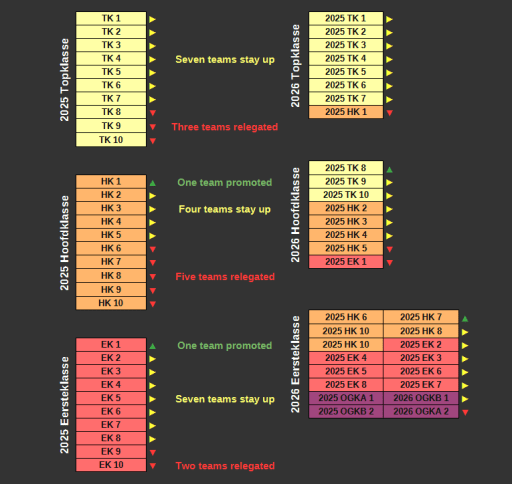
The KNCB today confirmed a substantial overhaul of the Dutch domestic one-day competition structure, with both the Topklasse and Hoofdklasse to return to an eight-team divisional league format from 2026 onwards.

The coming 2025 edition will dispense with the play-off system, reverting to a simple double round robin format, with the ten teams playing each other home and away. At the end of the season the bottom three Topklasse teams will be relegated, with the Hoofdklasse champions promoted to join the remaining seven for an 8-team competition in 2026. The crowded calendar precludes the possibility of a finals day or relegation play-off, meaning both the title and promotion/relegation will be directly determined by the final standings on the table. Similarly, the crowded schedule leaves no room for replays or reserve days during the competition.

The Hoofdklasse will likewise be returning to an 8-team format from 2026, with the consequence that no less than five teams will face relegation to the Eersteklasse at the end of the 2025 season, while the 2025 Eersteklasse champions will join the three relegated Topklasse sides and the four surviving Hoofdklasse sides for the 2026 Hoofdklasse season. As with the top division, there is no provision for a relegation play-off.

Conversely the Eersteklasse will be expanding from the current 10-team format to a two-pool 16-team leaguev (similar to the current Overgangsklasse) from 2026 onwards. The champion of the 2025 edition, also played as a straight ten-team double round robin, will win promotion to the 2026 Hoofdklasse, while the bottom two sides will be relegated to the Overgangsklasse, the latter to be renamed “Tweedeklasse”. A similar numerical naming scheme is to be applied to lower leagues, which remain otherwise unchanged.

The one-day season for 2025 is set to begin on the 26th of April and run until the 6th of August, with matches again played on Saturdays until the switch to Sundays in mid-July. The T20 competitons look broadly similar in format to last season, albeit switch to the other end of the Summer, commencing on August 13th and culminating in a finals day a month later.

The points system and the finals

Robert Vermeulen

21/11/2024


In May I posted an article about the delicate future of our beloved Game in The Netherlands. The vast majority of the feedback I received was positive. In this polarised digital world and a quite tribal Dutch cricket community, that is a remarkable thing. It stands to reason that there are several ways to solve the issue I tried to address. The most important thing is that we acknowledge the problem and try to formulate a strategy to face it.

You might think that I, as a lawyer, would propose strict rules and regulations. That is only partly true. Sure, I salivate by the thought of drafting such documents, but rules are more effective if they are broadly supported, are seen as ‘obvious’ and, finally, reflect an internal moral belief. The reason one does not steal is -hopefully- not that it is illegal, but that is ‘not right’. It goes against your moral fabric and would make your mother very very disappointed in you.

Breaking the trend

A rough estimate by ‘those-in-the-know’ is that we collectively, as clubs, might have spent as much as half a million Euro’s this year on players. If true, and I am afraid it might be, that is a shocking amount of money. At best one would hope that this money was spent on a lot of junior coaching hours…. if there were any juniors to coach.

I would suggest that it is time to start the (long) process towards addressing our unhealthy habits that have crept into our top leagues. We must stop spending resources on things that not evidently ensure the long term survival of the Game as a whole. A club will truly survive a relegation. Trust me, I have been there. Healthy clubs that invest in their home-grown stock and the health of their own club organisation and culture, will survive and return. Take VCC as an example, they went through a major lean patch some years ago but now they were (again) in contention for a championship. Good on them!

Only if the club does not have a strong foundation, the players might move on. That is the risk of those clubs who are ‘a bank account with a first team’. Mercenaries follow the money.

If we are to survive, a collective action is needed to stop ‘stupid money’ and encourage ‘smart money’. In my very humble opinion, a points based system as suggested by me in May, would stimulate that and see to it that clubs are forced to make the right choices. We must break the arms-race.

Let’s have a look at our semi-finalists in the Topklasse of this year: Punjab Ghausia (Punjab), VRA, VCC and HCC.

When I speak of local players, I mean those players that are either home-grown players or are players that are here for other reasons than cricket. This last group are those that moved here for work, study or other non-cricket related reasons like marriage/relationships/family reunion or refugee status. Home-grown players are players that learned their cricket here. Overseas players are players whose main reason for being in The Netherlands is to play cricket.

In this piece I will add the distinction between home-grown players by the club itself and home-grown players that came from other clubs. Why keep things simple?

Semi-finalists

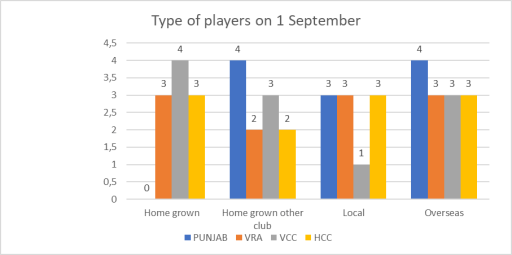
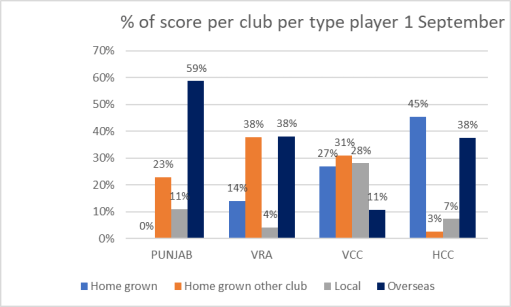
On 1 September 2024 I partly watched VCC 1 beat my beloved HCC 1. No complaints there: they were the better side, especially on the day. If one breaks down the makeup of the teams, HCC fielded 3 home-grown HCC players, 2 home-grown players that moved from other clubs, 3 local players (players who live here but are not home-grown) and 3 overseas players. VCC fielded 4 home-grown VCC players, 3 home-grown players that moved from other clubs, 1 local player and 3 overseas players. The home-grown players on a whole were quite influential, so cheers all round!

Punjab, a powerhouse in the last years, was in the Grand Final. Again, good on them. VRA had a sniff at victory but fell just short. A breakdown of these teams is as follows. Punjab fielded 0 home-grown Punjab players, 4 home-grown players that moved from other clubs, 3 local players (if Belgium is deemed local / plus a player I could not place in the other columns) and 4 overseas players. VRA fielded 3 home-grown VRA players, two home-grown players that moved from other clubs, 3 local players and 3 overseas players.

The differences between the clubs are not extreme.

The main reason Punjab does not have Punjab home-grown players is their recent rapid rise to prominence. Their efforts in junior cricket will reap benefits in due time. VCC fielded 4 VCC home-grown players on Sunday and 3 home grown players that came over from other clubs (two HCC raised and one ACC). 7 home grown players in total. Well done. Fair play!

Breakdown of relative influence of types of players in last Sunday’s games:

This is only one game but it should be interesting to make a broad analysis over the whole season. Certain retired CBS statisticians might be interested to have a go at this…

Second teams

In the Eerste Klasse VRA 2 beat Punjab 2 in the Grand Final. Punjab 2 beat HCC 2 in the semifinal. The fact that all-but-one player in HCC 2 are HCC home-grown players, delights me. They beat Qui Vive 1 in the elimination final and are clearly a tight group that have a boat load of fun together. That is what it is all about.

VCC 2 might have relegated to the Eerste Klasse, but that might only be healthy for the team as a whole so that they can rebuild and play at a level that might be more fun for younger players. I would say that VCC and HCC, for now, have a bright future. The strength of VRA 2 and Punjab 2 is very promising as well, albeit that the latter team contains not a lot of home-grown players and even overseas players.

The point that I am trying to make here is that the second teams of all the semi-finalists in the Topklasse are vibrant as well. That shows a broader basis of playing talent than just the flagship team. These second teams are usually not stacked with ringers, albeit that they might have potential first team players that were pushed out by overseas players acquired for the first team. If you would add to that picture the line up of these clubs in the U17 and U15 leagues, these Topklasse semi-finalists are largely healthy clubs. They are not an empty shell.

Points system

field competitive teams with the back up of strong second elevens and talented youth. VCC survived a drain from the Dutch XI and pro’s leaving home by fielding a slew of home-grown players; so did VRA. Again, cheers all around. The four finalists had enough depth in their selection to fill the gaps.

I would say all potential champions this year were clubs with a role to play in the future of our local Game.

If we would be able to reduce the amount (and influence) of overseas players in these (and other) teams, the further development of home-grown players could be stimulated and create a more level playing field for all clubs with good intentions. I am sure that these four clubs would support that idea (as they live in relative luxury). Others might be more reluctant, but it has to be done!

Clubs have limited resources that could and should be used wisely. The club members should demand transparency from their committees regarding the finances surrounding players. Depending on sugar daddies and non-recurring donations (even in kind) is no basis for long term policy. If they suddenly leave, you are done for.

The introduction of a points system results in a reduction of overseas players, this would reduce the need to spend money on everything surrounding overseas players and could free up resources for other, more productive, causes.

I hope that this autumn and winter will provide us with ample time to develop ideas to improve the future of or local Game.