









In-depth coverage of the Topklasse – the Netherlands' premier domestic One Day Cricket league
Rod Lyall 27/05/24
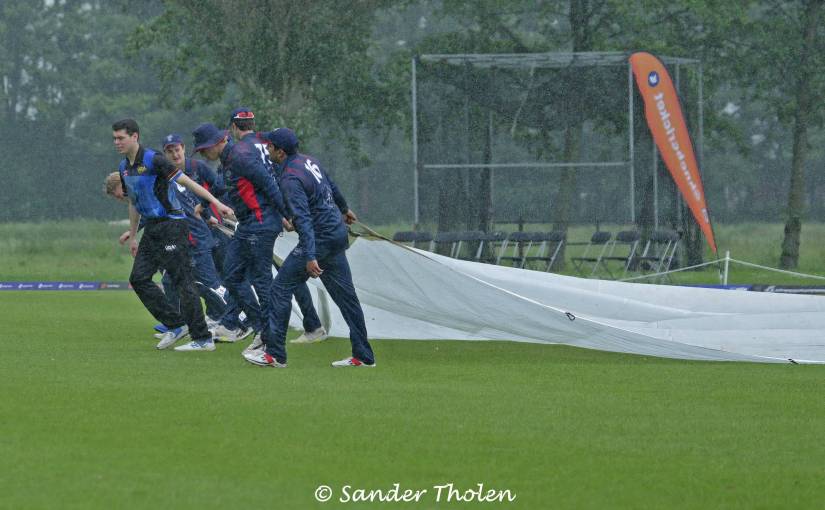
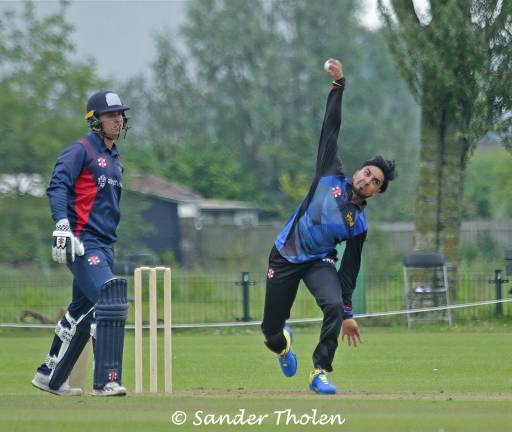
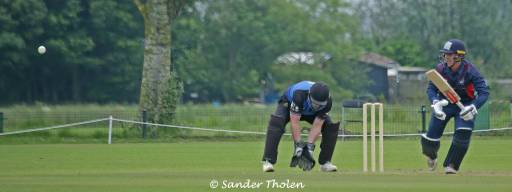
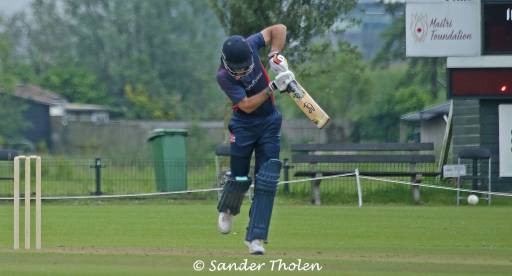
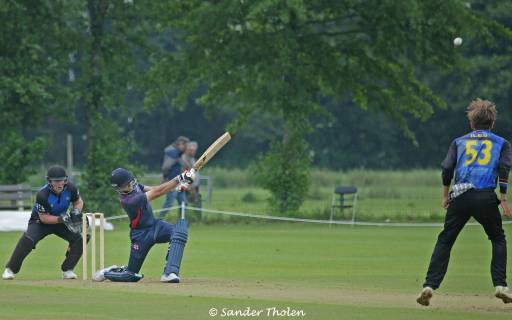
There were two winners at Westvliet on Sunday: Voorburg took the Topklasse T20 Cup, but mostly it was the dreadful weather which emerged victorious on a thoroughly disappointing day.
Voorburg had, in the final analysis, earned their title by finishing top of the table after the round-robin phase, but with only 46.4 overs of the scheduled 120 able to be bowled in the course of the day what should have been a showcase of Dutch cricket became a rain-soaked anticlimax.
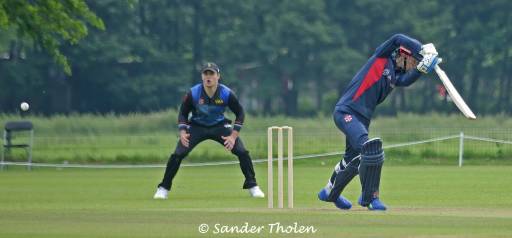
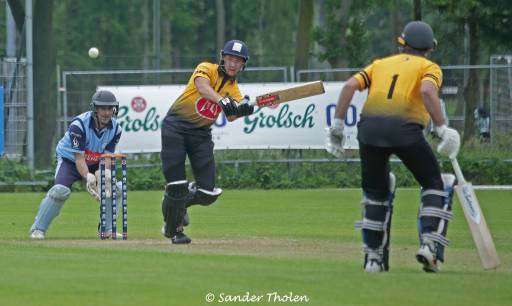
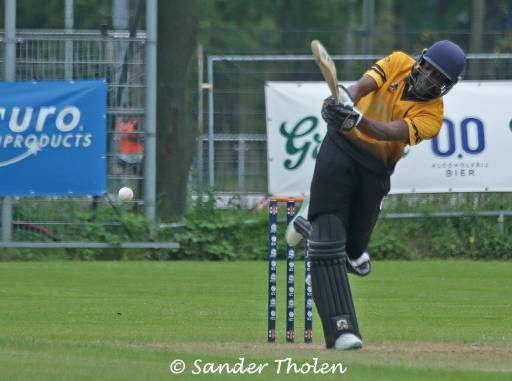
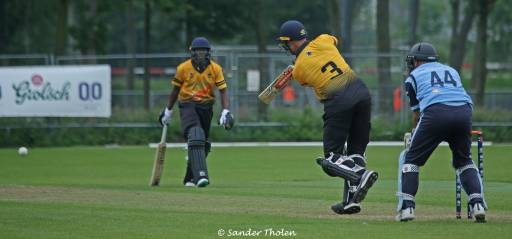
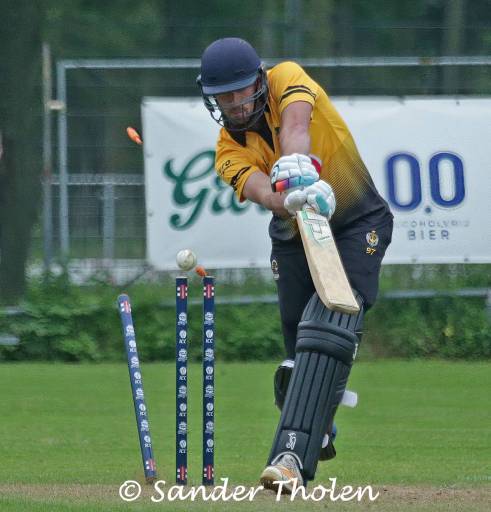
Matters were not helped by a tired pitch, already used for two of the international T20 tri-series matches, and in the first semi-final VRA Amsterdam’s quartet of spinners took full advantage of the conditions, bowling 14 overs between them and restricting Voorburg to 127 for seven.
It might, indeed, have been even less had there not been a late flurry from Noah Croes, whose 55 came from 49 deliveries and included just two fours, and Philippe Boissevain, who hit the only six of the innings.
The whole affair bore little resemblance to T20 cricket as we have come to know it, but before we could decide whether Voorburg had achieved a relatively commanding total in the circumstances, more rain ended proceedings just one over into the VRA reply, and the hosts went into the final.
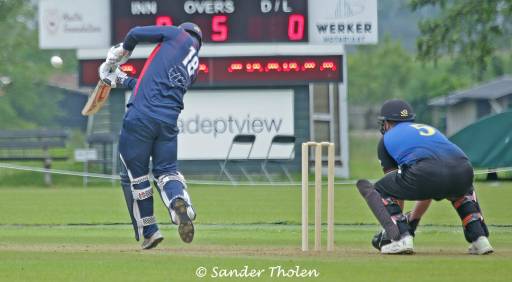
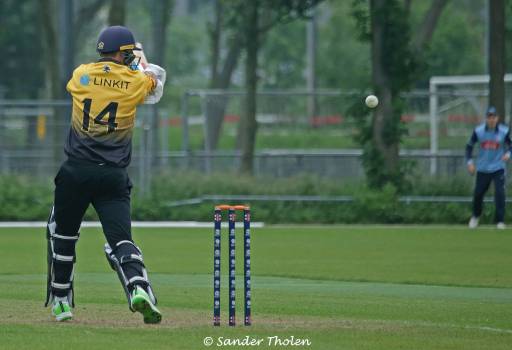
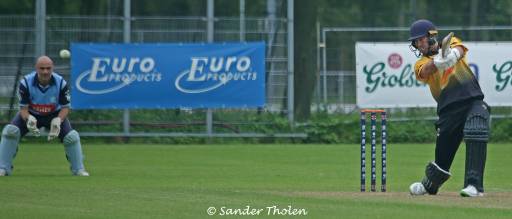
That rain meant that the second semi-final was cut to 13 overs a side, and HCC also struggled with the bat, Conor McInerney’s 26-ball 35 and Jed Wiggins’s unbeaten 21 from 12 deliveries nevertheless enabling them to reach 95 for five.
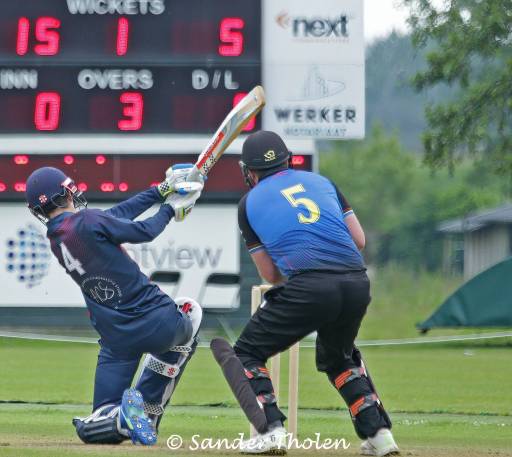
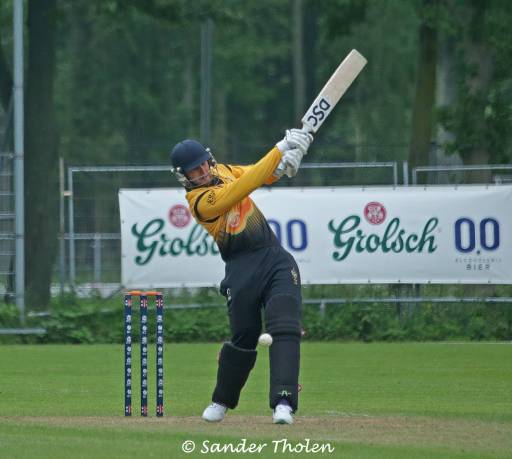
Any thought that that might have been enough was quickly dispelled by HBS allrounder Lehaan Botha, who seemed to be inhabiting a different universe as he smashed 62 not out from 26 balls, including three fours and six sixes, to take the Crows to a seven-wicket victory in just 8.4 overs.
The game was also notable for the return of HBS icon Tobias Visée, who faced only seven deliveries but contributed 16 runs, his six over long-on perhaps the cleanest and longest blow by any batter at Westvliet over the ten days, Ireland and Scotland’s big hitters not excepted.
But the most torrential rain of the day was now imminent, and only four overs the final, in which Voorburg reached 17 for the loss of Nehaan Gigani’s wicket, were possible before the covers went on for the last time and Voorburg got their hands on the trophy.
A result was possible at Maarschalkerweerd, where Rood en Wit won a rain-affected Hoofdlasse T20 final and made sure of a spot in next year’s Topklasse T20 Cup, while at Het Loopveld in Amstelveen Groen en Wit Amsterdam made 120 for nine but nevertheless saw their rivals, VRA’s second team, promoted to the Hoofdklasse T20 because they had finished higher on the table after the round-robin phase.
Rod Lyall 27/05/24
For a while on Saturday morning it looked as if the 2024 50-over Topklasse season would begin with a washout, as the cancellation of Excelsior ‘20’s match against ACC at Thurlede was quickly followed by returning Hermes-DVS’s game against VRA Amsterdam at the Loopuyt Oval and the encounter between HCC and Sparta 1888 at the De Diepput.
In the end, however, enthusiasts for the longer format were rewarded with two remarkable finishes, both the games which survived the weather producing the tightest of final-ball results.
At Craeyenhout, where the delayed start was caused as much by the tail-end of the football season as by the rain, Punjab-Ghausia skipper Sikander Zulfiqar won the toss and elected to bat, and by the time the players were forced from the field by a passing band of rain HBS had claimed four wickets for 104 runs.
After Lehaan Botha took a return catch to remove Musa Ahmad, young Elmar Boendermaker chimed in with the scalps of Punjab’s danger-men Shoiab Minhas and Jonathan Vandiar, and then, as the weather closed in, Matthew de Villiers snaffled another return catch to dismiss Mohsin Riaz.
The interruption caused the deduction of seven overs, and after the resumption Asad and Sikander Zulfiqar set about rebuilding the innings.
Sikander made 34, as did Fawad Shinwari, but with Botha taking three more wickets to finish with four for 39, Punjab had to battle their way to 224 for eight, assisted by two sixes from Samir Butt off the final over.
That was reduced to 221 on the DLS adjustment, and HBS were soon in trouble in reply, Sajjad Kamal turning in a fine spell which effected the departure of both Botha and Reece Mason inside three overs.
De Villiers contributed a brisk 34 before falling to Suleiman Tariq, but at the other end Tayo Walbrugh was steadily batting his way back into form, supported first by Lucas del Bianco and then by Martijn Scholte.
The Crows were well in the hunt as Walbrugh eased past fifty, and despite a sustained spell by Sikander only 61 were required from the final ten overs, with six wickets still in hand.
But two further wickets opened up the tail, and it soon became clear that everything depended on Walbrugh as Kamal and Zulfiqar turned the screw.
18 were needed off Sikander’s final over, and although Walbrugh managed to take twelve off the first four deliveries a single from the fifth left HBS short, and despite Walbrugh’s unbeaten 126 from 124 deliveries, Punjab won by four runs.
Meanwhile at the Hazelaarweg a very similar conclusion was taking shape.
The game had been cut to 33 overs a side before the start, and Voorburg, put in to bat by VOC, were able to reach 218 for eight, thanks in large measure to a third-wicket stand of 105 between Gavin Kaplan and skipper Noah Croes.
Croes eventually fell to Jelte Schoonheim for 43, but Kaplan went on to make 84, from 65 deliveries with ten fours and a six, and to see the total past 200 before he was dismissed by Asief Hoseinbaks.
Chasing over six and a half an over, Ryan Schierhout and Francois Fourie gave their side a solid start with an opening stand of 66, but Voorburg’s depleted attack chipped away at their opponents’ top order, and with eleven overs left 102 were still needed.
Jock McKenzie was still there, however, and he and Jason van der Meulen kept their side in the game with a sixth-wicket stand of 81 in just under ten overs, leaving 22 to get off the last two.
Then Michael Molenaar bowled Van der Meulen, but another six from McKenzie left 12 required from the last with Mees van Vliet bowling to McKenzie.
Two came from the first ball, and off the second Tim de Kok was run out, bringing Schoonheim to the crease.
A bye gave McKenzie the strike, but he could only manage a single, and now eight were needed from the final two deliveries.
Schoonheim hit another two, and at this point sensation broke out: Van Vliet bowled a wide, the batters attempted a run which would have reduced the deficit to four, but umpire Ashraf Din ruled that Schoonheim had deviated from his line when running and gave him out Obstructing the field.
So not only did the run not count, but Aaditt Jain was left to face the final delivery.
He contrived to take two, but when attempting another off an overthrow he was run out, and Voorburg had sensationally won by two runs.
Despite the confusion and controversy it had been a sensational finish, and the defending champions, without their national team players, must have been very relieved to take the points home to Westvliet.
Rod Lyall & Bertus de Jong 24/05/2024
Unusually, this year’s 50-over Topklasse gets under way as the T20 Cup reaches its conclusion, and the sides already have a full round robin in the shorter format under their belts. How they adapt to the demands of the one-day game will be one of the imponderables in the coming couple of weeks, as will the absence for several early rounds of national team players, which affects some clubs (most of all defending champions Voorburg) much more than others. The structure of the competition is essentially unchanged, so the initial battle will be to make sure of a place in the top six, who will contest the championship in the second and final phases.
RJL: Voorburg’s first challenge will be at the Hazelaarweg, where they will face a radically restructured VOC Rotterdam. The change is to a significant degree the result of the departure of Max O’Dowd and Scott Edwards to Kampong, but the Bloodhounds have compensated by recruiting four new overseas players, Taylor Bettelheim, Jock McKenzie, Jason van der Meulen and Ryan Schierhout. They didn’t really hit their straps during the T20 Cup, but they are likely to make a greater impact during the 50-over competition. Voorburg, however, also lost some key players over the winter, and go into the season’s second phase without several more, due to national team commitments. That said, they did top the T20 round robin, and their reserve strength is greater than that of many of their rivals. It was an encouraging sign for the champions that Ryan Klein was able to bowl a couple of tentative overs last weekend, since his contribution with the ball could be very important as the season develops. All this makes it a difficult game to call, but it would not be a massive surprise if VOC inflicted an opening day defeat on the defending champions.
BdJ: While Ryan Klein will still be in this weekend and is expected to feature on T20 finals day before flying out to join the national team, word is he won’t be playing 50-overs on Saturday. Though Noah Croes himself missed out on selection, he will be without the services of Engelbrecht, Kingma and Levitt too. VOC’s new side has had some time to settle now, and they will be at full strength facing what is essentially a second string Voorburg. Undoubtedly an opportunity for the Bloodhounds to put one over on the title-holders, though there will perhaps be less pressure on Voorburg’s understudies for whom every early season win will be a bonus.
RJL: Last year’s defeated grand finalists, HCC, will be at home to Sparta 1888. The Lions, too, have reinforced their squad significantly, and batter Conor McInerney and seamer Adam Leonard both did enough during the T20 competition to indicate that they will have key roles to play in the longer format. Jed Wiggins has been slower to settle into the side, but again, he may be better suited to the 50-over game. But with former internationals Tonny Staal, Boris Gorlee and Hidde Overdijk likely to make significant contributions and Daniel Crowley and Patient Charumbira both bowling well, HCC seem certain to be a force again this season. They may well be too strong for a Sparta side which struggled in the T20 Cup, despite the presence of another swathe of overseas players, wicketkeeper-batter Riley Mudford the most impressive of them so far. Ahsan Malik and Khalid Ahmadi remain their potential trump cards with the ball, but it’s a real question whether the bowling unit has the collective firepower to bowl sides out, and they may face a tough season ahead.
BdJ:Sparta are hardly alone in their reliance on overseas players for runs this season,but their dependence on Mudford specifically for match-winning knocks has been particularly pronounced. Whether the prospect of having 50-overs to bat curbs his natural aggression is an open question, but Sparta will likely need him to bat time. Khalid Ahmadi and Ahsan Malik have been excellent in the short format, but the rest of the attack will indeed need to back them up better if Sparta are to keep sides under pressure. HCC bat a fair way down now with the addition of the three overseas, while also providing the lion’s share of the wickets in the T20 season. meanwhile the homegrown trio of Staal, Overdijk and Gorlee looks set to become a quartet with the emergence of Teun Leijer as a force with the ball. Though the Lions have yet to really fire on all cylinders this season, they’ll start as heavy favourites in their first match.
RJL: After a blistering start to their T20 Cup campaign Hermes-DVS Schiedam fell away somewhat, and they face a tough return to the Topklasse itself when they take on VRA Amsterdam at the Loopuyt Oval on Saturday. They will, moreover, be missing Aryan Dutt, although this is balanced by the absence of VRA opener Vikram Singh and captain Teja Nidamanuru. The Hermes top order boasts CP Klijnhans and Ashley Ostling as well as Spanish international Daniel Doyle, who has two centuries to his credit already, and with Olivier Elenbaas and skipper Sebastiaan Braat spearheading the attack the Schiedammers have the nucleus of a useful side. Whether the supporting cast are capable of taking them into the top six one might legitimately doubt, although Hermes’ first task will be to stay well clear of relegation. Even without Singh and Nidamanuru VRA have a pretty formidable outfit, and the fact that most of last year’s team are playing in the seconds is testimony to the Amsterdammers’ strength in depth. The acquisition of international spinners Clayton Floyd and Shariz Ahmad along with Australian overseas Elijah Eales makes them genuine championship contenders, and they will want to establish their credentials from the word Go.
BdJ: While stand-in skipper Johan Smal is expected to return this weekend, Nidamanuru’s deputy has been sidelined with a hip injury for the entire season so far. He’ll be taking over command of a side that was struggling for cohesion even before the departure of his two predecessors as captain, and one that has been reliant on Singh especially delivering with bat and ball. While Hermes remain a top-heavy batting side, if the top order were to fire the sky blues could very well put one over on a makeshift VRA outfit.
RJL: ACC’s season began in the Hoofdklasse T20 Cup, but a much better performance in last year’s 50-over competition, where they finished in the top six, kept them in the top flight for the longer format. With three overseas players – South Africans Guy Sheena and Ben van der Merwe and Indian Izhaan Sayed – they will be aiming to do at least as well this time round, but they face a tricky initial assignment with a visit to Thurlede to take on Excelsior ‘20. The Schiedammers narrowly missed out on a spot at the T20 finals day, but with experienced South African Derek Mitchell forming a solid middle-order partnership with the evergreen Lorenzo Ingram, openers Tim Etman and skipper Roel Verhagen in good form, and Stan van Troost emerging as a useful number three, they will be looking for a much-improved performance than last year’s, when they found themselves in the relegation pool in the latter part of the season.
BdJ: While ACC managed a surprisingly strong finish in last year’s competition, it’s worth noting most of their runs last season came from either Heino Khun or Thomas Hobson, neither of whom will be turning out for them in 2024. Old Dosti hands Rahil Ahmed and Mahesh Hans have been were similarly instrumental in keeping them afloat in the top division, but even with some overseas reinforcement they’ll be starting as underdogs in most every game they play this season and tomorrow is no exception.
RJL: Perhaps the most intriguing match of the round will be at Craeyenhout, where a Barresiless HBS will entertain newly hyphenated Punjab-Ghausia. With Jonathan Vandiar having returned from HCC and Musa Ahmad transferring from Voorburg the Punjab top order may be less Zulfiqar-dependent than in recent seasons, although both Saqib and Sikander, the latter having taken over the captaincy from Suleiman Tariq, but their trump cards may well be opener Shoaib Minhas and left-arm spinner Ahmad Shafiq. The Belgium-based pair of Fawad Shinwari and Burhan Niaz, too, seem likely to make useful contributions, while Sajjad Kamal and Samiullah Salarazai complete a new-look pace attack. For HBS, allrounders Lehan Botha and Matthew de Villiers join fellow-South African Tayo Walbrugh in a strong squad, while Kyle Klein’s pace bowling has brought him to the brink of the national squad. Expect a high-scoring tussle, with the Crows’ home advantage perhaps enough to give them the edge.
BdJ: Neither Kyle Klein nor Saqib Zulfiqar will feature tomorrow of course, as their plane to the States leaves mid afternoon. Despite the latter’s solid season thus far, one nonetheless feels HBS will feel the loss of their internationals more keenly. Walbrugh himself has been in middling form with the bat, and while the two new South Africans seem to have adapted to conditions well, the Crows don’t have the bench strength to easily cover for Klein’s all-round contribution.
RL’s picks: VOC, HCC, VRA, Excelsior, HBS.
BdJ’s picks: VOC, HCC, VRA, Excelsior, Punjab
Rod Lyall 24/05/2025

The start of the 50-over competition brings top-flight cricket back to Het Loopveld, the first month of the season having seen ACC playing in the Hoofdklasse T20 Cup following their relegation in that format at the end of last year.
They sprang something of a surprise in the longer form last year, winning as many games as they lost and finishing fifth, thanks in large part to Heino Kuhn’s 594 runs and the all-round efforts of Thomas Hobson.
Neither will be in the squad this year, but the Amsterdammers have recruited three new overseas players: leg-spinning allrounder Guy Sheena; wicketkeeper-batter Ben van der Merwe, both from South Africa; and pace bowler and former Indian under-19 player Izhaan Sayed.
All three have had significant roles in the side’s reaching the semi-finals of their T20 Cup, but they will find life tougher in a 50-over competition which is, for better or worse, brimming with imported talent.
But ACC will have been encouraged by the early-season batting form of Rahil Ahmed, their leading run-scorer in the T20 competition, who took some time to settle after his transfer from Dosti last year but who could form a valuable opening partnership with Van der Merwe.
The batting will also depend on Shreyas Potdar, who has taken over the captaincy from Anis Raza, the latter still a crucial figure in the middle order.
The attack has been strengthened by the return of Sahil Kothari, and with Sayed spearheading a seam unit which also includes Joseph Reddy, Aryan Kumar and perhaps Waqar Ahmad, backed up by the spin of Devanshu Arya, Raza, Mahesh Hans and Sheena, ACC look well qualified to hold their own against many of the more favoured teams.
Not the least of these is VOC Rotterdam, who failed to fire in the T20 Cup but who have the potential to be a real force in the longer format.
With four new overseas in opener Ryan Schierhout, middle-order batters Taylor Bettelheim and Jason van der Merwe and allrounder Jock McKenzie the Bloodhounds should be on the scent of a successful 50-over campaign despite the loss of international stars Scott Edwards and Max O’Dowd, and like ACC they are unlikely to be troubled by the international call-ups which will affect some of their rivals.
They have also been boosted by the arrival of teenage pace bowler Aaditt Jain, who joins his elder brother Arnav in the attack.
But they will also be looking to wicketkeeper-opener Francois Fourie to continue the batting form he displayed in the shorter format, not to mention the allround contribution of veteran Jelte Schoonheim and the batting of skipper Tim de Kok in the middle order.
VOC’s dependence on O’Dowd and Edwards for runs has limited their effectiveness as a team over the past few seasons, and however successful their quartet of overseas players may prove to be, they will need the rest of the squad to front up as well.
Robert Vermeulen
23/05/2024
It was more than 15 years ago that I last gave an online opinion on a cricket-related topic, at the time regarding identification of players during games following a few then recent incidents in which teams had fielded players under false or fake names. A mildly controversial matter at the time. I would now like to express my opinion on a more fundamental issue that will hit a few more nerves within our small community. I avoid naming names in this piece as that would not be right, but every person who has a more than fleeting knowledge of the Dutch cricket world can come up with their own examples.
Introduction
This piece was brought on by a quote from my friend Rod Lyall in his piece of 21 April 2024 for this website:
For the first time in the 134-year history of the Dutch competition, more overseas-produced players took the field in top-flight games than those who had learned their cricket in the Netherlands – the actual figure was 57%.
This remarkable statistic is perhaps skewed a little by the fact that three teams did not play, the triple-header at Thurlede having been called off on Friday night after a week of heavy rain, but nevertheless the trend is clear: the leading Dutch clubs are relying ever more heavily on imported players in their quest for silverware.
Of the seven teams who did play, only three fielded a majority of Dutch-produced players, and one, Salland, actually put out a side without a single member who had learned their cricket in this country.
What are we talking about?
For the sake of clarity I would like to present you with a few definitions. When I speak of local players, I mean those players that are either home-grown players or are players that are here for other reasons than cricket. This last group are those that moved here for work, study or other non-cricket related reasons like marriage/relationships/family reunion or refugee status. Home-grown players are players that learned their cricket here. Overseas players are players whose main reason for being in The Netherlands is to play cricket. There are ample examples of hybrid situations or evolving situations. The fact that I bumped into Lindon Joseph (former WI and Gandhii (Dosti) fast bowler) last year, shows that some former overseas players can end up very local players in time. Great to see one of the all-time greats still in action!
Players with a Dutch passport (like in the Dutch XI) who are non-local players, are overseas players. For the purpose of my argument, their nationality is a coincidence.
I have been told multiple times that certain overseas players are not paid by the clubs or just small amounts for coaching etc. That is not the point. The reason why overseas players come over to play in The Netherlands is irrelevant for this discussion. It might be relevant to the debate about the allocation of limited funds within the Dutch cricket community. That is a matter for a different day.
Points system
I must point out that, during my stint within the KNCB Board, the Bureau, Rod and myself did look into a system to regulate the influx and use of overseas players. For me the main reasons for that would be:
We had a look at the Victoria (Australia) ‘points method’ whereby teams were only allowed to field a maximum amount of 24 (player) points per match. Based on their status (home-grown by the club, home-grown, local or overseas) players are allotted a certain amount of (player) points. Home grown-players would count for 1 point, but test players for 7, with many variations in between.
We played around with a few KNCB specific variants at the time, but it never really caught on. The last version was produced in October 2020. I re-read it and I still feel that it has significant merits, not in the least as a basis for a more fundamental discussion about our collective future as a cricketing nation.
Lets be brutally honest. The number of clubs that can say that they have a plan to create their own home-grown player pool can be counted on the fingers of one hand, maybe two. One only has to look at the current junior competitions to see which Topklasse and Hoofdklasse clubs are absent in most of the age groups. There is no natural succession there. Those clubs will have to rely on either an influx from within the current local player pool or procurement of overseas players.
Would a point based system be legal?
In the past we played around with a few types of systems to limit the amount of overseas players in our top leagues. The most recent regulation limiting the amount of overseas players was (long) upheld by a mutual understanding between the clubs. The most potent legal point against this regulation was not EU regulation, but the Dutch Wet Gelijke Behandeling (the Equal Treatment law). One cannot make any distinctions between people based on nationality. It was because of that the regulation was scrapped and never replaced by anything other than the players list requirement.
The points system would, in my humble opinion, not be problematic as it categorises players based on their (cricketing/club) status and only places a restriction on the team total. Everybody as an individual can play, the club must balance their points per match.
Make or buy?
The player-tombola we saw this winter was a nice example of destructive forces at work. 20 years ago, when I chaired HCC, we would receive calls from players after every season to see what ‘deal’ they would be able to get. We never were interested. This type of players is notoriously fickle. At the time it was only a small group of nomadic players.
Now it is worse. The rumours were rife this winter of whole groups of players hawking their services to the highest bidder. Everybody was talking to everyone it seemed. Even players that one would regard as ‘club people’ were clearly willing to hop around.
Just like in business the question is clearly: Make of Buy? Most clubs can’t make, so they buy. I suggest to you that this will be our collective undoing in the long run. Both for the clubs and for Dutch Cricket.
Recent growth
It is not only doom and gloom though. In the last few years we have been blessed by a significant increase of local players, mainly from India. This means that the sport grows. That is really great on the face of it, but will be highly dependent on the stability of growth. Will these players, especially the juniors that rise through the ranks, permanently commit to Dutch cricket?
For now we must enjoy the broadening of our players base and welcome all to our fields. We can even see a few local players, non-home grown, playing in our top leagues. It is early days.
Topklasse / Hoofdklasse
The more pressing issue is that of the population of our top leagues. As stated, the clubs compete for a very limited amount of local players. Apart from the usual journeyman players who have no clear club affiliation at all, I was shocked to see a few transfers of some real club people. This is a zero-sum game, whereby the gain of one club is a real loss for the other. This hurts clubs. If this happens at junior level, it is even worse. If, as a club, you invest effort and resources in building a junior program and juniors are constantly poached by clubs that put in less effort, you undermine the future of the whole community. What is the point of putting in the effort when others can just wait until you have produced a ‘poach-able’ player? These centers of youth development should be protected and cherished.
And then there is the issue of what I have coined ‘the bank accounts with a first team’. The only apparent current reason for their existence is the survival in a certain league. It is an empty shell for the rest. There is no junior development, hardly a club structure and most definitely no long term strategy other than: next year we will still play at this level. What is the point? If the bank account runs out of funds, the team vanishes. There is no added value to the long term development or even survival of our Game. It can even be argued that it damages the Game. A championship is meaningless if you can simply buy it. It is nice to boast that you were champions, but lets be honest, what is the point if you implode like a soufflé after that.
I understand that the introduction of overseas players has on the one hand beneficial effects on the level of play, but, on the other hand, could take the place of a home-grown player that would like to play and evolve. We need the home grown and local players for the long term. They are the ones that will play when the pro is not available, they will play second XI, they are the parents of the next generation. They are the club.
A junior who feels or knows that he/she can (and will) be replaced by any overseas player in a blink of an eye, might lose their motivation and stop competing. It is potentially utterly corrosive.
Nederlands XI
The Dutch XI has done very well the last few years and we were all delighted to play on the big stage. But, apart from a few home-grown players, most of the players are overseas players (with a few hybrid players). The current success is not necessarily the result of an increase of level of play within The Netherlands. The current group is very talented and has shown ample character. It is certainly not a matter to take for granted; Cricket is a funny game.
Strong clubs
I have previously advocated that our local cricket community will only survive when we have healthy clubs with healthy long-term goals. The current situation just thinly papers over the big cracks. It is a truly fragile situation. We need to extend the pool of local players, preferably through long-term growth.
The French situation with regard to phantom Women Cricket leagues shows how risky rules could be to make youth or women teams mandatory in order to play top cricket. Although I was previously in favor of such ideas, this made me reconsider a bit. A better first step could be regulations to promote the direction of limited resources towards better choices, like home-grown players.
We need to turn the balance away from buy towards make. That can only be done by dis-incentivizing buy by introducing a system whereby clubs are rewarded for make. If you can’t field a team without exceeding the maximum, you might want to reconsider your future as a going-concern top cricket club in The Netherlands. Such systems would need an implementation period of a few years to give teams the chance to adapt.
I would like to call upon the members of the KNCB to consider a version of the points system and, even slowly, steer clubs back towards make. We can still turn the tide.
A lot of clubs are in some kind of survival mode, with a lack of active volunteers, constant financial issues, nonsense with their facilities and low member participation. Few shoulders bear most of the weight. An effort should be made to assist these clubs. That is a better way to spend your resources than trying to hang on to success that you know you cannot sustain in the long run.
Bertus de Jong 23/05/24

Defending champions Voorburg CC are among the clubs most heavily affected by the national team’s absence, if not quite as heavily might have. Former skipper Sybrand Engelbrecht will be Stateside, as will prolific opener Michael Levitt pace spearhead Vivian Kingma, and with Fred Klaassen ruled out late Ryan Klein has also been called up as travelling reserve, though he’s not expected to fly out until after the first round of Topklasse fixtures. The trio’s unavailability will further fathom the depth of the Voorburg bench, already tested by the depatures of brothers Musa and Shariz Ahmad, the retirement of Karl Nieuwoudt, and Flip Boissevain’s move to New Zealand.
New skipper Noah Croes, who only narrowly missed out on national selection himself, will likely find himself captaining a rather callow team for the first half of the season, though many of VCC’s youngsters show great promise and some have already stepped up during the T20 season. Nehaan Gigani and Floris de Lange have impressed since stepped into the senior side spinners section, while Mees van Vliet has proved an effective foil for Kingma. The batting is more of a concern, with youngsters Cedric de Lange and Michael Molenaar short of form, as is captain Croes himself.
Yet if Voorburg can weather the early season absences without slipping too far down the table, their chances of defending their title look decent. If the young understudies can grow into their roles Voorburg may well finish the season with an appreciably stronger squad then they started.

Meanwhile the selecors had left Punjab-Ghausia unscathed, only for Daniel Doram’s late injury to rob them for the services of Saqib Zulfiqar for the duration of the Dutch World Cup campaign. Though Saqib’s batting and legspin will be missed, Punjab remain a stronger side than they’ve shown in the short format thus far this season.
The return of Jonathan Vandiar bolsters a top order already strengthen ed by the arrival of Musa Ahmad from Voorburg, with three of four Zulfiqars and Shoaib Minhas also in the line-up it’s fair to say Punjab retain a fairly stacked batting card.
Mohammad Shafiq’s left arm spin has also proved very effoective in the short format, while Sajjad Kamal’s arrival (also from Voorburg) ruounds out a solid seam attack also featuring Sikander Zulfiqar, Samiullah Salarazai and newcomer Burhan Niaz, who switched from VOC, as well as the wiley former skipper Sulaiman Tariq.
All told there’s few obvious weaknesses in the Punjab side and despite the late loss of Saqib Zulfiqar to national duty they look set to challenge for a top-table position, especially if they can take advantage of thit rivals’ more substantial availability issues.
.
Bertus de Jong 21/05/2024

VRA Amsterdam have looked in better shape on the field than off it of late, but even so the leadership vacuum left by Peter Borren continues to be felt to an extent. New captain Teja Nidamanuru has had some time to settle in, but both he and his immediate predecessor in the role, Netherlands opener Vikram Singh, will be on international duty for the next few weeks, while Nidamanuru’s current deputy, Johan Smal, has been out injured all season.
Whether the club’s new-look first team can hold together under the circumstances will be a key question, though they do have the personnel to cover on paper. Singh leaves a big hole both with bat and ball, but VRA have the depth to, if not replace him, at least recreate him in the aggregate. There’s discarded depth still in the seconds, with the experience of Jack Balbirnie, Leon Turmaine and Luke Scully to call on if required, while young prospects Adam Constant and Ibaad Zaidi may well see call-ups to the ones.
Nonetheless Shirase Rasool will need to shoulder more responsibility with the bat at the top, while the spin all-rounders in the middle order will also need to reliably contribute with the bat. Left arm spinners Clayton Floyd and Udit Nashier have both shown some promise in that regard, as has Shariz Ahmad, whose missing the cut for the World Cup only strengthens VRA’s squad for the early season.
Of the new arrivals Elijah Eales has had the most immediate impact in the short format, while left arm seamer Ben Fletcher has also looked a handy acquisition. But VRA will likely to be lmore relaint on both for the first part of the season at least. Nidamanuru was keen to stress ahead of the summer that this season’s success would be measured more by team cohesion and ethos than by silverware, but if VRA are in the top half of the table by the time the internationals return, they might start thinking “why not both?”

Similarly HBS Craeyenhout will also be missing their skipper for their first few games, with the veteran Wesley Barresi called up for national duty along with key all-rounder Kyle Klein, who heads across the Atlantic as travelling reserve for the national side. The pair have been the stand-outs for the Crows in thw shorter format, and for a side already in something of a transitional phase their absence will doubtless be keenly felt for the first few rounds.
Tayo Walbrugh will take over the captaincy, while new signings Matt de Villiers and Lehan Botha also look capable of taking up some of the slack both with bat and ball. Reece Mason has also looked capalbe of accumulating steady runs, while left-arm spinner Julian de Mey seems to have recaptured some of his old wicket-taking guile.
In the absence of old hands such as Toby Visee and Ferdi Vink, however, HBS’ youngsters will likely have to play a substantial role too, at least to bridge the gap until Barresi and Klein return. Lucas del Bianco has shown great promise both with bat and gloves, while Elmar Boendermaker and Azam Khan may also feature more regularly.
Echoing Nidamanuru’s sentiments, Barresi told Tkcricket at the start of the summer that he’d be looking for commitment and consistency of performance over silverware as a benchmark, and set comparatively modest goals. In the T20 format a return to finals day would count as a successful season, and that much the Crows have already achieved. In the 50-over format a top four finish is the notional target, though Barresi was reluctant to set one at all.
“I’m not the sort of captain who wants to look at things and say we have to win the league do this or that, but looking at the balance of the team we have I see we can do a lot better than last year – and just enjoy our cricket!”
Rod Lyall 20/05/24
One of the most significant aspects of this Topklasse season is that it brings a resumption of the Schiedam Derby, long one of the most notable features of the Dutch cricket season.

Promoted club Hermes-DVS started their T20 campaign at a gallop, thanks in large measure to their opening pair, Chris Klijnhans and Daniel Doyle, but apart from Doyle’s blazing second century of the season last weekend they have found life a bit more difficult since.
Skipper Sebastiaan Braat has been a tower of strength in the middle order as well as being a key member of the seam attack, but Aryan Dutt has had limited success with the bat.
Dutt’s bowling, though, is a key factor in the longer format, and his absence through national team commitments will have a big impact on Hermes’ chances of making it into the top six; realistically, staying well clear of the relegation zone and avoiding a quick return to the Hoofdklasse is likely to be the club’s main concern.
That said, Klijnhans, Doyle and Ashley Ostling may well find the 50-over format more to their liking, and if they can fire consistently the side will have a decent chance of reaching totals which are within the power of what is an honest but somewhat limited attack to defend.
Oliver Elenbaas has been their leading wicket-taker to date, and Hermes will need him, together with Braat, to put the generally powerful top order of opposing sides under early pressure if they are to succeed at this level, especially when the reliable Dutt is away.
Ravi Thapliyal has done enough to suggest that he could be a valuable addition to the attack, but generally speaking Hermes have given the impression of relying rather too heavily on a small core of players, and they may find the going tough as the Topklasse competition unfolds.

Neighbours Excelsior ’20 had a somewhat disappointing 2023, and they will be looking for significant improvement this year.
Having taken over the captaincy from Tom Heggelman, Roel Verhagen has been in good form with the bat, and he and established opening partner Tim Etman lead a top order in which Lorenzo Ingram remains a stalwart factor, reinforced by the arrival of the experienced Derek Mitchell, the return of Joost Kroesen from Sparta, and the continuing emergence of Stan van Troost.
The limitations of the T20 format mean that Kroesen has had few chances so far, especially because the top four have been in outstanding form, and the same applies to allrounder Victor Lubbers, whose contribution since his arrival from Salland has mainly been with the ball.
Australian overseas Jason Ralston is the new spearhead of the Excelsior attack, and he and Niels Etman, supported by Jens Blankestijn, will provide the cutting edge.
But under Heggelman’s captaincy Excelsior frequently proved themselves able to defend comparatively low totals, with Ingram’s control an important factor, and with Lubbers chipping in and wrist spinner Luuk Kroesen playing an increased role, they have the resources to maintain that tradition.
As things stand they are free from losses to the national team, and they will doubtless be delighted that their match against defending champions Voorburg is scheduled for 1 June.






 TKcricket