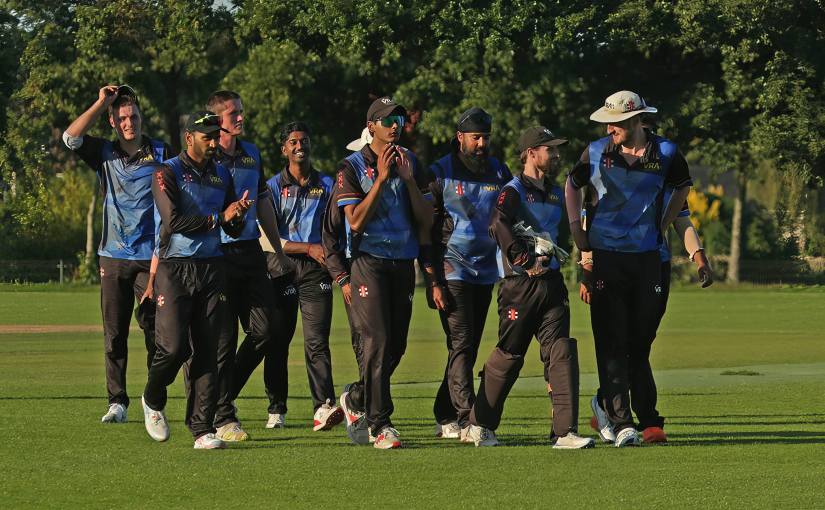
VRA Amsterdam will face HCC in the 2025 Topklasse T20 Final on Saturday, following a ruling in their favour in regards the eligibility dispute pertaining to their semi-final win over Voorburg CC last weekend.
more details to follow.

In-depth coverage of the Topklasse – the Netherlands' premier domestic One Day Cricket league
VRA Amsterdam will face HCC in the 2025 Topklasse T20 Final on Saturday, following a ruling in their favour in regards the eligibility dispute pertaining to their semi-final win over Voorburg CC last weekend.
more details to follow.
Bertus de Jong 10/09/2025
Defeated semi-finalists Voorburg CC, who lost to VRA by 22 runs in the second semi-final of the Topklasse T20 competition on Sunday, are seeking to have the result of that match overturned on grounds that VRA fielded an ineligible player. VCC are understood to have challenged the eligibility of VRA opening bat Shirase Rasool – who scored a brisk 41 before retiring hurt in the match in question – on the basis that he had not played sufficient matches in the preceding league phase.
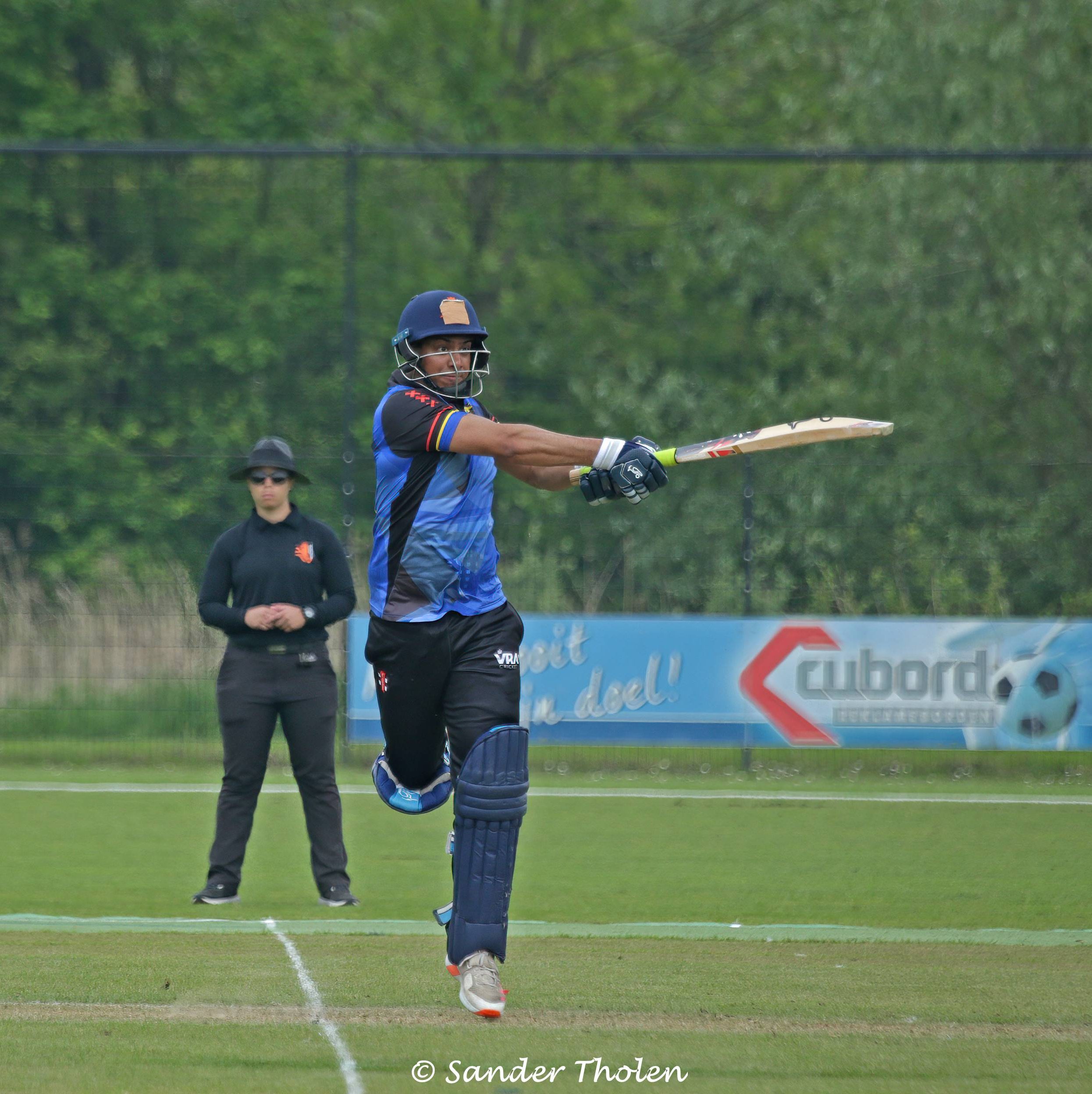
Rasool, a former regular at the top of the order for VRA, has played only intermittently this season owing to personal commitments. In total Rasool has made three appearances for VRA’s second team and five for the senior side this season, but crucially played only four matches in the T20 competition.
Under Article 18 of the Competitieregelement only players that have played a minimum of 50% of the first (league) stage matches of the T20 competition are eligible to participate in the final rounds. Under the current competition format the minimum is thus five matches in across divisions prior to the finals phase; Rasool therefore falling one match short.
However, a number of exemptions to these requirements are detailed in the same document, not least 18.II.7.b which exempts long-standing members of a club from the above participation requirements, under which Voorburg match-secretary and first team occasional Floris de Lange was able to play. VRA maintains that Rasool is similarly exempt under Articles 18.II.6 and 18.II.7.b, which provides for players who have regularly played for a club in preceding seasons, though the language of the document is arguably inconsistent as to whether this refers to all competition or exclusively divisions below the top flight.
“VRA is confident that we are fully within the regulations regarding the eligibility of Shirase Rasool. Articles 18.II.6 and 18.II.7 clearly state that he qualifies to play without needing to meet the five-match threshold or apply for dispensation. It is extremely disappointing how this situation has unfolded, as it distracts from the spirit of the competition and takes the focus away from the cricket itself.” VRA first team captain and General Manager Teja Nidamanuru told TKcricket.
Voorburg Chair Richard de Lange was equally confident however, stating; “VCC remains confident in the strength of our position and our rightful place in the T20 final based on the merits of our case and adherence to competition regulations. We respect the ongoing appeals process and trust that the proper procedures will ultimately ensure the integrity of the competition is upheld. We look forward to a swift and fair resolution that serves the best interests of cricket in the Netherlands.”
VRA immediately appealed the KNCB’s initial decision, which Tkcricket understands awarded the match and a place in the final to VCC and imposed a 100 euro fine on VRA. That appeal appears to have been at least initially successful in reversing the decision, but said reversal has duly been appealled in turn by VCC. At press time it remains unclear who, if anyone, HCC will face in Saturday’s final at the Loopuyt Oval.
Bowing to whelming popular demand, CricketXI and TKcricket are delighted to announce the return of Topklasse Fantasy Cricket for the 2025 season.
Pit your managerial wits against your friends and team-mates, test your Topklasse knowledge against the self-styled experts.
Submissions for teams and leagues are now open over at CricketXI. Entry is entirely free, the trophy for the global winner is a rather fancy hat. (Hat currently believed to be in the custody of Mr RC Campbell, county Durham)
Rod Lyall 07/04/2025
Following feedback on its plans from the KNCB Special General Meeting on 13 March, the Board has made a number of adjustments to the reorganisation of the domestic competitions.
The destination – Toplasse and Hoofdklasse divisions of eight teams, two Eerste Klasse divisions, each of eight teams – remains the same, but the path towards it has been changed in order to make it more palatable to those who feel unduly threatened by the possibility of relegation.
The most immediate is that whichever Topklasse team finishes eighth this season, a position which under the original proposal would have led to automatic relegation, will now have a partial reprieve in the form of a play-off against the Hoofdklasse champions.
This is a measure which has been used in the past when there have been reductions in the number of teams in a division, and seems a logical way of ensuring that the eight best-qualified teams take part in the Topklasse in 2026.
A more substantial change, although it will only take effect next year, is that in 2026, for one season only, there will be two eight-team sections in the Hoofdklasse.
The effect of this will be, For One Year Only, to bring four teams up from the Eerste Klasse, giving a total of 16 teams a chance to claim one of the eight places in the 2027 Hoofdklasse.
The other eight will drop down into a two-section Eerste Klasse, settling the total number of teams in the top three divisions at 32, compared with the 30 which have that status at present.
It should be noted that this process will play out independently in the 50-over and T20 competitions, which might well mean that by 2027 there will be greater differentiation between the rankings in the two formats: a strong T20 side could in theory reach the Topklasse in that format while the same club’s 50-over side was still playing in the Eerste Klasse.
Already, after just two seasons of independent promotion and relegation, eight teams from the top three divisions will be playing at different levels in the two formats, and this can only be expected to develop further over the coming years.
Bertus de Jong 12/03/2025
The beleaguered KNCB board headed by Guido Landheer will face further tribulation tomorrow, as they look to face down opposition to the overhaul of the domestic one-day competition structure that was announced in January. A number of clubs from various divisions, including Sparta 1888, VRA, Dosti, Hercules, Rood en Wit, Salland CC, VVV, Quick 1888 and Qui Vive among others, moved last month to request a Bijzondere Algemene Ledenvergadering (Special General Members Meeting) to reconsider the proposed changes, and that meeting has been duly scheduled for tomorrow (March 13th).
Perhaps unsurprisingly Hoofdklasse clubs comprise a substantial proportion of the remonstrants, more than half the current competitors in the second division adding their voices to the call. Under the current proposal the Hoofdklasse will see fully half of the current field relegated at the end of the coming season, with five teams dropping down to an enlarged Eersteklasse for 2026, to make room for three relegated Topklasse teams and the promotion of the 2025 Eersteklasse champions.
Speaking on behalf of the clubs appellant, former national team captain and sometime KNCB vice chair Steven Lubbers stressed that the appeal for a BALV was a move of last resort, but the group saw no other option. Lubbers, who has long advocated a broader pyramid with expedited promotion especially at the lower end of the ladder, told TKcricket that the remonstrant clubs felt there were significant deficiencies both in the process and that led to the new structure revealed in January, as well as the outcome.
Lubbers argues that the relegation of half of the Hoofdklasse would leave those clubs in an appreciably weaker position vis-a-vis local councils and rival sports when it came to Topsport subsidies and competition for facilities. Lubbers also echoed an observation which several commentators have raised regarding the board’s proposed promotion/relegation scheme for 2025/26, namely that the absence of any relegation playoffs means that sides in lower divisions enjoy a perverse advantage in jockeying for position for 2026. A team now in the Eersteklasse, for example, need only win that division (effectively placing 21st on the ladder) to win promotion to the Hoofklasse for 2026 while a team starting in the Hoofdklasse would have to place in the top five (essentially 15th in the full rankings) to retain their place.
Lubbers had previously championed and alternate plan which had come to be known as Voorstel Salland, which envisioned broadening the pyramid structure substantially all the way up to the Hoofdklasse, which under the Salland plan would be split into two pools and expanded to 16 or more teams, while lower divisions would also be expanded and slip into more pools – a format which Lubbers argues would both alleviate competitive pressure on clubs while allowing for expedited promotion.
Former VRA chair John Wories, who has played a leading role in the opposition to the new structure, observed in a memo circulated to clubs early last month that “expanded relegation will increase the pressure on clubs for extra reinforcement with foreign players/coaches” further crowding out homegrown youth talent on the field while limiting other expenditure “if only because financial resources would be used for [overseas recruitment] rather than for improving facilities (including grass wickets), strengthening participation and developing (young) players.” Indeed while early indications suggest that we may be on course for record spending on overseas talent for the coming season, at least in the Hoofdklasse. That in and of itself may however generate resistance to the remonstrants’ proposals from clubs that have already invested heavily ahead of what is currently slated to be a cut-throat season.
The remonstrating clubs are arguing for a postponement of any substantial restructure, either maintaining the same format as 2024 for the coming season or, in deference to the difficulty of overhauling the calendar at this late stage, at least postponing the envisaged transition to the planned 2026 structure and the numerous relegations that it would entail. Pointing to perceived deficiencies in the consultative process followed by the KNCB, which saw a nine-member working group headed by Reinout Scholte and Adriaan van der Dries arrive at the current restructure plan, the dissenting clubs propose a new committee be set up to consider the question.
Scholte, KNCB board member with the High Performance portfolio who has acted as point-man for the board on the issue, stepped down last month citing in part the increasingly fractious nature of the controversy, but the board shows little sign of throwing in the towel. Regretting the departure of Scholte, KNCB chair Guido Lanheer said in a previous statement, “The reasons for his departure give rise to thought and reflection on the way we deal with each other within cricket Netherlands. Differences of opinion will always exist, but the way we currently deal with each other and with these differences of opinion does not lead to the best result for cricket Netherlands in our view.”
Speaking to TKcricket, Landheer defended the process that produced the restructure plan, which included wide consultation with clubs across various divisions. While conceding that it was regrettable that the subject could not be discussed at the December ALV (which was busy with other matters), an extra virtual meeting was scheduled in January to address the issue specifically. “There were 45 clubs represented at the January (8th) meeting, and all clubs were afforded the chance to comment up until January 24th.” Landheer said, observing that neither Salland nor VRA did so at the time.
Referring to the alternate proposals first tabled two years ago, Landheer insists they were not dismissed out of hand. “The so-called Voorstel Salland was considered in depth, and several aspects of it have been incorporated into the new structure.” Landheer told Tkcricket, “a broader pyramid, and regionalisation at lower levels, for example, the latter especially has been made easier by the new scheduling software.” Landheer explained. “We’ve sought to give more attention to T20 and recreational cricket, while providing for more predictable and stable scheduling compared to the previous system.” The board is not entirely blind to some of the problems the upheaval expected at the end of the 2025 season may throw up, and aspects of the “Big Bang” transformation are less than ideal as Landheer concedes. “Transition is difficult but it is a necessary investment in the future.”
Following several bruising meetings focusing on the KNCB’s now well-documented financial woes, the board may even be relieved to be back on the familiar ground of wrangling about domestic structures, and it has been noted that the ALV’s role in questions of domestic structure is, constitutionally speaking, purely advisory. Nonetheless it is doubtful that the board will be afforded an easy time of it tomorrow, though with the first ball of the season now just weeks away it is late in the day to be changing course…
Bertus de Jong 18/01/2025
The KNCB today confirmed a substantial overhaul of the Dutch domestic one-day competition structure, with both the Topklasse and Hoofdklasse to return to an eight-team divisional league format from 2026 onwards.
The coming 2025 edition will dispense with the play-off system, reverting to a simple double round robin format, with the ten teams playing each other home and away. At the end of the season the bottom three Topklasse teams will be relegated, with the Hoofdklasse champions promoted to join the remaining seven for an 8-team competition in 2026. The crowded calendar precludes the possibility of a finals day or relegation play-off, meaning both the title and promotion/relegation will be directly determined by the final standings on the table. Similarly, the crowded schedule leaves no room for replays or reserve days during the competition.
The Hoofdklasse will likewise be returning to an 8-team format from 2026, with the consequence that no less than five teams will face relegation to the Eersteklasse at the end of the 2025 season, while the 2025 Eersteklasse champions will join the three relegated Topklasse sides and the four surviving Hoofdklasse sides for the 2026 Hoofdklasse season. As with the top division, there is no provision for a relegation play-off.
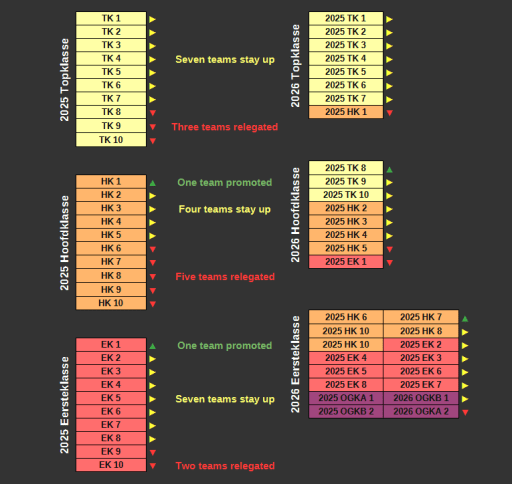
Conversely the Eersteklasse will be expanding from the current 10-team format to a two-pool 16-team leaguev (similar to the current Overgangsklasse) from 2026 onwards. The champion of the 2025 edition, also played as a straight ten-team double round robin, will win promotion to the 2026 Hoofdklasse, while the bottom two sides will be relegated to the Overgangsklasse, the latter to be renamed “Tweedeklasse”. A similar numerical naming scheme is to be applied to lower leagues, which remain otherwise unchanged.
The one-day season for 2025 is set to begin on the 26th of April and run until the 6th of August, with matches again played on Saturdays until the switch to Sundays in mid-July. The T20 competitons look broadly similar in format to last season, albeit switch to the other end of the Summer, commencing on August 13th and culminating in a finals day a month later.

CricketXI and TKcricket are delighted to announce the return of Topklasse Fantasy Cricket for the 2022 season.
Pit your managerial wits against your friends and team-mates, test your Topklasse knowledge against the self-styled experts.
Submissions for teams and leagues are now open over at CricketXI. Entry is entirely free, the trophy for the global winner is a fancy hat.
Have we missed any signings, retirements or transfers? Get in touch and let us know.
Rod Lyall 05/06/21
After consultation with the clubs taking part in the Men’s Topklasse and the Women’s Hoofdklasse the KNCB Board has decided upon some changes to the rules governing this year’s competitions.
The reconsideration was occasioned by criticism of the new points system, under which four points are awarded for a win, two apiece for a tie, and one each for abandoned matches.
This was felt by some to be unfair to clubs who, through no fault of their own, were unable to play fixtures as a result of bad weather, and the dissatisfaction was heightened by an unseasonably wet May which led to some teams having half their first six matches cancelled.
There was strong support among the clubs for the principle that the fairest competition is one in which all teams have played the same number of matches.
Following further discussion the Board has decided to stay with the new point system until at least the end of the season, after which there will be an evaluation, but to arrange in the meantime for abandoned matches to be replayed wherever possible.
The main limitation to this is the availability of suitable grounds, a problem which will become acute once the T20 Cup gets under way, and even more so should the remaining competitions be able to start once the current Covid-19 restrictions are lifted.
Competition leader Bart Kroesen explained this week that this meant it would be impossible for matches to be replayed after 10 July, but that until then grounds were available.
This means that all ten Men’s Topklasse matches and the two Women’s Hoofdklasse matches so far rained off will now be replayed.
Topklasse matches have been scheduled as follows:
Sunday, 13 June:
Sparta – Excelsior’20
Punjab CCR – HBS
ACC – Dosti
HCC – VRA
Sunday, 20 June:
HCC – VCC
Excelsior’20 – Dosti
VOC – ACC
Sunday, 27 June:
VRA – Punjab CCR
HBS – Excelsior’20
Dosti – HCC
TKcricket will replace the results of the rained-off games in the Points Table with those of the replays as the latter take place.
Another outcome of the consultation process is that play-offs for the Topklasse title have been confirmed: the leading side after the round-robin phase will play the team placed second, the winner going straight into the final, while the sides in third and fourth place will also play each other.
The loser of the match between No. 1 and No. 2 will then meet the winner of the game between No. 3 and No. 4, the winner of this contest reaching the final.
This system was last used in 2012, when Excelsior ’20, after finishing fourth, beat VRA Amsterdam in the semi-final and ACC in the elimination final before going on to take the title with a 102-run victory over Dosti Amsterdam in the final.
Bertus de Jong 30/04/21
Just 24 hours away from the first round of games in what is now best called the league phase of the 2021 Topklasse season, it has emerged that this year’s competition will also feature a playoff finals phase in the second half of August.
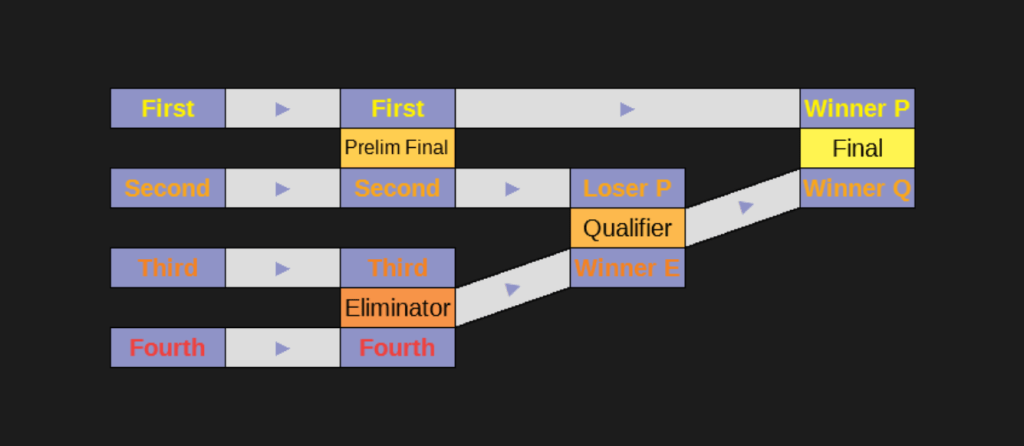
Following the ten team double round-robin league phase, the top four teams will contest IPL-style playoff finals. The top two teams will be face off in a de-facto semi final, with the winner progressing to the grand final, while the third and fourth-placed teams will contest an eliminator playoff. The winner of the eliminator will then meet the loser of the first semi final to contend for the second spot in the national final.
The new format means the 2021 season will be the first iteration of the Dutch domestic 50-over competition to feature a national final since the 2016 season, when the decision was made to revert to a ten team format and scrap the best-of-three finals.
At the other end of the table, the bottom four teams will contest a similar series of playoffs to determine who takes the wooden spoon, though with no risk of relegation this season (the league is instead slated to expand to 12 teams for 2022) the lower table play-offs are effectively more of a post-season denoument, or perhaps a dress rehearsal for the relegation battle expected next year.
Topklasse Finals Schedule
Sun Aug 22: First Semi Final (1st v 2nd)
Sun Aug 22: Elimination Playoff (3rd vs 4th)
Sun Aug 29: Second Semi Final (loser SF1 vs winner EPO)
Sat Sept 4: Topklasse Final (winner SF1 vs winner SF2)
“Relegation” Playoffs Schedule
Sun Aug 22: First Playoff (7th v 8th)
Sun Aug 22: Second Playoff (9th vs 10th)
Sun Aug 29: Third Playoff (loser PO1 vs winner PO2)
Sat Sept 4: Woode Spoon Playoff (loser PO2 vs loser PO3)
Bertus de Jong 01-07-2020
As the Netherlands slowly emerges from Coronavirus lockdown the KNCB have confirmed that Topklasse cricket can resume this coming weekend, albeit subject to certain restrictions and protocols to protect the health of players, officials and spectators (details of which are expected to be made public within the next few days), and without the prospect of relegation or an official national title to contend for.
The restrictions imposed by the Dutch government to combat the spread of COVID-19 have prevented any inter-club cricket thus far in the 2020 season, though individual clubs had begun to organise ad-hoc intra-club matches in the past few weeks.
Beginning from Sunday, however, the regular competition will continue effectively unchanged from the original schedule with regular matches being played on Sundays, treating the first half of the season as essentially written off. The initially planned 10-team double round robin format which would have seen each club play their nine rivals home and away can be fairly simply cut in half, such that each fixture will now be played either at home or away, though with only eight rounds left in the current schedule space will have to be found for one additional round to complete a nine-match per team calendar, the traditional free weekend at the end of July the obvious option.
Despite the ambition to run a “full-half” all-play-all competition, however, the 2020 season will not be accorded the status of a national championship and, as was already decided early in the year as the likely impact of the pandemic became apparent, there will be no promotion and relegation between the Topklasse and Hoofdklasse or any of the lower leagues this season. With significant international travel restrictions still in place, most Topklasse sides will be missing their overseas players, whilst a number of Dutch national team players who typically play abroad during the Dutch winter also remain outside the country, meaning several teams will be severely under-strength.
A handful of clubs are understood to have lobbied for the Topklasse itself to be replaced with a short-format league, but it seems the advocates of 50-over cricket won out in the end. Given the likely reliance of many clubs on their youth players, the value of the longer format for development was a significant consideration.
“Keeping the development of younger players in mind (longer bowling spells, more time in the middle, building an innings) played a role in the decision making, especially since most clubs are without overseas players/coaches and will rely more havily on their youth players. The national coaches/captain have also been consulted and expressed the same opinion.” -a KNCB spokesperson told Tkcricket.
It is as yet unclear when and in what form Twenty20 cricket will resume, but the board are optimistic that some form of T20 competition can be arrange. “The exact format and number of teams is not clear yet, but we’re aiming for a TK/HK T20 on Friday evenings or Saturday afternoons, with a regional based poule phase and finals day.”
Provisional fixtures for the first round of Topklasse games on Sunday July 5th are as follows. Live coverage, as always, only on Tkcricket.
ACC vs HCC at het Loopveld
VOC vs VCC at Hazelaarweg
Excelsior vs Sparta at Thurlede
HBS vs Punjab at Craeyenhout
Dosti vs VRA at Drieburg

 TKcricket