Topklasse Team of the Year 2025

Rod Lyall & Bertus de Jong 20/09/25

So, as the season nears its end, it’s time for us to come up with our seventh Topklasse Team of the Year.

RL: Once again, we cannot avoid the issue of overseas players, and how many we should include. Arguably, we could name a side like:
Janett (VOC), Doyle-Calle (Hermes-DVS), Kaplan (Voorburg), Walbrugh (HBS), Melville (Voorburg), Brown (HCC), Bangs (Kampong), Shahzad (Punjab-Ghausia), Ruffell (VRA), Ralston (Excelsior) and Rossouw (HBS)
which wouldn’t be too much of a travesty, but while it might make a point, it wouldn’t be a totally fair reflection of the season so far. So perhaps the sensible course is once again to give preference to local, or at least Dutch-qualified, players wherever possible, while including a small number of the most influential imports.

So here goes:

Starting with the openers, the first name on my sheet is that of Cedric de Lange (Voorburg), still eligible to play in the KNCB’s Under-17 competition but already a Topklasse regular, with 634 runs this season at 42.27. No other locally-produced opener has shown anything like the same degree of consistency, with some, like VRA’s Vikram Singh and HCC’s Tonny Staal, having distinctly disappointing returns. Musa Ahmad (Punjab) spent most of the season at three, but his promotion to opener brought him plenty of runs, and his 621 at 42.40 earns him a place in one or other of these positions. If we were to go for an overseas to partner De Lange, then Daniel Doyle-Calle’s 711 at 64.64 (at a strike rate of 105) for Hermes, although he fell away somewhat towards the end of the season, makes him the outstanding candidate.
Cedric de Lange

BdJ: De Lange is probably the easiest pick this season for what one suspects will be the first of many TK team of the year appearances. The 17 year-old doubtless has a bright future ahead of him both in the Topklasse and indeed in Orange, his maiden international call-up coming earlier than even he might have hoped one imagines. The second opener is a tougher pick, however. Musa Ahmad indeed did well opening, but with only four appearances at the top of the order probably doesn’t qualify. It’s perhaps recency bias that summons VOC’s Scott Jannet to mind – his unbeaten 83 in the relegation play-off arguably the single most consequential innings of the season. Conversely, we perhaps shouldn’t discount Doyle-Calle’s weight of runs merely because the lion’s share came at the start of the season. DDC’s early season form was a big part of Hermes’ dominance over the first few weeks of the competition, and ensured they had a cushion of safety even as their title challenge rather sputtered out.

There’s a rather more crowded field for numbers three through five, though again overseas players feature heavily. Voorburg’s Gavin Kaplan is an obvious contender again, while strong cases might be made for Kampong’s Lane Berrry – whose 684 runs for the champions came at an average over 50 and a blistering strike rate of 124, while VOC’s Danish number 4 Monty Singh also had an excellent debut season, and had his long commute from Denmark not limited him to ten appearances the Bloodhounds’ season might have looked rather different. Among the locals Kampong’s Pierre Jacod deserves at the very least an honourable mention among the batters with 403 runs at 57.57, though he’s generally been at his best further down the order. For my money though, we should probably stretch our definition of local players to include those set on qualifying for the Netherlands again. That would make room for Tayo Walbrugh and Johan Smal who, though both still a few months from eligibility (much to the frustration of the aforementioned selectors as the injuries and unavailabilities mount up ahead of the impending Bangladesh tour) have already been training with the national side and one imagines will be donning the Orange sooner rather than later. Walbrugh once again finished top of the run tables with 831 at an average of almost 60, while Smal was just two spots behind, his 715 runs at 55 crucial to keeping VRA in the top half of the table while other senior bats at the Bos seemed to struggle all season.

RL: There’s obviously a serious danger that our final eleven might start to look very like the satirically-intended one I named at the outset! The lack of outstanding local candidates is due to a mix of factors: the tendency of the clubs to pack their sides with overseas players, thus limiting the opportunities for their own products, combines with the presence of relatively few young Dutch players of genuine quality and the fact that the top Dutch batters either played relatively few games or had disappointing seasons. Only eight Dutch-qualified players figure in the top twenty of the batting averages, and of those Scott Edwards played only nine times for Kampong (and had five innings) and Noah Croes (Voorburg) one more. If we agree that Jacod ought to bat at six or seven, and if I’m allowed to insist that we only include one overseas in the top/middle order (Walbrugh again, for my money), then I’d want to make a case for two of Wes Barresi (465 runs at 42.27), Boris Gorlee (628 at 39.25) and Noah Croes (372 at 41.33). Or perhaps . . .

. . . all three, if Croes keeps wicket. Equally, Edwards’ 260 at 65.00 from his extremely limited opportunities is a pretty strong case too. If we’re going to confine ourselves to keepers with a more frequent presence, on the other hand, then the top candidates are probably Mark Wolfe (HCC) and Asad Zulfiqar (Hermes), with 20 victims apiece. VRA’s Jack Cassidy had 28, but then we’re back with the overseas vs. locals debate again. Zulfiqar bats higher up the order than Wolfe but had a fairly disappointing campaign with the bat, while young Wolfe, batting lower down, played some useful innings when the HCC top and middle order had struggled. So on balance I’d probably be inclined to give him the nod.

BdJ: Well it seeems every year we’re destined to have the same tussle, as to whether to adhere in our Topklasse Team of the Year selection to a rule that hasn’t applied in the actual competition for the better part of a decade now, and was more honoured in the breach when it did. If we are to make current Dutch-eligibility rather than Topklasse performance the principal qualification for this exercise we may as well just name the national team and have done with it. In a similar vein, while Scott Edwards doubless does a fine job with the gloves in Orange I frankly draw the line at picking a wicketkeeper here that basically never keeps wicket in the Topklasse. Edwards and Croes have a total of 7 appearances behind the stumps between them this season, and to my mind picking either as Topklasse keeper of the year would send us deep into the realm of farce. Monty Singh scored more runs and effected more dismissals than both combined despite missing half the season, away playing for Denmark rather than the Dutch. If we must look to Dutch-eligible glovemen then I’d argue Kampong’s actual keeper Damien van den Berg has a stronger case, doing a fine job behind the stumps and setting the tone at the top of the order with some 400 runs at a run-a-ball. The Crows’ Lucas del Bianco had a comparable season with the bat, but a glaring 30 byes probably disqualifies him there.

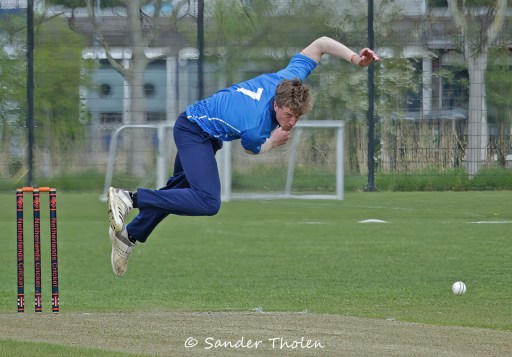
Turning to seamers we are inevitably confronted with a familiar quandry, as the two leading quicks in the comp are likewise non-Dutch-eligible. HCC’s Joshua Brown took 34 wickets at 15.32 while VRA’s Peter Ruffel claimed 33 scalps at 16.55, and both were crucial to keeping their sides in the top half of the table. There is however a tad more local competition in the fast bowling stakes, with Hermes skipper Sebastiaan Braat’s 30 wickets at 16.67 earning him a spot in the top five, closely followed by Kampong captain Alex Roy, who picked up 29 wickets at 14.52 while leading his side to the title. TK TOTY regular Hidde Overdijk also deserves an honourable mention at the very least, his 26 wickets coming at just 13.69 apiece.
Alexander Roy

RL: Maybe we should pick two sides, one limiting ourselves to, say, two or three overseas players, and the other a No-Holds-Barred team, a bit like the one I ironically suggested at the outset? I for one hope that the KNCB finally gets a grip on the nuclear arms race of overseas player recruitment over the winter!

Turning to the spinners, we’ve already mentioned Musa Ahmad, Wes Barresi and Pierre Jacod in our discussion of the batting, and if all three make it into the final eleven we have a pretty reasonable array of slow bowling. Even I, though, would find it difficult to go past the Crows’ Jayden Rossouw, the competition’s leading wicket-taker with 38 at 19.37. With four off-spinners this attack would, admittedly, have a certain sameness about it, but we have to play with the cards we’re dealt, and left-armers and leg-spinners have not been conspicuous among the wicket-takers this year.

BdJ: I’d argue that four slow bowlers of any ilk would be a bit much in a season largely dominated by the quicks, but picking four right arm finger spinners of whom only two made the top ten wicket-takers seems entirely excessive. Nonetheless I’m going to have to give at least an honourable shout-out to one more right-arm tweaker here, namely VOC’s Arnav Jain, who may only have bagged 19 scalps this season but went at just 3.44 an over. If offspin is generally seen as a defensive art there’s a strong case to be made that that’s a better showing than the relatively leaky Barresi or the objectively expensive Ahmad. Among the purveyors of more esoteric or aggressive spin there’s only one genuine stand-out, namely Hermes’ leggie Hikmatullah Jabarkhail. His 32 wickets at 16.5 played a big part in the Schiedammers’ early dominance, and would make him a sure pick were it not for his hailing from Belgium. Similarly Excelsior stalwart Lorenzo Ingram to my mind has a better case than either Ahmad or Barresi, with more wickets at a better average than either and at an economy of just 3.29 – the best of any front line bowler in the competition – and a better batting average to boot. But Ingram of course, despite a Topklasse career spanning well over a decade, is not yet eligible to play for the Netherlands.

I will once again plead that we ought be picking a Topklasse XI rather than a Dutch development squad here, and point out that even if we were picking the latter at least those on track for eligibility should be accorded equal treatment, but will defer to experience when it comes to the final word…

RL:One might take the position that given the apparent indifference of the clubs to the fututre of Dutch cricket, our own annual selection might at least serve by contrast as rebuke or aspiration, but on the other hand there’s a strong case for reporting things as they aare. Considering the our differing positions on the overseas question, it’s remakable how little divergence there eventually turned out to be in our preferred selections. While I remain sceptical of treating palyers on the path to qualification as though they were already there, I’ll concede Smal has a marginally stronger claim than Musa to a place, at least a batting slot. While Ingram has not even comitted to that path, he is unquestionably a long-standing servant of the Dutch domestic game, and indeed would add variety to an otherwise offspin-heavy spin attack, so once again am happy to defer to my colleague there. On the keeping question, Cassidy certainly had a fine season, helped no doubt by the quality of the quick bowlers he’s kept to. Van den Berg’s fewer dismissals are balanced by fewer byes conceded, and there’s little to choose between them in terms or runs scored except the rate at which they scored them, so on balance van den Berg edges it irrespective of the overseas question. Finally it seems to me that given his side’s success and his on contibution to it, Alex Roy is the outstanding candidate to captain our team of the year.

Touch wood by the time we come to do this exercise next year the KNCB may have found a way of encouraging or forcing clubs to rectrict their use of overseas players, if not we’ll doubless again be wrestling with this dilemma, and hopefully diverting you all by arguin it out in public. For now though, here is TKcricket’s 2025 Team of the Year:

Daniel Doyle-Calle (Hermes), Cedric de Lange (Voorburg), Johan Smal (VRA), Tayo Walbrugh (HBS), Lorenzo Ingram (Kampong), Damien van den Berg (Kampong), Pierre Jacod (Kampong), Sebastiaan Braat (Hermes), Alex Roy (c) (Kampong), Joshua Brown (HCC), Jayden Rossouw (HBS).

Previous TOTYs 2024 | 2023| 2022 | 2021 | 2020 | 2019 | 2018

Topklasse Team of the Year 2024

Rod Lyall & Bertus de Jong 04/09/23

So, that time rolls round again when we at TKcricket nominate our Topklasse Team of the Year. It’s all a bit different this year, since the influx of overseas players recruited by the clubs changed the character of the competition (once again, we’re only concerned here with the 50-over version) to a significant degree.

RL: Whatever the clubs may have done, I think we should confine our choice of overseas players to two, as we have done in the past. There is, of course, a large field to choose from, but for my money the first name on the sheet has to be that of Voorburg’s Gavin Kaplan, who went past fifty no fewer than seven times in just ten innings in compiling his 701 runs, going on to three figures on four of those occasions. Add to that the fact that he proved a useful change bowler, and his selection is a no-brainer. The second overseas is trickier: pace spearheads Jason Ralston (Excelsior) and Cameron Fraser (Sparta) claimed 38 and 29 wickets respectively for teams in the lower reaches of the table. Ralston has a strong claim, but my choice would probably be ACC’s Izhaan Sayed, who not only had the knack of grabbing early wickets but also topped his struggling side’s batting averages.

BdJ: While I do appreciate the high-minded sentiment on the overseas question, I’d be inclined to take a Jeffersonian approach and stylishly swim with the current on this one rather than risk principled petrification. With the influx of overseas showing no signs of slowing, if we stick to our guns here we may struggle to even pick a competitive XI in a few seasons’ time. Close to half the players in the competition already hail from abroad, accounting for more than half the runs and wickets this season, so I say who are we to blow against the wind?

Nowhere is that case more convincing than at the top of the batting card. The majority of clubs went with overseas at the top of the order this season, and of Dutch-produced or Netherlands-qualified players nobody averaged over 30 opening the batting. VCC’s Michael Levitt was the best of a bad bunch with 260 runs at 28.9, a disappointing season by his own standards, followed by HCC’s Tonny Staal with 300 runs at 27.3. If one had to pick an opening pair from among the local players one would probably go for Vikram Singh and Musa Ahmad, though both had more consistent success down the order. Ahmad’s sometime opening partner and near-permanent fixture in Dutch club cricket Shoaib Minhas arguably has a stronger case for his efforts against VRA alone, hitting the match-winning century in the first qualifying semi at the Zomercomplex that secured a home final and two half centuries against the same opposition earlier in the season making sure would be played there in the first place. Jonathan Vandiar also deserves a mention as an occasional opener albeit a committed overseas, and it’s notable that Punjab are the only side with two bats in the 500-club this season. Hermes’ overseas opening combo of Ashley Ostling and Daniel Doyle Calle were the most prolific pairing at the top of the order this season, Ostling the only opener to hit 500 runs from the top of the order during the League Phase.

RL: I can’t argue with m’colleague’s analysis of the problem, but my view is pragmatic as well as ‘high-minded’: if the competition continues on its present course, it will become almost impossible to produce young Dutch players capable of holding their own on the international stage. The clubs were unhappy when the Dutch-produced contingent in the national side withered to one or two, and it’s true that some progress has been made under the two Ryans (Campbell and Cook) to restore the balance. It’s really a topic for a different discussion, but I am personally convinced that the KNCB will need to act to curb the current arms race. That way, madness lies.

Another structural problem, of course, is that some of the leading players were absent for much of the second phase, so averages are probably a better guide to performance than aggregates. I’d certainly want to go with Musa Ahmad (420 at 30.00) as one of the openers, and Singh’s 367 at 40.78 make him a credible partner, even if neither of them had the sort of season they might have wanted.

As for the rest of the top order, if we have Kaplan at three, there are three more places available in the top six, or perhaps four, depending on what we decide about a keeper. Punjab’s Saqib Zulfiqar, for instance, finished seventh in the averages behind six overseas players, and his 326 runs at 46.57 give him a strong claim. He would slot in well at four, while I’d be inclined to include Voorburg’s Noah Croes (466 at 38.83) at five, thus filling the wicketkeeping spot at the same time. That would leave room for two more batters, or batting allrounders (it’s notable that apart from Croes, all the Dutch-qualified players we’ve named so far are more than useful change bowlers). The leading contenders would be Shariz Ahmad (VRA, 331 at 41.38) and Ryan Klein (Voorburg, 356 at 39.56), both of whom have greatly improved their batting and have played crucial innings for their sides.

BdJ: While I’m inclined to agree that Something Must Be Done about the proliferation of overseas players in the league, I still feel our Team of the Year ought to reflect the competition as it is rather than as we’d like it to be. Perhaps as a compromise we could make room for those overseas now permanently based in the Netherlands and intent qualifying for the national side. That would allow us to pick the soon-to-be-Dutch-eligible Tayo Walbrugh, whose 596 runs for HBS at an average of almost 60 make him a strong runner-up to Kaplan in the batting stakes this season. A case might also be made for VRA stand-in skipper Johan Smal, who missed out on the 500 club by just five runs and was indispensable to his side’s making their run to the final despite Teja Nidamanuru’s season-ending injury early in the summer and the regular absences of Singh, Ahmad and Floyd.

Johan Smal

Croes has little competition for the keeper slot, with none of the other glovemen in the league coming close to matching his 466 runs. Nonetheless some honourable mentions can be made, Luke Scully did some fine work in the handful of games he played for VRA 1s this season, averaging 44.3 across 4 innings in the Topklasse as well as playing a crucial role in the second team’s successful promotion campaign in the Eersteklasse. In terms of pure glovemanship, it’s worth noting that Sparta’s Riley Mudford gave up just three byes over the course of the season, even if he wasn’t able to replicate his short-format form with the bat. HCC’s Yash Patel also had a fine season behind the poles, effecting five stumpings and taking 21 catches to top the dismissal tally table.

RL: An hon. ment. also for Fawad Shinwari, whose 27 victims in 14 matches took him to the top of list and helped Punjab to their title. He also raises the thorny question of where Belgian-based players fit into our discussion of the overseas issue.

Whether or not we agree that Shariz and Saqib earn a place as allrounders, both have a strong claim as wrist-spinners, especially the former, whose 21 wickets at 21.52 may have been a smaller tally than last year but came from just 14 matches. Not many slow bowlers feature prominently in the averages, but Mahesh Hans (ACC) and Leon Turmaine (VRA) both averaged a shade over 16, the latter once he’d forced his way back into the first team. Neither, perhaps, has an overwhelming claim, but if we really wanted to include a finger spinner both could be relied upon to produce a decent performance.

BdJ: It has indeed been a remarkably lean summer for the slow-bowlers, with seamers occupying the first eight spots on the wicket-taking table, with Ahmad’s 21 the best tally for a spinner. The indefatigable Lorenzo Ingram was the only finger spinner to break 20 wickets this season, though six of those came in succession running through a hapless Sparta lower order. With two slow bowlers already penciled in on the strength of their batting, I’d be inclined to make room for an extra quick given the weight of wickets this season has heavily favoured them.

On that front it’s hard to look past Jason Ralston’s 38 for Excelsior, whose 14-wicket lead over Cameron and Sayed outweighs the latters’ ability to chip in an average 20-odd runs in my book. Among Dutch and Dutch-qualified seamers the stand-out this season was newcomer Ben Fletcher with 29 wickets at under 15 for VRA, the tall left armer already attracting the attention of national selectors. Hermes’ Ralph Elenbaas also had an excellent season, eclipsing his more-celebrated brother with 25 wickets at 15.4. Sajjad Kamal also enjoyed a fine first season for Punjab picking up 24 scalps, though they came at a comparatively hefty price in terms of runs conceded. Mees van Vliet, charged with leading the VCC attack while national duty or injury kept Kingma and Klein out of the side, is next on the wicket-taking table with 23 across 16 matches, but was similarly expensive, going at an economy rate of 5.65 an over. If one were to prize miserliness over penetration in our second seamer three names jump out. The first is that of Ryan Klein, who sent down 48 overs at the cost of just 142 runs, but then of course he spent much of the season bowling off-spin rather than his usual medium pace. HCC’s Adam Leonard was the most economical of the dedicated quicks, his 19 wickets coming at 16.9 runs apiece at the rate of 3.4 per over.The last is that of last year’s TK Team of the Year skipper Martijn Snoep, who had another quietly effective season for his side picking up 18 wickets at 16.4 while going at 3.5 an over.

RL: That about covers the field, I reckon. A shout-out, though, for Kyle Klein of HBS, who claimed 18 wickets despite playing only seven matches, at an economy rate of 4.05. And in a season in which young home-grown players had regrettably few opportunities, or who seemed to have gone backwards when they did, two young seamers who enhanced their reputations were Aaditt Jain and Roman Harhangi of VOC. I still have a strong preference for picking Dutch (or at least Dutch-qualified) players over out-and-out incomers, which would lead me to give the nod to Fletcher – who also offers the bonus of being a left-armer – and Elenbaas minor over the rest of the contenders. That gives us three front-line seamers plus the incidental contributions of Kaplan and Singh, and two spinners.

Plenty of bowling, so we can afford to go back and add one more batter. Here the choice lies between adding an opener, who would have to be an overseas like Punjab’s Shoaib Minhas (see above), and including another batting allrounder, which which case the strongest claim is arguably that of Ryan Klein.

As for the captaincy, the only regular captains we’ve included are Croes and Walbrugh, and for my money the nod should go to the former, who led Voorburg with authority whenever he was available.

BdJ: The matter of the armband is a tricky question this year, with several clubs switching captains through the season and few full-time skippers having stand-out seasons. The field-promoted captain Smal is the notable was the notable exception there, probably the unluckiest to miss the cut this year and would have taken the armband too had he made it into the XI. But I’d agree that Croes is a sound second choice to lead our 2024 TK Topklasse Team of the Year…

The Team: Musa Ahmad (Punjab-Ghausia), Vikram Singh (VRA), Gavin Kaplan (Voorburg), Noah Croes (Voorburg), Tayo Walbrugh (HBS Craeyenhout), Saqib Zulfiqar (Punjab-Ghausia), Shariz Ahmad (VRA), Ryan Klein (Voorburg), Ralph Elenbaas (Hermes-DVS), Ben Fletcher (VRA), Jason Ralston (Excelsior ’20).

Previous TOTYs 2023| 2022 | 2021 | 2020 | 2019 | 2018
Topklasse Team of the Year 2023

Rod Lyall & Bertus de Jong 04/09/23


RL:  Once again it’s time for us to select our Topklasse Team of the Year. This year we need to specify that the selection is based on performances in the 50-over competition, and once again we will restrict ourselves to two overseas players in the eleven. So, first the openers. Voorburg’s Michael Levitt certainly stands out, with four centuries in his 655 runs, including a fine 102 in the grand final, and there’s a strong case, too, for Vikram Singh of VRA, although it’s true that 155 of his 548 runs came in one extraordinary innings at Craeyenhout. Still, he did make two other hundreds, and on his day he is capable of destroying an attack like nobody else in the Dutch game. Max O’Dowd (VOC), another brutal batterer of bowling, had a comparatively quiet season by his high standards after hammering 186 against ACC, and another honourable mention should go to Shirase Rasool, often Singh’s opening partner at VRA. But I’d go with Levitt and Singh.

Tayo Walbrugh

BdJ: A fair shout I’d say, in what’s otherwise been a comparatively lean summer for openers the two youngsters certainly stand out. Another shout out is probably due Ratha Alphonse, who played some more than useful innings at the top of the order for his new club, but the numbers aren’t there for him to challenge Singh or Levitt. Fair to say they benefit from Tayo Walbrugh having dropped down the order for HBS, as have the Crows themselves – to the tune of almost 1,000 runs. With 988 at 61.75 Walbrugh topped the runs table by a distance, with Sparta’s Garnet Tarr more than 200 runs behind in second place. Both merit a place in the team of the year top order for my money, even at the cost of both of our overseas slots. Walbrugh’s weight of runs simply can’t be ignored, while Tarr taking the gloves for much of Sparta’s season  saves us an otherwise tricky discussion on the subject of wicketkeepers.

Unless they’re secretly holding Dutch passports, that leaves room for neither VRA’s Johan Smal nor VOC’s Lane Berry, though both comfortably broke the 600-run mark this season. By the same token, ACC’s Heino Kuhn is ruled out despite being in large part responsible for the club’s mid-table finish in what was looking a tough year. Conversely, Voorburg’s Sybrand Engelbrecht is overseas no longer, and his return of 549 runs at 54.9 (coupled with the small matter of captaining his side to the title) certainly gives him a strong claim. Punjab’s Shoaib Minhas and Mohammad Riaz both also finished the season with 50+ averages, but to my mind finished it rather too soon to be considered for inclusion here. If one were minded to include another specialist bat then a case might be made for Scott Edwards, who racked up 509 runs at almost a run-a-ball, or perhaps for VCC’s Musa Ahmad, though his best returns have come in the shorter format this year. I’d be more inclined to go with a genuine all-rounder at here though, and Saqib Zulfiqar’s 534 runs at 44.5 are more than enough to warrant a place in the top six even before considering his 29 wickets.

RL: A top six of Singh, Levitt, Walbrugh, Tarr, Engelbrecht and Saqib Zulfiqar works for me. If we’re going to slip our keeper in as a top-order batter, though, I’d also want to give a shout-out to Voorburg’s Noah Croes, whose 18 catches and seven stumpings was a not inconsiderable factor in their success. (I’d acknowledge, however, that a bowling unit like Voorburg’s is bound to be healthy for any keeper’s statistics.)  If we have room for a bowling all-rounder at number seven, then the choice seems to me to lie between Hidde Overdijk, whose 32 wickets at 20.62 made a big contribution to HCC’s reaching another grand final and who also averaged 24.42 with the bat, and Sikander Zulfiqar of Punjab, who only took 18 wickets but who made 411 runs at 41.10 and played several very significant knocks to keep his side in contention longer than they might otherwise have been. Forced to choose, I’d go for Overdijk, but I’d be happier still if we could find room for both.

Saqib Zulfiqar

BdJ: I’d hesitate to call Sikander a bowling all-rounder at this point, given he’s generally occupied the number four spot for Punjab this season, and while 18 scalps is a decent tally those wickets have come at an average of almost 30 and an economy rate over a run a ball. If we were to go looking for another seam bowling all-rounder, I’d say that Kyle Klein, whose contributions with both bat and ball have been indispensible for HBS, arguably has the strongest case after Overdijk, though not an overwhelming one.

Turning to to the spinners, one name comes pre-printed on the sheet. With 47 wickets at 10.66 Voorburg’s googly-merchant Shariz Ahmad has been instrumental in their title run, his wrist-spin partnership with the more conventional Philippe Boissevain crucial to their near-perfect run through the competition. With Saqib Zulfiqar already inked in there’s little room for another leggie, but two left armers do  stand out among the finger spinners for their parsimony. The evergreen Lorenzo Ingram bowled 120 overs for Excelsior at the cost of just just 383 runs and claimed 26 wickets into the bargain, yet the veteran has been eclipsed this year by fellow West Indian Daniel Doram, the Sint Maartener taking one more wicket while matching Ingram’s economy of 3.13. Right arm off-spinners have had tougher time this season, with the notable exception of VOC’s Arnav Jain. Despite struggling with a shoulder injury Jain took 23 wickets opening the bowling for VOC at an average of just 16 while going for just 3.5 an over, head and shoulders above rival right arm tweakers.

Martijn Snoep

RL:  I’m not sure that Ingram, despite his long and distinguished service with Excelsior, doesn’t still count as overseas, but I completely agree that Doram, in a very different way from Shariz, has been a stand-out spinner this season. If we include these two spinners and Overdijk as a fast-bowling all-rounder, we have two places left for specialist pace bowlers. Voorburg’s Ryan Klein only played 12 matches, but he claimed 27 wickets at 11.56, with a strike rate of 17.93 (second only to Shariz among the regular bowlers) and an economy rate of 3.87. Who should join him is a tougher call: Ahsan Malik and Khalid Ahmadi of Sparta were excellent before the break but did not reappear after it, and, as Bertus noted earlier, Kyle Klein’s 21 wickets at 27.24 don’t constitute an overwhelming argument even when his batting is taken into account. My inclination would be to go for one of the genuine servants of the domestic game in Sparta’s excellent captain, Joost Martijn Snoep, who took 22 wickets at 19.23, with an economy rate of 3.63. In the absence of Malik and Ahmadi and Mudassar Bukhari struggling with injury, he bore much of the burden as well as proving a dogged number eleven with the bat.

BdJ: Well it seems we find ourselves in furious agreement here. In light of expectations at the start of the season, coupled with the difficulties posed by the unavailabilities and injuries that dogged  the Spartan seam section, I’d argue that Snoep leading his side to a top-four finish is a more impressive accomplishment than Voorburg’s deservedly claiming the silverware, and one that warrants the armband this year for Sparta’s skipper-chair. With ball in hand he was not only Sparta’s lead wicket-taker, but also the second most economical seamer in the competition behind only VCC’s Vivian Kingma who deserves a mention here as the only quick to go at less than 3.5 an over this season. At the other extreme we’d be remiss not to make some mention of Eduard Visser’s tally of 31 wickets, second best of the seamers and third overall behind only Overdijk and Ahmad by that metric, but the 752-run price tag attached puts him behind Klein for mine too, even before considering the latter’s title-sealing performance in the Grand Final.

RL: So, TKcricket’s Topklasse Team of the Year is:

Vikram Singh (VRA), Michael Levitt (Voorburg), Tayo Walbrugh (HBS), Garnett Tarr (Sparta), Sybrand Engelbrecht (Voorburg), Saqib Zulfiqar (Punjab), Hidde Overdijk (HCC), Shariz Ahmad (Voorburg), Ryan Klein (Voorburg), Daniel Doram (HCC), and Joost-Martijn Snoep (Sparta, captain).
12th man: Arnav Jain


Previous TOTYs | 2022 | 2021 | 2020 | 2019 | 2018
Topklasse Team of the Year 2022

Bertus de Jong & Rod Lyall 04/10/22


BdJ: While the TK-TOTY teamsheet this year doesn’t quite come with one of the openers pre-printed as it did for the last couple of seasons, one might say Tonny Staal’s name has been helpfully pencilled in for us at the top already. HCC’s former skipper amassed 767 runs at an average of 48 at a healthy strike rate just a shade under 81, his contributions at the top of the order despite the lack of a dependable regular opening partner being instrumental to HCC’s successful title run. A stand-out innings of 143 off 144 against Excelsior in their first phase 2 clash key to HCC’s second-place finish and double-shot at a place in the final. The choice for second opener is perhaps less clear cut, largely because season stop-scorer Tayo Walbrugh did not consistently play that role for HBS, yet though Walbrugh occasionally dropped down to three for the Crows, even on the handful of occasions he’s not opened the batting he might as well have done, generally finding himself in the middle after a few balls regardless. Walbrugh’s tally of 844 runs at an average little over 60 certainly warrants a place somewhere in the top three, but the chief reason to push him down to three would be to make room for VOC’s Max O’Dowd, whose 669 runs from just 13 matches helped keep the Bloodhounds clear of danger this season, and indeed had he and opening partner Scott Edwards not been preoccupied with the national team’s  frenetic schedule VOC’s 2022 might have looked quite different. Similarly Voorburg’s Andre Malan would be a strong contender here had he played a whole season, having taken to Dutch conditions rather better than his more celebrated brother. Malan racked up 395 runs at an average of 65.8 and a strike rate of 110 from the eight games he played, and one suspects if he comes back for a full season he’ll be getting more than an honourable mention.

RL: Staal and Walbrugh were certainly top of my list, but O’Dowd wasn’t far away, and a top three of Staal, O’Dowd and Walbrugh makes perfect sense to me. One might think this is a bit rough on HCC’s Zac Worden, whose admirable consistency brought him 782 runs at 52.13 without his reaching three figures; nine half-centuries in 17 innings was a pretty remarkable effort and contributed significantly to HCC being anywhere near contention for the grand final, although a strike rate of a tad below 60 is a point against him. Others worthy of an honourable mention include Voorburg’s Musa Ahmad and Kampong’s overseas Cole Briggs, the latter too often having to try to hold a fragile batting line-up together.

Tonny Staal

RL: If we’re repeating last year’s decision to restrict ourselves to two overseas players, then Jonathan Vandiar of Punjab must surely have a decent claim to join Walbrugh in the side: it’s true he only played ten matches, but his tally of 581 runs at 83 with a strike-rate of 95 and including three centuries and two fifties in only eight innings was unquestionably one of the outstanding individual efforts of the season, and it brought some solidity to a Punjab side which fired a good deal below its championship-winning form of last season. There certainly has to be a spot for Voorburg’s skipper Bas de Leede, whose 627 runs came at 48.23 and again did not include a hundred, although he made seven half-centuries. Nor should we forget his 16 wickets at 22.50. Among the wicketkeeper-batters who might tuck into the middle order there’s a strong case for Scott Edwards (VOC), who filled this role successfully in national colours and who did make over 500 runs at an average of almost 50, and he should probably be preferred to either ACC’s Robin Smith or the mercurial but inconsistent Ali Raza of Sparta, who did top the keeping table along with Excelsior’s Roel Verhagen. That brings me to six, but it’s not entirely for sentimental reasons that I want to make a case for VRA captain Peter Borren, who bade farewell to the Topklasse with 377 runs at a strike rate of almost 92 and 15 wickets at an average of 21: as a captain and as a role model he has been a giant in the Dutch game, and I’d unquestionably have him leading this side.

BdJ: Walbrugh’s overseas status is of course not as clear-cut as it once was of course given his rumoured aspirations to orange, and there’s a couple of reasons it might be tempting to fudge things a little on that front. First among them is Delano Potgieter, who was a big reason VCC looked nigh-unbeatable early in the season. 17 wickets at an unmatched average of 10.94 and 259 runs at 43 across his ten matches make him one of the summer’s most impressive acquisitions, despite his status as a short-stay. Excelsior too picked their overseas wisely, Brett Hampton bagging 21 wickets and kicking in some decisive knocks down the order, and Lorenzo Ingram again proving his worth with 647 rns at 59 despite a comparatively quiet season with the ball. Failing overseas rule-bending, a case might also be made for Wesley Barresi whose 626 runs at 48 for HBS kept the Crows in contention deep into the season. As m’collegue observes, however, there are good reasons to argue for Borren’s inclusion beyond valedictory nostalgia and a vague feeling that we’ve unjustly overlooked him in the past. While Borren would be a shoe-in for team of the decade, he has admittedly had a merely adequate personal season by his own standards. As captain, however, he saw VRA through a season that many speculated would be a relegation battle – without any overseas and denied the services of Quirijn Gunning, Eric Szwarczynski and Ben Cooper –  and took what was essentially a youth team with hangers-on into the championship group.

Peter Borren

BdJ: Of Borren’s young charges, Aryan Dutt stood out in the slow-bowling department, taking 24 wickets at 16 in the Topklasse when not bagging likes of Nicholas Pooran or Babar Azan in orange. Fellow teenaged spinner Shariz Ahmad likewise managed to fit in an excellent domestic season around his international commitments, taking 31 wickets at 17 for VCC, and when it comes to spin options it’s hard to look past the two 19 year-old break-outs. That said, HCC’s Clayton Floyd has a winners’ medal to go along with his 25 wickets, while Alex Roy’s efforts in Kampong’s doomed campaign were among the few positives in the Utrecht side’s ill-fated top-flight return. Salland’s German spin pair Venkat Ganesan and Elam Bharathi are also worth a mention here, though it’s perhaps hard to make a case for either individually (if only because there’s little to choose) they did take 42 wickets at 17.5 between them, and their contribution to Salland’s survival is difficult to overstate.

RL: To take the quicker bowlers first, Roy is certainly a strong contender with his 23 wickets at 20.48. So too is ACC’s Mees van Vliet, who had the best strike rate of all the front-line bowlers and who led the wicket-taking table for much of the season, only pipped by Hidde Overdijk as HCC played three extra games in the finals series. With 38 wickets at 16.18 Overdijk surely has to be included, and to have him coming in at eight would also give the batting additional depth. Others deserving serious consideration include Ahsan Malik of Sparta, who often kept his side in contention by securing the early breakthrough, Excelsior’s new-ball combination of Niels Etman and the evergreen Tom Heggelman, and Ryan Klein of HBS. With De Leede and Borren in the side and Overdijk getting a shout as well, I’m left with a difficult choice between Roy and Van Vliet, and I’m happy in the end to go along with m’colleague’s nomination of the former. In the spin department it is indeed a choice of two from off-spinner Dutt, the leg-breaks (or more accurately, wrong’uns) of Shariz, and the left-arm spin of Floyd. Seemingly under-rated at international level, Floyd is a proven wicket-taker, but in another very close call I too would give the last two places to Dutt and Shariz.

So there you have it, TKcricket’s Team of the Year:

Tonny Staal (HCC), Max O’Dowd (VOC), Tayo Walbrugh (HBS), Bas de Leede (Voorburg), Jonathan Vandiar (Punjab), Scott Edwards† (VOC), Peter Borren [c] (VRA), Hidde Overdijk (HCC), Alex Roy (Kampong), Aryan Dutt (VRA), Shariz Ahmad (Voorburg).

Previous Seasons TOTY | 2021 | 2020 | 2019 | 2018
Topklasse Team of the Year 2021

Bertus de Jong & Rod Lyall 08/10/21


Having had some time to reflect on the highs and lows of a fortunately full season 2021 of Topklasse, we at TKcricket are once again seating ourselves in the selector’s chair (or bench?) to fill out the roster for the 2021 Topklasse Team of the Year.

Max O’Dowd

BdJ: Once again the easiest pick this year is also the first, VOC’s Max O’Dowd appears at the top of the run aggregates this year, and so at the top of our batting order. His 820 runs at a shade over 63 included five 50s and three centuries, and the Netherlands’ opener has been unmatched at the top of the order all season. The question of who partners him at the top is a little trickier, however. VCC’s keeper-opener Mohit Hingorani deserves a mention, having had a quietly effective season seeing off the new ball at Westvliet, and this despite the added burden of keeping to the league’s most intimidating pace attack, a task which he has performed admirably. But his numbers just don’t quite justify a claim to an opening slot, nor indeed the gloves, over O’Dowd’s usual partner at the top of VOC’s line-up, Scott Edwards. Edwards’ tally of 533 runs at 53 certainly makes a strong case for including him alongside O’Dowd, but for the fact that this season Edwards could not always be relied upon to take the field at the top of the order as scheduled. Assuming we’re not willing to risk our Team of the Year opener being caught short at the start of the innings, Edwards’ natural spot, it seems to me, is that of “floater.” This would also make room for Punjab’s Stephan Myburgh, who didn’t quite replicate his phenomenal showing last season but nonetheless racked up 570 runs at a brisk strike rate of 109.6, along with a Topklasse winner’s medal of course.


RL: In a season in which several well-established openers couldn’t quite come up to expectations – one thinks of VRA’s Vikram Singh (338 at 21.12), HCC’s Tonny Staal (261 at 21.75), Myburgh’s partner at Punjab, Rehmat Zulfiqar (334 at 19.65), and Tobias Visée (231 at 17.77) – the choice of O’Dowd and Myburgh seems immensely reasonable. It may be that the wettest summer in living memory had something to do with the batters’ modest returns, but it also confirms a pattern whereby Dutch-produced players have been less successful with the bat than with the ball.

Tristan Stubbs


RL: The same applies to the rest of the top six, which makes it all the more sensible to adopt m’colleague’s suggestion and bat Edwards at four or five. My number three would be Punjab’s Asad Zulfiqar, whose 529 runs at 37.79 lent solidity to a top order which blazed brightly much of the time but which could be extinguished on occasion. Asad hit three fifties, and the same argument of consistency in a line-up which often faltered leads me to find a place for VRA’s Eric Szwarczynski in his valedictory season; he only played 14 matches, but made 345 runs at 28.75, including four half-centuries. Another strong contender, if we pick him as a batsman-who-can-bowl rather than as an out-and-out all-rounder, is Navjit Singh of HBS, who contributed 519 runs at 39.92, earning himself a place in the Dutch A squad. This assumes we aren’t going to avail ourselves of the services of one of the handful of overseas players who graced the competition this year; if we are, then there’s a quartet of contenders for a spot in the top order.


BdJ: We’ve not specified our rules regarding overseas players with any more clarity than the League itself, but whatever the allowance you’d think Tayo Walbrugh’s 780 runs at 65 for HBS would give him a stronger claim to the number three slot than any potential challenger, likewise even if we count the Netherlands-eligible Tristan Stubbs as an overseas for as long as Cricket South Africa continue to be difficult about his potential call-up, his three figure average for Excelsior makes a strong case for finding space for him in the top order despite his early departure. Sybrand Engelbrecht’s overseas status must likewise be fading somewhat now that he’s settled in the Netherlands, though the desire to include him may stem somewhat from recency bias, having had a fairly quiet season until his magnificent innings against VRA propelled VCC into the final. Among the overseas contingent Garnett Tarr also deserves at least an honourable mention, his 637 runs at a shade under 40 one of the few positives for Sparta in an otherwise miserable season. All told Walbrugh and Stubbs remain head and shoulders above the rest of the Topklasse pros this season however, and would be my picks if we restrict ourselves to the rather retro two-overseas maximum. If the gloves go to Edwards I’d say Navjit Singh shades it over Asad Zulfiqar or Szwarczynski, by a distance the most improved bat in the competition over the past couple of seasons, and his busier, hard-running style makes him a fine foil to his HBS team-mate Walbrugh and the big-hitting Stubbs.

Sikander Zulfiqar


BdJ: On to the all-rounders, and two names immediately stand out here, or one if we’re going by surnames. Sikander and Saqib Zulfiqar have both had excellent seasons with bat and ball, and indeed their stats these season look as similar as do the brothers themselves. Both averaging just over 30 with the bat, and 27 wickets each with the ball, the pair have been instrumental in Punjab’s successful title run throughout the season. Sikander’s game-changing century in the first qualifier was a strong contender for knock of the season, and the pair’s six consecutive wickets were instrumental in the Rotterdammers defending 157 against VCC in the final. HCC’s Hidde Overdijk likely has the next strongest claim, despite only playing 12 matches, 19 wickets at 15.5 and 225 runs at 44.8 is an excellent return. VCC’s Bas de Leede, with 26 wickets at 12.4, would be a tempting option as a bowling all-rounder despite a middling season with the bat.


RL: Of the faster bowlers, De Leede’s season looked up after a slowish start, but Overdijk’s contribution to the HCC attack during that period when they were consistently ripping through opponents’ top order – the run which would have taken them into the play-offs but for that nonsense in the final round – gives him the edge in my view, as a bowler who can bat if not as an allrounder. But pride of place among the pacemen must go to Ryan Klein of HBS, whose 27 wickets at 12.93 gave his side’s attack an invaluable cutting edge. Not far behind comes Voorburg’s Viv Kingma, who claimed 23 at 12.78 despite another bout of injury worries; his partnership with Logan van Beek (who deserves an honourable mention in the allrounders category) was a key factor in the side’s elevated position, and their absence mid-season was a considerable blow. An honourable mention, too, for Suleiman Tariq, both as a tireless seamer who often bowled his ten overs unchanged, and as a canny captain, whose role in Punjab’s first championship should not be underestimated.

Clayton Floyd


BdJ: Klein’s appearances in an orange shirt this summer have put his local status beyond question, and his place near the top of the wickets table would make him a shoe-in for this side even without his occasional but crucial cameos for HBS with the bat. Of the competitors to share the new ball Kingma has the edge over his VCC partner van Beek or Punjab’s Tariq by dint of his superior strike rate, and by the same token I’d say De Leede probably has the strongest claim as first change, and if we are to go with four seamers likely worth his spot as a dedicated bowler this season. That doesn’t leave us a lot of room in the spin section of course, if Stubbs and Saqib Zulfiqar both make the cut we’ve only one slow-bowling slot to play with, and despite some notable performances filling it ought not to be the toughest assignment for the selectors.


RL: If O’Dowd is the first name on the sheet, HCC’s slow left-armer Clayton Floyd is fairly certainly the second: with 37 wickets at an average of 7.32 he was ten wickets ahead of his nearest rivals, and he claimed five in an innings on three occasions. That gives us two or three spinners turning the ball away from the right-handers, but to be fair none of the leading off-spinners has made an overwhelming case for inclusion. With 26 wickets Voorburg’s Philippe Boissevain, another leggie, deserves a shout-out, while another to watch out for in future is VOC youngster Siebe van Wingerden, who only bowled 65.1 overs in his 16 matches but still took 22 wickets at 13.77 and finished seventh in the bowling averages. That gives us then, an almost settled selection, with issues balance leaving us with one spot still up for debate…

BdJ: Saqib Zulfiqar or Bas de Leede is indeed the last question left to us, and though it leaves the side looking a little spin-heavy I feel that team balance must take a back seat to the weight of a champion’s medal in this case. Cruel as the cut may be, one hopes that de Leede will be able to find some solace in his call-up for the Netherland’s World Cup squad.

Our Topklasse Team of the Year:

Max O’Dowd (VOC), Stephan Myburgh (Punjab), Tayo Walbrugh (HBS), Navjit Singh (HBS), Tristan Stubbs (Excelsior), Scott Edwards (VOC), Saqib Zulfiqar (Punjab), Sikander Zulfiqar (Punjab), Clayton Floyd (HCC), Ryan Klein (HBS), Vivian Kingma (Voorburg)

12th man: Sieb Van Wingerden (VOC).

Previous Seasons TOTY | 2020 | 2019 | 2018
Topklasse Team of the Year 2020

There may only have been half a Topklasse campaign this season, but that won’t stop us from picking our Team of the Year. One significant difference, though, is that with only a handful of overseas players in the competition we aren’t considering a reserved place in that category; the overseas contingent will take their chances along with the locals.

Opening batsmen

Capture
Overdijk bowls to Myburgh

RL: Punjab’s Stef Myburgh’s is not merely the first name on the sheet; the sheet comes with ‘S Myburgh’ pre-printed on it. His 524 runs at an average of 131.00, with three centuries and two fifties in seven innings, was a phenomenal effort, and his strike rate of 133.67, even allowing for the diminutive proportions of Punjab’s home ground, took the pressure off the rest of the top order. That said, his partner Rehmat Zulfiqar didn’t hang around either, and he is certainly one of the contenders for the other opening slot. Another is VRA’s 17-year-old Vikram Singh, who made a good deal of further progress in a batting line-up whose inconsistency demanded that he take a lot fewer risks than some of his rivals. Lenert van Wyk’s Topklasse form may not have been as stellar as in the T20 Cup, but he still averaged 42.33, while Musa Nadeem Ahmad made a pretty good fist of his step up from Groen en Wit to HCC.
BdJ: Myburgh is of course the easiest pick in this or any other team of the year, though the second opening slot is a good deal trickier. Van Wyk would be the obvious choice if we were to take T20 performances into account, but he only actually opened for Sparta in three Topklasse matches. By the same token Eric Szwarczynski’s unrivalled record at the top of the order for VRA rather suffers from comprising only two data points. The flip side of Singh’s rather placid approach is that one might argue it may have placed the rest of the line up under pressure to up the scoring, but of players that got a consistent run at the top of the order his average there of 40.83 probably puts him slightly clear of what competition there is.

Top and middle order

Capture
Bas de Leede

BdJ: The rest of the top order is perhaps a little more keenly contested, but with 382 runs at an average of 63.67 VCC skipper Bas de Leede is another easy pick, and has a strong claim on the captaincy too. Last season’s MVP Mudassar Bukhari made less of an impact with the ball this season, but the Sparta captain’s 253 runs at a shade over 50 also put him in the running for a middle order slot, though in captaincy terms it was arguably VOC’s Corey Rutgers that had the toughest assignment this season, deputising for the injured Pieter Seelaar while trying to hold together a team that had been thoroughly gutted by absence and unavailability, Rutgers’ own return of 275 runs at 45.83 understates the role he played in keeping VOC looking occasionally competitive this season. It’s tough to make a case for either over Punjab’s Teja Nidamanuru, however; the Auckland all-rounder may have had a modest impact with the ball in his debut Topklasse season but 261 runs at 87 must be enough to guarantee him a place on the strength of his batting alone. Conversely HCC’s Hidde Overdijk would doubtless make the team purely on the strength of his bowling (taking 17 wickets at 12.71 across eight games) even if he hadn’t scored a run all season. In fact he scored 250 at an average of 41.67, which makes him comfortably 2020’s stand-out all rounder.
RL: Corey Rutgers is your man for trench warfare and his role for VOC was invaluable, but no doubt others have a stronger claim here. De Leede, Nidamanuru and Overdijk are all in that category, and the fact that they all bowl as well perhaps gives us licence to add another batsman to the list. Among the younger brigade ACC’s Shreyas Potdar and VOC’s Arnav Jain both made good progress in sides where the batting was often iffy, but the greatest progress of all was made by Julian de Mey of HBS, whose conclusion to the season converted him from spin bowler to batting all-rounder. I’d put him at five or six in this team.

Wicketkeeper

RL: Wicket-keeping statistics are hard to interpret: the number of catches taken behind the stumps is often a function of the attack as much as the keeper himself. Purely on the stats Satish Ravichandran of Dosti came out on top this year, but three others are worthy of consideration: Mitch Lees of VRA was always tidy, Tim de Kok did well in his first season keeping for VOC, but my candidate would be Ali Raza of Sparta 1888, not only for his work with the gloves but also for his destructive batting. I reckon he’d love coming in at seven with eight or ten overs to go.
BdJ: Just on weight of runs it’s hard to argue for anyone but Raza, though it should be noted that his best performances came after he moved up the order toward the back end of the season. But even after what has generally been a rather quiet season with the bat for the league’s glovemen, there’s a couple of further honourable mentions to be made. Toby Visée was rather hit and miss even before injury ruled him out for the last couple of games, but was as brutal as ever when he came off, his 169 runs coming at a strike rate of almost 200. The summer’s most impressive showing however, didn’t come from a specialist keeper at all. Dilettante gloveman Eric Szwarczynski kept for VRA through all 47.2 overs of Punjab’s final innings of the season without conceding a single bye, having batted through the entirety of the first innings for an unbeaten 120*.

Seamers

BdJ: With Overdijk and De Leede already assured of a spot the seam section is already rather cramped, but space must surely be found for Overdijk’s team-mate Ollie Klaus, whose return of 18 wickets at 9.11 was instrumental in HCC topping the table. Punjab skipper Suleiman Tariq’s 19 wickets may have come at more than twice the price, though given the size of the Zomercomplex that would seem harsh grounds to exclude the summer’s top wicket-taker. A case might nonetheless be made for the VOC’s veteran Jelte Schoonheim, who broke into the top five wicket-takers for the first time in his storied career with 16 scalps at 13.62. Equally impressive was his team-mate Ahsan Malik, who finished with 11 wickets at 12.27 despite missing the first half of the season.
RL: Hard to argue with Klaus and Tariq: the former sharpened the edge of HCC’s table-topping attack, while the latter, as well as taking the new ball, has an enviable record as the competition’s most effective cleaner-up of tails. It’s a bit rough on Schoonheim, who got better as the season went on and who suffers from the plethora of seam-bowling all-rounders, and perhaps even more on Dosti’s Waheed Masood, who was the most consistent performer in a largely overwhelmed side. If we could squeeze in another seamer, Masood would get my vote. And there should be an honourable mention for Rens van Troost of Excelsior, another who grew into a more responsible role in a young and comparatively inexperienced team.

Spinners

Capture
Philippe Boissevain

RL: If we include De Mey as a batting all-rounder a case could be made for adding just one more spinner (thus making room for Masood, or Schoonheim), and the strongest contender would probably be Voorburg’s leg-spinner Philippe Boissevain, ahead of HCC’s Clayton Floyd and Punjab’s Saqib Zulfiqar. Floyd’s strike rate was marginally better than Boissevain’s (24.33 to 26.00), but the success of HCC’s pace attack meant that he played a less crucial role overall. In terms of impact, few could rival VRA’s 14-year-old left-armer Luke Hartsink, but one senses that his time will come soon enough.
BdJ: It’s remarkable that if we’re looking for a specialist spinner that young Hartsink is such a strong contender, the 14 year-old’s eight wickets coming across just five matches and at a better economy than any of his rivals, even ignoring the genuine game-changing spells he produced in the T20 competition. That said, Boissevain remains the lead Topklasse wicket-taker amongst the slow bowlers despite missing the final two games due to injury, and his development as a batsman should not be discounted. His average of 35.25 this season is scarcely lower than de Mey’s, and his 141 runs came at better than a run a ball. To my mind Boissevain pretty much owns the spin all-rounder slot this season, freeing up space for another specialist.
So, with all the above in mind, we have:

Our Team of the Year:

Stephan Myburgh (Punjab), Vikram Singh (VRA), Ali Raza [+] (Sparta), Bas de Leede [c] (VCC), Corey Rutgers (VOC), Teja Nidamanuru (Punjab), Hidde Overdijk (HCC), Philippe Boissevain (VCC), Jelte Schoonheim (VOC), Ollie Klaus (HCC), Suleiman Tariq (Punjab)
12th man: Luke Hartsink (VRA)

Topklasse team of the Year 2019

Rod Lyall & Bertus de Jong 11/09/19


And so, once again, it falls to us to take up our self-appointed task of selectors of TKcricket’s Topklasse Team of the Season.

RL: Unlike most clubs we’re confining ourselves to two overseas players, but making that choice has become more difficult, not only because there are more to choose from, but also because the definition has become somewhat blurred. Several names do, however, leap out at us: leading run-scorer Sharn Gomes of HBS, who made 832 runs at 52.00 and HCC’s Bryce Street, who tops the averages with 722 at 65.64, both have strong claims among the batsmen, as do Nic Smit, who entered late but often held Voorburg’s staggering batting together, and Gomes’s team-mate Zac Elkin was an effective opener for HBS. Among the bowlers two stand out: Dosti’s Kuldeep Diwan with 36 wickets at 10.36 and Brady Barends of ACC, an outstanding spearhead throughout the season and not far behind with 33 wickets at 13.58. Which pair we opt for in the end might depend on the balance of the side, but I’d provisionally go for Street, a genuine allrounder, and Barends.

Bryce Street
Bryce Street

BdJ: The somewhat stringent restriction we’re placing on selection here inevitably means some deserving players will miss out, but Street is first name on the sheet for my money. Besides topping the batting averages he was also HCC’s lead wicket-taker with 25 scalps at 22 and also topped the outfield catch count with 16 grabs. I think the case of Gomes might be referred to our event technical committee given his length of residence in the Netherlands, but three names from last year’s team might give us pause, with Taruwar Kohli, Jay Bista and Lorenzo Ingram also having excellent seasons again. Bista’s absence for the first few matches arguably cost Quick in the end, his 625 runs coming at a strike rate of well over 100 and his off-spin also contributing 17 wickets, likewise Kohli’s early departure told against Dosti. Ingram meanwhile had the second best average of any bowler after Diwan whilst also racking up almost 500 runs. With Street already filling the seam all-rounder’s role I’d be tempted to go with Diwan over Barends for the second slot, though that would certainly make Barends the unluckiest player to miss out. An honourable mention too for his ACC team-mate Jean Marais, who had an excellent season with the gloves, effecting 21 dismissals in his 13 matches and conceding just 6 byes, while also doing a job with the bat after being promoted to open. Had he stayed on a full season he might well have forced his way into the side.


BdJ: If Elkin and Bista miss out for want of a Dutch passport then we’ve arguably benched the league’s two most successful openers already, but there a handful of candidates for whom a strong case could be made. HCC’s Adam Wiffen was leading the run scoring tables for a decent chunk of the season before being eclipsed by his team-mate, and doing so against the new ball. With 525 runs at an average a shade over 40 and a top-score of 135*, even a comparatively quiet later half of the season is probably not enough to rule him out. VOC’s Max O’Dowd is another strong contender, though his best performances this season have come in Orange or away at the European Championships, with 575 runs at 38 he’s the only full-time opener other than Elkin and Bista to break into the top ten scorers of the season. Just one spot behind him is VRA’s young Vikram Singh, who broke 500 runs for the first (but surely not last) time this year.

RL: There aren’t too many locally-produced openers who had a really consistent season, and Singh – who has both youth and left-handedness on his side – is undoubtedly one who made real progress. He therefore makes my list, alongside Wiffen or O’Dowd or, if we feel inclined to gamble on his hit-or-miss approach, Tobias Visée of HBS. He only made 417 runs at 27.80, but with a strike rate in excess of 140 – the best in the competition by a distance – he takes a lot of the pressure off his partner and the later batsmen. For T20 it’s a no-brainer; for the longer format the call is tighter, and the safer choice would be either Wiffen or O’Dowd.


Ben Cooper
Ben Cooper

RL: For the three or four top- and middle-order batsmen there is perhaps a wider range of options, although many of them are scarcely unfamiliar names. Wesley Barresi didn’t have a stellar season, but he still made 597 runs at 49.75, and his century against HCC in the opening game was simply a joy to watch. He had the advantage of batting in a very strong top six, but others demand consideration because they held their side together week after week: VRA’s Peter Borren, for example, whose 721 runs at 48.07 included a century and six fifties in 16 innings, or Mudassar Bukhari (Sparta 1888), with 589 at 36.81. Another in this category is Quick’s Geert Maarten Mol, whose contribution was ultimately unavailing but nevertheless a model of true grit. These four are in the veteran category, and it’s a little disturbing that of the younger brigade several made less impact than might have been hoped, or flourished briefly and then fell away. My foursome would therefore be: Barresi, Borren, Mol, Bukhari.

BdJ: Another fine season for Borren with the bat, though you’d say he’d already nailed down a place in the side on the strength of his captaincy, turning VRA’s season around after taking back the armband with the Amsterdammers looking Hoofdklasse-bound. When it comes to purely batting performances, however, I’m not sure any of the above can reasonably lay claim to a place ahead of Ben Cooper, who’s 629 runs came at exactly a run-a-ball and put him 5th on the overall scoring table. Cooper could also fill the number three role, where the other contenders have all preferred to bat down the order this season. Bukhari has been coming in at five or six for Sparta, though as he’d likely be making the team on the strength of his bowling anyway I’d be tempted to drop him down the order to make room for another specialist bat, ideally Gomes at four if we deem him eligible.


BdJ: The wicketkeeper’s slot is also a little trickier than it was last time round, if Toby Visée’s preferred opening role is already taken it’s tough to make a case for him on keeping stats alone, while his nearest rival last year, VOC’s Scott Edwards, only kept in six games all season. Conversely Sparta’s Atse Buurman is a long way in front on total dismissals, 13 ahead of his nearest rival on 34 across 17 matches, though of course that has a fair bit to do with where and with whom he was playing. With ACC’s Jean Marais ruled out on nationality grounds, I’d be tempted to go with VCC’s Noah Croes, fourth on the dismissals count and the only full-time gloveman to break 500 runs for the season.

RL: I hadn’t completely ruled out picking Visée as an opener, but unless we went that route I’d agree with my distinguished colleague that it’s hard to include him for his keeping alone. Buurman’s an interesting case: 20 of his 34 victims came in nine games at the Bermweg, and while more than half his catches came off the bowling of Mudassar Bukhari and Joost Martijn Snoep, he accepted chances from all Sparta’s other bowlers as well. Purely on keeping I think you’d have to go for him, but he had a disappointing season with the bat, and if that’s a consideration then Croes might well get the nod.


RL: It wasn’t a vintage season for spin bowlers, and the most effective of them was ACC’s Saqib Zulfiqar, who took 30 wickets at 17.77, well ahead of any of his Dutch-based rivals. If we don’t pick Kuldeep Diwan as one of our overseas players then leg-spinner Zulfiqar is the obvious choice, ahead of other possible contenders like Umar Baker, who made the most of limited opportunities at Excelsior, Philippe Boissevain (Voorburg), Leon Turmaine (VRA), and national captain Pieter Seelaar (VOC).

BdJ: Yes the slow bowlers have played something of a supporting role all season, and the lack of competition only strengthens the case for picking the season’s lead wicket taker in Diwan. Saqib Zulfiqar’s 30 wickets make him the strongest candidate for a second spinner, though his ACC team-mate Devanshu Arya also had a fine season, picking up 24 wickets at a shade under 17. Lorenzo Ingram has also been particularly parsimonious for Excelsior, going at barely over 2.5 per over and his 26 wickets coming at an average of 12.69.

Mudassar Bukhari
Mudassar Bukhari


BdJ: With Bukhari , Borren and Street pencilled in the pace section already looks fairly solid, and Barends aside it’s not easy to pick a fourth seamer. Champions Excelsior boast four quicks that all passed 20 wickets at a sub-20 average, of whom the stand-out is probably Rens van Troost who bagged 23 scalps at 16.39. But behind Barends and Bukhari the summer’s most prolific wicket-taking quick was HBS’ Berend Westdijk, who took 31 in 16 matches to lift his total career tally past 200 and breaking into the top 50 wicket-takers.

RL: Van Troost was undoubtedly one of the most effective pace bowlers in the competition once he was fully fit and he was, along with skipper Tom Heggelman, a key factor in Excelsior’s regaining of the title. And Westdijk, too, must be regarded as a serious contender, the most productive of HBS’s under-regarded seam attack, in which Farshad Khan and Wessel Coster (as well as overseas Zak Gibson) bowled some seriously impressive spells.


RL: So: we’re agreed on Vikram Singh, Bryce Street, Peter Borren, Mudassar Bukhari, Saqib Zulfiqar, and Rens van Troost. That leaves five places: an opener (Wiffen, Visée, or possibly O’Dowd), an overseas (Diwan or Barends), a keeper (probably Croes if Visée doesn’t make it, or just possibly Buurman), at least one specialist batsman (Gomes if we treat him as local, and/or Cooper and/or Barresi), and possibly another bowler if there’s room. Personally, I’d be inclined to open with Visée, who would also keep, leaving room for both Cooper and Gomes, as well as whichever overseas we settle on and one more bowler.

BdJ: There’s certainly a case for opening with Visée, who racked up 417 runs across the season despite ducking out to Canada for three games, not least because his strike rate of 144.79 might go some way to balance out Singh’s comparatively conservative approach, which occasionally saw him rack up hefty scores to the detriment of VRA’s actual chance of winning. It’s likewise considerations of strike rate that put Cooper ahead of other contenders for the upper midlle order, though his improving offspin also helps, especially if one looks at qualifty of wickets over quantity. That said I’d hesitate to rely on either Cooper or Barresi as a second spinner to back up Zulfiqar, so Diwan’s a no-brainer for me. The question we’re left with is whether both Gomes and Barresi fit into the side, or whether we plump for another seamer. My inclination here would be to go with both Westdijk and van Troost, Barresi missing out unless a convincing case be made against Gomes’ local status. If forced to choose between van Troost and Westdijk, then purely on weight of wickets I’d go with the latter, though reasonable minds may differ.


RL: Let’s think about the attack: both Bukhari and Westdijk have regularly taken the new ball for their clubs, while the other seamers – Street, Van Troost and Borren – are arguably more effective later in the innings. The fact that three of these five are genuine all-rounders makes selection easier, so I’m happy to include all of them, and to take Diwan ahead of Barends on grounds of balance. With Visée keeping we have room for another specialist batsman, and that leaves us with the difficult choice between Gomes and Barresi. Would it be a criminal offence to exclude Gomes on grounds of nationality? His claims to being local are, it seems to me, doubtful at this stage, but his batting average is a tad better than Barresi’s, and his three centuries and four fifties in 18 innings constitutes an even more impressive level of consistency than Peter Borren’s. So Gomes shades it, and if that means we need to be a little flexible on our self-imposed two-foreigners policy, then so be it.


When all’s said and done, then, the TKcricket Team of the Season is: Tobias Visée (HBS), Vikram Singh (VRA), Ben Cooper (VRA), Sharn Gomes (HBS), Bryce Street (HCC), Peter Borren (VRA, captain), Mudassar Bukhari (Sparta), Saqib Zulfiqar (ACC), Kuldeep Diwan (Dosti), Rens van Troost (Excelsior), and Berend Westdijk (HBS).
12th man: Noah Croes

Topklasse Team of the Year 2018

Rod Lyall and Bertus de Jong 09/09/18


As the dust settles on another Topklasse campaign, Bertus de Jong and Rod Lyall discuss their Team of the Year.

Overseas players

Jay Bista
Jay Bista

RL: In my view four players stand out: Taruwar Kohli (Dosti United), Jay Bista (Quick Haag), Lorenzo Ingram (Excelsior), and Sharn Gomes (HBS Craeyenhout). Kohli’s form early in the season shot Dosti up the table, and in addition to his three centuries and two fifties in his first seven innings he took valuable wickets as well. He was less dominant as the campaign progressed, but even so, only his early departure prevented him from topping the batting aggregates. That honour went instead to Bista, whose contribution to a struggling Quick side was enormous, and he was more responsible than anyone for his team staying in the top flight.

Gomes, too, was at his most consistent in the first half, with six half-centuries and a hundred in his first ten innings, but thereafter he fell away, while Ingram, after hitting back-to-back centuries at the end of May, was less influential as Excelsior’s title defence foundered. Kohli and Bista are therefore my pick for the two overseas player spots.

BdJ: Yep, Kohli and Bista are probably the easiest picks in this little exercise. Without them it would be hard to see Dosti or Quick surviving the season. Kohli’s efforts saw Dosti top the table early and ensured they were never in any real danger of relegation, with four centuries and leading the run aggregates when he departed with 722 runs at an average of 60+ he faces no real competition for his spot. Bista meanwhile would be my pick for season MVP, holding Quick above water all-but single-handedly, making 800+ runs largely from the opening spot and stepping up to take the captaincy in Jeroen Brand’s absence.

Were we permitted a third overseas player my pick would be Bryce Street ahead of Gomes or Ingram though. In trying to fill the shoes of Jonathan Vandiar, Street probably had the toughest assignment of any of the league’s overseas coaches, and he delivered admirably for HCC. With 650 runs at a shade over 40, as well as chipping in a valuable 23 wickets over the season the young Queenslander has had an excellent debut season and is pretty unlucky to miss out on a team of the year spot in my book.


Opening batsmen

BdJ: With Bista having scored heavily from the top of the order I’d say that one of the slots here has already been filled, and indeed it’s not easy to say anyone’s made a convincing case to take the second. ACC’s Richardt Frenz is ruled out as the overseas slots are full, though his contribution to the Amsterdammers’ fortunes after being promoted to open should not be underrated, with 657 runs at 40 he is statistically the most successful opener behind Bista. A case might also be made for his opening partner Rehmat Zulfiqar, who has rather outshone his siblings in domestic cricket this season and memorably smashing the season’s top-score of 188 against Quick from the top of the order.

Tobias Visée
Tobias Visée

A more conservative option might be VRA’s Dan ter Braak, who has accumulated an unshowy 620 runs at 38 over the season, but my preference would be for aggression at the top. With 523 runs at a strike rate over 150, I’d be tempted to have HBS skipper Toby Visée as a specialist batsman even were he not also top of the dismissals table with the gloves. In a season where “decent but unspectacular” could be applied to most of the league’s openers, I’m picking the one who can win a game in the first few overs.

RL: No disagreement from this quarter about opening with Visée: his ability to knock new-ball bowlers off their stride makes him an obvious choice. But given his methods you have to allow for the possibility that he won’t come off, and for that reason I’d be inclined to have Jay Bista at three rather than as an opener. That creates room for Rehmat Zulfiqar who, as m’ colleague notes, has been the most consistently successful of the four brothers this time round. A top four of Rehmat, Visée, Bista and Kohli should be enough to daunt any opening attack.


Top and middle order

RL: My proposal would then leave us with two, or at most three, specialist batting places to fill – three if, as is often the case, one or more of the batsmen is also a useful bowler. (Bista and Kohli, indeed, would also be likely to feature in the attack, as perhaps would Rehmat, so maybe we could go all the way down to No. 8 with the batsmen . . . )

The leading contenders on my list would be Ben Cooper and Peter Borren (both VRA), VOC captain Pieter Seelaar, Mohammad Hafeez (Dosti), and Wesley Barresi (HBS). These are all, of course, well established names, and it’s a little worrying that there are so few young guns forcing their way into consideration. Tonny Staal (HCC) played some valuable innings, and despite injury Sikander Zulfiqar (ACC) did so as well. But in a crowded field, it’s hard to go past the left-handed Cooper (third in the aggregates with 661 runs at 47.21), Seelaar, Borren and Hafeez, with Barresi possibly just edging out Borren.

BdJ: Indeed going purely on stats it would seem churlish to exclude Cooper, but then I am nothing if not churlish. Aside from being reluctant to disturb Kohli from his position at first drop, where he’s scored four centuries, I feel it should be pointed out that of his five fifties in the season, only Cooper’s 69 against HBS won VRA a match that mattered.

Pieter Seelaar
Pieter Seelaar

I’d also be hesitant to chance Bista as a front-line bowler given his mixed results with the ball for Quick, though obviously I’d not say the same of Hafeez, who is the only player this season who would likely make the team on the strength of both his batting and bowling. Peter Borren probably comes closest on that front, despite having what he himself described as a “pretty ordinary” season (though having averaged over 100 last year perhaps his expectations of himself have become somewhat unreasonable). The former Dutch skipper picked up 29 scalps to finish joint 5th in the wicket-taking tables, as well as scoring 565 runs from number 5. His successor at the helm of the national team, Pieter Seelaar, has had an equally successful season, with 555 runs and 50.5 and 21 wickets at 13.7 not to mention captaining his side to the title, the VOC skipper is surely a must-pick.


Wicketkeeper

BdJ: Having settled on Visée at the top of the order our hands are rather tied here, though with 34 dismissals behind the stumps HBS’ skipper’s glove-work is hardly in question. One might otherwise make a strong case for VOC’s Scott Edwards, who despite trailing Visée by eleven dismissals has arguably shown himself the tidier keeper, conceding just 9 byes in 16 matches as well as racking up 576 runs at an average of 52.36 – one of only four players to average over fifty over the season.

RL: Indeed, including both Visée and Edwards, one of them as a specialist batsman, would not be a daft move. That’s probably worth looking at when we review the overall balance of the team. And we’re agreed that they are the two outstanding keepers of the season.


Seamers

RL: This is an interesting one. If we assume seam from both ends initially, there are several contenders for the new ball: Sparta’s Mudassar Bukhari, who was pipped by Hafeez as leading wicket-taker but who claimed 34 wickets at 13.82; Ali Ahmed Qasim and Hidde Overdijk, both of HCC and both with 32 wickets; and Fred Klaassen (VOC), who took 29. There are pros and cons in all four cases: Bukhari played half his games at bowler-friendly Bermweg; Ali Ahmed took 14 of his wickets in just two devastating performances; Overdijk mostly bowled first change for HCC, who preferred pairing Ali Ahmed with spinner Ryan Ninan; and Klaassen surely benefited from having Pierce Fletcher at the other end. But the VOC man was outstanding in claiming early wickets, and his left-arm pace could be genuinely threatening.

Hidde Overdijk
Hidde Overdijk

A few other seamers are certainly worthy of consideration, even if their statistics are less impressive than those of this foursome: the HBS new-ball pairing of Wessel Coster and Berend Westdijk, the latter plagued by injury, as well as their team-mate Farshad Khan; VRA’s Quirijn Gunning, and Sikander Zulfiqar, who despite also being injured has a reasonable claim as an all-rounder.

But my pick would be Klaassen and Ali Ahmed, with Overdijk as first change.

BdJ: Klaassen is a sure pick for me, consistently finding early wickets and outstanding at the death, though the question of who he shares the new ball with is a little trickier. Bukhari’s duties with Belgium took precedence over his bid to best Hafeez at the top of the wickets table in the final round, but sheer weight of wickets is hard to argue with regardless of where he took them, and as it happens he took more than half of them away from home. He would just edge Ahmed in my book, though reasonable minds may differ on that. We agree on Overdijk though, if anything, his ability to take wickets with an older ball is a plus, as first-change is a somewhat less hotly-contested spot and a creditable average just shy of 20 with the bat only strengthens his case.

Rather overlooked in the role of seam-bowling all-rounder, however, is the veteran Doc Mol, who has quietly played an absolute blinder for Quick, and is arguably as much responsible for their survival in the top flight as was Jay Bista. In the midst of what might charitably called a transitional phase for the club (less charitably as a shambles of a season) Mol’s 480 runs (including a maiden century) and 26 wickets make him their lead wicket-taker and second behind Bista in the runs. Mol’s numbers may still be modest in the scheme of things, but given the context and the pressure Quick were under from the start, it’s hard to think of a player who’s been more crucial to his side this year.


Spinners

BdJ: With Seelaar and Hafeez sure of their spots the slow-bowling question more or less takes care of itself, but there’s certainly some honourable mentions to be made. First among them is Seelaar’s spinning partner at VOC, Max O’Dowd. He had the help of traditionally spin-friendly conditions at Hazelaarweg of course, but nonetheless 21 wickets at a shade over ten apiece is a remarkable effort. Leon Turmaine (VRA) also bowled better than his (still perfectly decent) figures suggest, whilst Lorenzo Ingram would be a tempting option had we another overseas slot.

RL: Turmaine’s team-mate at VRA, the evergreen Adeel Raja again demonstrated that he is, when available, still able to winkle out opposing batsmen, while Wesley Barresi would no doubt also wish to be seen as a spinning option, having claimed 16 wickets in his limited opportunities with the ball, at a strike rate of 26.06. But only O’Dowd (with a strike rate of 19.33, the best in the competition) is a real contender to balance off-spin against the very different left-armers in Seelaar and Hafeez.


So, with all the above in mind, we have:

Our Topklasse Team of the Year:

Jay Bista (Quick Haag), Tobias Visée (HBS, wk), Taruwar Kohli, Mohammad Hafeez (both Dosti United), Wesley Barresi (HBS), Peter Borren (VRA), Pieter Seelaar (VOC, captain), Geert Maarten Mol (Quick Haag), Hidde Overdijk (HCC), Mudassar Bukhari (Sparta 1888), and Fred Klaassen (VOC).
12th man: Ali Ahmed