

Topklasse Team of the Year 2026

Rod Lyall & Bertus de Jong | 30-09-2026


This year we (and you!) are spared our annual debate about how many overseas players we should include in our Topklasse Team of the Year, thanks to the KNCB’s new player points system (full disclosure: one of us initially proposed the system and is involved in its implementation). We shall adopt the 28-point limit for our side, and argue instead solely about the relative merits of the candidates for selection. And we will, with apologies for the long delay in picking this year’s team, be confining ourselves to the 50-over competition.

Openers

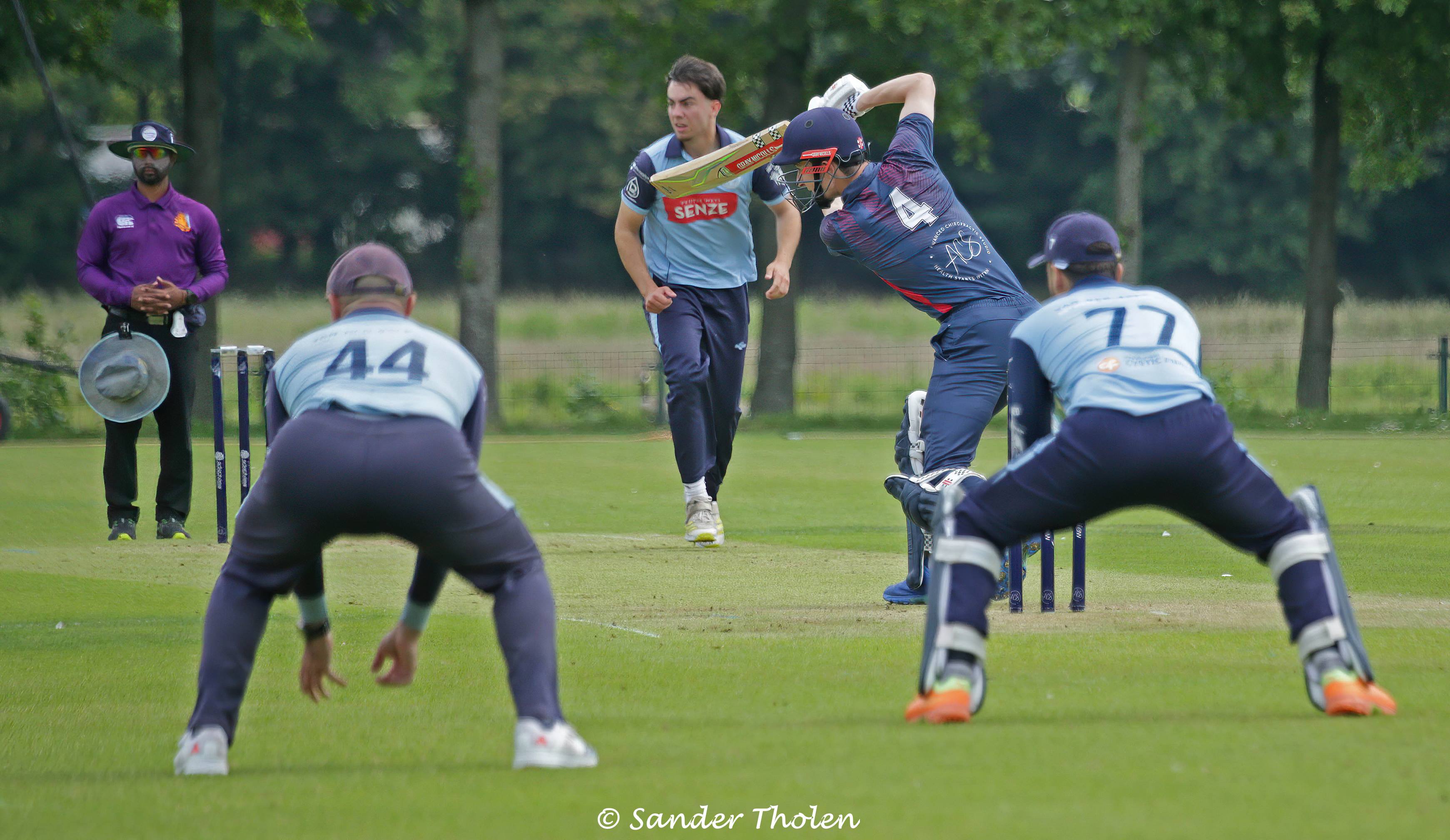
RL: There are several outstanding candidates here, not least Voorburg’s Cedric de Lange, whose run of big scores at the start of the campaign earned him a spot in the national team for the League 2 series in Canada; he finished with 574 at 52.18 and is fifth in the overall aggregates. We also can’t ignore another left-hander in Rotterdam’s Musa Ahmad: his 638 runs at 49.08 played a vital part in his side’s taking the title, and their phenomenal run of big totals. If we’re looking for a right-hander to pair with one of them, then we should certainly look at Tonny Staal (HCC), who quietly accumulated 493 runs at 41.08, or indeed Musa’s opening partner Shoaib Minhas, with 468 at 36.00. Then there’s David Rushmere (Hermes-DVS), a feast-or-famine specialist: 454 of his 591 runs came in three innings, but there’s no denying his destructive abilities once he’s set. The coward’s way out would be to open with Musa and Staal (or Rushmere) and bat De Lange at three, but that reduces the scope for picking the top order in a remarkably run-heavy season.
Cedric de Lange
Cedric de Lange

BdJ: It has indeed been a season heavily dominated by bat over ball, though arguably as much a personnel issue as a reflection of conditions, two of last season’s three lead wicket-takers subbed out for batting acquisitions, though certainly the turf wickets have tended toward the batting-friendly too. Nonetheless the success of young Dutch-produced batting talent this season has been remarkable, and few have enjoyed better season’s than de Lange, who was racking up tons like it was going out of style for the first few rounds. His efforts earned him an ODI debut in the least hospitable conditions one can encounter in International cricket, and though his courageous showing in the pits of King City aren’t factored into our selection policy for this exercise, de Lange’s place at the top of the order is an easy pick. Ahmad’s claim is almost as strong, and indeed he outscored de Lange in aggregate over the season, in part due to being overlooked by the selectors. His 638 runs at a shade under 50, accumulated over the course of more than 24 hours at the crease, were the foundation upon which the record-breaking, championship-winning Rotterdam batting basilica was built. It’s difficult to make a case to displace either from the top of the order, though Staal certainly warrants and honourable mention, his understated return to form playing a big part in HCC keeping in touch with the top of the table until the final weekend. VRA’s Vikram Singh also had an excellent (albeit abbreviated) season with the bat, if somewhat overshadowed by his own efforts with the ball. 368 runs at 46 across the eight games he played was a fine return at the top, but not enough to challenge the incumbents. He’ll have a stronger case to press further down the page of course, but one can afford perhaps to disturb him from his preferred position on the batting card.

Top order

BdJ: First drop is a more closely contested position with a handful of bats doing fine work in the role across the season. None have done better than Gavin Kaplan, who struck two fifties and two tons across the six innings he played for Voorburg, but his abbreviated season probably excludes him. Of regular number threes there’s little to separate Lehan Botha, Johan Smal and Asif Gondal – the former two both passing 500 runs for the season, the latter missing that milestone by five runs though he does have a champion’s medal weighing in his favour. Smal’s forced foray into bowling owing to Singh’s absence and injury does work in his favour there though, going at a shade over fours in a high-scoring season no mean feat for a part-timer. Kampong’s Scott Edwards also has a brace of centuries from number three and his place at the top of the aggregates alongside Musa Ahmad assures him a spot somewhere in the line-up, though he’s generally been flexible about where exactly he comes in. Rotterdam’s Mohsin Riaz has rather less competition at four, though Kent Goedeke accumulated more runs across the season his top score came at five. Saqib Zulfiqar also has a strong claim to the number five slot however, the majority of his 528 runs coming at that position and his extraordinary strike rate of more than eight an over arguing strongly in his favour.

RL: I’d want to add to that list Lucas del Bianco of HBS, who probably did as much as anybody to keep the Crows in the top flight for another year: his 573 runs at 71.63 included seven fifties in just 12 innings. He is, moreover, a remarkable utility player, having broken into the side as a keeper, but increasingly slotting into the attack. He’s batted at five or six this year, and I reckon there’s a strong case, given the number of batting allrounders on offer, that we can extend our top order at least to number six. There really is very little to choose between Smal, Botha and Gondal, all of whom probably have a stronger case than Riaz, although his storming finish to the campaign put the icing on Rotterdam’s victory cake. So my four would be Smal, Gondal, Saqib and Del Bianco, with Edwards picked as keeper – a role he has seldom played for Kampong this season – and batting at seven.

Bowling

RL: Given that six of the top seven bowled more or less regularly during the 50-over season, though rarely if ever a full quota of overs, we can perhaps reasonably restrict our selection of specialist bowlers to four. Averaging 12.48 for each of his 23 wickets until injury put him on the sidelines, Vikram Singh was a dominant force for VRA in the first half of the season, and really does demand to be given the new ball, even if it would mean his batting, as Bertus signalled earlier, in a somewhat unfamiliar role. But can you imagine a more intimidating number eight? His partner should probably be Voorburg’s Jaynul Islam, who despite playing only ten matches finished with the most wickets, 28, at an average of 16.79. Josh Brown and Daniel Crowley both did sterling service for HCC, taking 25 and 19 wickets respectively, while Justin Trijzelaar had a better economy rate than either of them and deserves at least an honourable mention. Another of the up-and-coming brigade is Joris van Oosterom of HBS, whose best deliveries are capable of dismissing the best batters. If we’re looking for a third seamer, and we probably should be, then my nod would go to Crowley out of those candidates. Among the spinners, given that we already have several options among the top order, the chief claimants are probably Rotterdam’s Ahmed Shafiq, Sahil Kothari of Hermes-DVS, and Pierre Jacod of Kampong. Again, there’s little to separate them, but Shafiq’s contribution to his side’s title probably gives him the edge; genuine allrounder Jacod would be a strong contender for the twelfth man role.

Vikram Singh
Vikram Singh

BdJ: Zulfiqar looks a lock for the spin all-rounder slot, and with de Lange and Ahmad able to chip in there’s perhaops even a case to do without a second spinner. Shafiq probably has the strongest case as specialist slow bowler, aided by his outstanding 13 outfield catches across the competition, though Jacod’s all-round season does make him tough to leave out. A mention at least should also be made here of the evergreen Lorenzo Ingram, who took just six wickets this summer but was the only frontline bowler to go at under 3.5 an over in what’s been a remarkably high-scoring season, while Aryan Dutt’s 15 wickets at an economy of a shade over 4s is also worth acknowledgement in this context. It’s on grounds of economy and average too that I’d be minded to give the nod to Trijzelaar over Crowley or Brown, being the only frontline seamer to go at under fours this season, and his 18 wickets also coming at an average of under 20. It’s worth pointing out here that Kampong’s Shashank Kumar took as many wickets at a better average and at an economy rate barely over four, but the deciding factor for mine is that Trijzelaar has tended to bowl first change or later, a role for which there is comparatively little competition among the options above. In a season where bat has dominated over ball, anyone who can keep the scoring rate contained through the middle is an invaluable asset.

A strong showing for home-grown talent and long-time stalwart this season means we can be fairly confident of meeting any restrictions one might car to pick this year, but leaving the question of totalling up the exact points value as an exercise for the reader, here’s TKcricket’s 2026 Topklasse Team of the Year:

Cedric de Lange (VCC), Musa Ahmad (RCC), Johan Smal (VRA), Lehan Botha (HBS), Saqib Zulfiqar (RCC), Lucas Del Bianco (HBS), Scott Edwards (Kampong), Vikram Singh (VRA), Ahmed Shafiq (RCC), Justin Trijzelaar (HCC), Jaynul Islam (VCC)
12th man: Pierre Jacod (Kamping)

Topklasse Team of the Year 2024

Rod Lyall & Bertus de Jong 04/09/23

So, that time rolls round again when we at TKcricket nominate our Topklasse Team of the Year. It’s all a bit different this year, since the influx of overseas players recruited by the clubs changed the character of the competition (once again, we’re only concerned here with the 50-over version) to a significant degree.

RL: Whatever the clubs may have done, I think we should confine our choice of overseas players to two, as we have done in the past. There is, of course, a large field to choose from, but for my money the first name on the sheet has to be that of Voorburg’s Gavin Kaplan, who went past fifty no fewer than seven times in just ten innings in compiling his 701 runs, going on to three figures on four of those occasions. Add to that the fact that he proved a useful change bowler, and his selection is a no-brainer. The second overseas is trickier: pace spearheads Jason Ralston (Excelsior) and Cameron Fraser (Sparta) claimed 38 and 29 wickets respectively for teams in the lower reaches of the table. Ralston has a strong claim, but my choice would probably be ACC’s Izhaan Sayed, who not only had the knack of grabbing early wickets but also topped his struggling side’s batting averages.

BdJ: While I do appreciate the high-minded sentiment on the overseas question, I’d be inclined to take a Jeffersonian approach and stylishly swim with the current on this one rather than risk principled petrification. With the influx of overseas showing no signs of slowing, if we stick to our guns here we may struggle to even pick a competitive XI in a few seasons’ time. Close to half the players in the competition already hail from abroad, accounting for more than half the runs and wickets this season, so I say who are we to blow against the wind?

Nowhere is that case more convincing than at the top of the batting card. The majority of clubs went with overseas at the top of the order this season, and of Dutch-produced or Netherlands-qualified players nobody averaged over 30 opening the batting. VCC’s Michael Levitt was the best of a bad bunch with 260 runs at 28.9, a disappointing season by his own standards, followed by HCC’s Tonny Staal with 300 runs at 27.3. If one had to pick an opening pair from among the local players one would probably go for Vikram Singh and Musa Ahmad, though both had more consistent success down the order. Ahmad’s sometime opening partner and near-permanent fixture in Dutch club cricket Shoaib Minhas arguably has a stronger case for his efforts against VRA alone, hitting the match-winning century in the first qualifying semi at the Zomercomplex that secured a home final and two half centuries against the same opposition earlier in the season making sure would be played there in the first place. Jonathan Vandiar also deserves a mention as an occasional opener albeit a committed overseas, and it’s notable that Punjab are the only side with two bats in the 500-club this season. Hermes’ overseas opening combo of Ashley Ostling and Daniel Doyle Calle were the most prolific pairing at the top of the order this season, Ostling the only opener to hit 500 runs from the top of the order during the League Phase.

RL: I can’t argue with m’colleague’s analysis of the problem, but my view is pragmatic as well as ‘high-minded’: if the competition continues on its present course, it will become almost impossible to produce young Dutch players capable of holding their own on the international stage. The clubs were unhappy when the Dutch-produced contingent in the national side withered to one or two, and it’s true that some progress has been made under the two Ryans (Campbell and Cook) to restore the balance. It’s really a topic for a different discussion, but I am personally convinced that the KNCB will need to act to curb the current arms race. That way, madness lies.

Another structural problem, of course, is that some of the leading players were absent for much of the second phase, so averages are probably a better guide to performance than aggregates. I’d certainly want to go with Musa Ahmad (420 at 30.00) as one of the openers, and Singh’s 367 at 40.78 make him a credible partner, even if neither of them had the sort of season they might have wanted.

As for the rest of the top order, if we have Kaplan at three, there are three more places available in the top six, or perhaps four, depending on what we decide about a keeper. Punjab’s Saqib Zulfiqar, for instance, finished seventh in the averages behind six overseas players, and his 326 runs at 46.57 give him a strong claim. He would slot in well at four, while I’d be inclined to include Voorburg’s Noah Croes (466 at 38.83) at five, thus filling the wicketkeeping spot at the same time. That would leave room for two more batters, or batting allrounders (it’s notable that apart from Croes, all the Dutch-qualified players we’ve named so far are more than useful change bowlers). The leading contenders would be Shariz Ahmad (VRA, 331 at 41.38) and Ryan Klein (Voorburg, 356 at 39.56), both of whom have greatly improved their batting and have played crucial innings for their sides.

BdJ: While I’m inclined to agree that Something Must Be Done about the proliferation of overseas players in the league, I still feel our Team of the Year ought to reflect the competition as it is rather than as we’d like it to be. Perhaps as a compromise we could make room for those overseas now permanently based in the Netherlands and intent qualifying for the national side. That would allow us to pick the soon-to-be-Dutch-eligible Tayo Walbrugh, whose 596 runs for HBS at an average of almost 60 make him a strong runner-up to Kaplan in the batting stakes this season. A case might also be made for VRA stand-in skipper Johan Smal, who missed out on the 500 club by just five runs and was indispensable to his side’s making their run to the final despite Teja Nidamanuru’s season-ending injury early in the summer and the regular absences of Singh, Ahmad and Floyd.

Johan Smal

Croes has little competition for the keeper slot, with none of the other glovemen in the league coming close to matching his 466 runs. Nonetheless some honourable mentions can be made, Luke Scully did some fine work in the handful of games he played for VRA 1s this season, averaging 44.3 across 4 innings in the Topklasse as well as playing a crucial role in the second team’s successful promotion campaign in the Eersteklasse. In terms of pure glovemanship, it’s worth noting that Sparta’s Riley Mudford gave up just three byes over the course of the season, even if he wasn’t able to replicate his short-format form with the bat. HCC’s Yash Patel also had a fine season behind the poles, effecting five stumpings and taking 21 catches to top the dismissal tally table.

RL: An hon. ment. also for Fawad Shinwari, whose 27 victims in 14 matches took him to the top of list and helped Punjab to their title. He also raises the thorny question of where Belgian-based players fit into our discussion of the overseas issue.

Whether or not we agree that Shariz and Saqib earn a place as allrounders, both have a strong claim as wrist-spinners, especially the former, whose 21 wickets at 21.52 may have been a smaller tally than last year but came from just 14 matches. Not many slow bowlers feature prominently in the averages, but Mahesh Hans (ACC) and Leon Turmaine (VRA) both averaged a shade over 16, the latter once he’d forced his way back into the first team. Neither, perhaps, has an overwhelming claim, but if we really wanted to include a finger spinner both could be relied upon to produce a decent performance.

BdJ: It has indeed been a remarkably lean summer for the slow-bowlers, with seamers occupying the first eight spots on the wicket-taking table, with Ahmad’s 21 the best tally for a spinner. The indefatigable Lorenzo Ingram was the only finger spinner to break 20 wickets this season, though six of those came in succession running through a hapless Sparta lower order. With two slow bowlers already penciled in on the strength of their batting, I’d be inclined to make room for an extra quick given the weight of wickets this season has heavily favoured them.

On that front it’s hard to look past Jason Ralston’s 38 for Excelsior, whose 14-wicket lead over Cameron and Sayed outweighs the latters’ ability to chip in an average 20-odd runs in my book. Among Dutch and Dutch-qualified seamers the stand-out this season was newcomer Ben Fletcher with 29 wickets at under 15 for VRA, the tall left armer already attracting the attention of national selectors. Hermes’ Ralph Elenbaas also had an excellent season, eclipsing his more-celebrated brother with 25 wickets at 15.4. Sajjad Kamal also enjoyed a fine first season for Punjab picking up 24 scalps, though they came at a comparatively hefty price in terms of runs conceded. Mees van Vliet, charged with leading the VCC attack while national duty or injury kept Kingma and Klein out of the side, is next on the wicket-taking table with 23 across 16 matches, but was similarly expensive, going at an economy rate of 5.65 an over. If one were to prize miserliness over penetration in our second seamer three names jump out. The first is that of Ryan Klein, who sent down 48 overs at the cost of just 142 runs, but then of course he spent much of the season bowling off-spin rather than his usual medium pace. HCC’s Adam Leonard was the most economical of the dedicated quicks, his 19 wickets coming at 16.9 runs apiece at the rate of 3.4 per over.The last is that of last year’s TK Team of the Year skipper Martijn Snoep, who had another quietly effective season for his side picking up 18 wickets at 16.4 while going at 3.5 an over.

RL: That about covers the field, I reckon. A shout-out, though, for Kyle Klein of HBS, who claimed 18 wickets despite playing only seven matches, at an economy rate of 4.05. And in a season in which young home-grown players had regrettably few opportunities, or who seemed to have gone backwards when they did, two young seamers who enhanced their reputations were Aaditt Jain and Roman Harhangi of VOC. I still have a strong preference for picking Dutch (or at least Dutch-qualified) players over out-and-out incomers, which would lead me to give the nod to Fletcher – who also offers the bonus of being a left-armer – and Elenbaas minor over the rest of the contenders. That gives us three front-line seamers plus the incidental contributions of Kaplan and Singh, and two spinners.

Plenty of bowling, so we can afford to go back and add one more batter. Here the choice lies between adding an opener, who would have to be an overseas like Punjab’s Shoaib Minhas (see above), and including another batting allrounder, which which case the strongest claim is arguably that of Ryan Klein.

As for the captaincy, the only regular captains we’ve included are Croes and Walbrugh, and for my money the nod should go to the former, who led Voorburg with authority whenever he was available.

BdJ: The matter of the armband is a tricky question this year, with several clubs switching captains through the season and few full-time skippers having stand-out seasons. The field-promoted captain Smal is the notable was the notable exception there, probably the unluckiest to miss the cut this year and would have taken the armband too had he made it into the XI. But I’d agree that Croes is a sound second choice to lead our 2024 TK Topklasse Team of the Year…

The Team: Musa Ahmad (Punjab-Ghausia), Vikram Singh (VRA), Gavin Kaplan (Voorburg), Noah Croes (Voorburg), Tayo Walbrugh (HBS Craeyenhout), Saqib Zulfiqar (Punjab-Ghausia), Shariz Ahmad (VRA), Ryan Klein (Voorburg), Ralph Elenbaas (Hermes-DVS), Ben Fletcher (VRA), Jason Ralston (Excelsior ’20).

Previous TOTYs 2023| 2022 | 2021 | 2020 | 2019 | 2018