News

Topklasse to return to eight teams from 2026

Bertus de Jong 18/01/2025


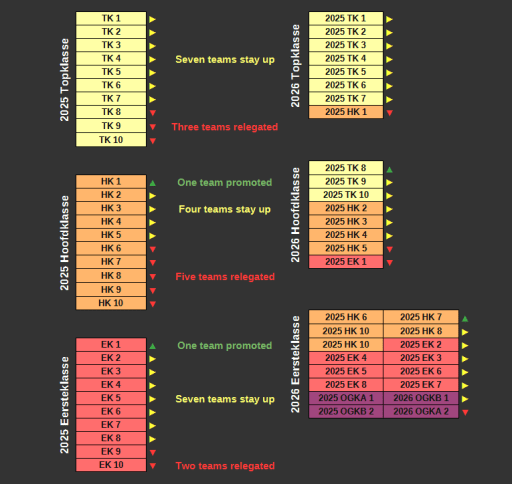
The KNCB today confirmed a substantial overhaul of the Dutch domestic one-day competition structure, with both the Topklasse and Hoofdklasse to return to an eight-team divisional league format from 2026 onwards.

The coming 2025 edition will dispense with the play-off system, reverting to a simple double round robin format, with the ten teams playing each other home and away. At the end of the season the bottom three Topklasse teams will be relegated, with the Hoofdklasse champions promoted to join the remaining seven for an 8-team competition in 2026. The crowded calendar precludes the possibility of a finals day or relegation play-off, meaning both the title and promotion/relegation will be directly determined by the final standings on the table. Similarly, the crowded schedule leaves no room for replays or reserve days during the competition.

The Hoofdklasse will likewise be returning to an 8-team format from 2026, with the consequence that no less than five teams will face relegation to the Eersteklasse at the end of the 2025 season, while the 2025 Eersteklasse champions will join the three relegated Topklasse sides and the four surviving Hoofdklasse sides for the 2026 Hoofdklasse season. As with the top division, there is no provision for a relegation play-off.

Conversely the Eersteklasse will be expanding from the current 10-team format to a two-pool 16-team leaguev (similar to the current Overgangsklasse) from 2026 onwards. The champion of the 2025 edition, also played as a straight ten-team double round robin, will win promotion to the 2026 Hoofdklasse, while the bottom two sides will be relegated to the Overgangsklasse, the latter to be renamed “Tweedeklasse”. A similar numerical naming scheme is to be applied to lower leagues, which remain otherwise unchanged.

The one-day season for 2025 is set to begin on the 26th of April and run until the 6th of August, with matches again played on Saturdays until the switch to Sundays in mid-July. The T20 competitons look broadly similar in format to last season, albeit switch to the other end of the Summer, commencing on August 13th and culminating in a finals day a month later.

The points system and the finals

Robert Vermeulen

21/11/2024


In May I posted an article about the delicate future of our beloved Game in The Netherlands. The vast majority of the feedback I received was positive. In this polarised digital world and a quite tribal Dutch cricket community, that is a remarkable thing. It stands to reason that there are several ways to solve the issue I tried to address. The most important thing is that we acknowledge the problem and try to formulate a strategy to face it.

You might think that I, as a lawyer, would propose strict rules and regulations. That is only partly true. Sure, I salivate by the thought of drafting such documents, but rules are more effective if they are broadly supported, are seen as ‘obvious’ and, finally, reflect an internal moral belief. The reason one does not steal is -hopefully- not that it is illegal, but that is ‘not right’. It goes against your moral fabric and would make your mother very very disappointed in you.

Breaking the trend

A rough estimate by ‘those-in-the-know’ is that we collectively, as clubs, might have spent as much as half a million Euro’s this year on players. If true, and I am afraid it might be, that is a shocking amount of money. At best one would hope that this money was spent on a lot of junior coaching hours…. if there were any juniors to coach.

I would suggest that it is time to start the (long) process towards addressing our unhealthy habits that have crept into our top leagues. We must stop spending resources on things that not evidently ensure the long term survival of the Game as a whole. A club will truly survive a relegation. Trust me, I have been there. Healthy clubs that invest in their home-grown stock and the health of their own club organisation and culture, will survive and return. Take VCC as an example, they went through a major lean patch some years ago but now they were (again) in contention for a championship. Good on them!

Only if the club does not have a strong foundation, the players might move on. That is the risk of those clubs who are ‘a bank account with a first team’. Mercenaries follow the money.

If we are to survive, a collective action is needed to stop ‘stupid money’ and encourage ‘smart money’. In my very humble opinion, a points based system as suggested by me in May, would stimulate that and see to it that clubs are forced to make the right choices. We must break the arms-race.

Let’s have a look at our semi-finalists in the Topklasse of this year: Punjab Ghausia (Punjab), VRA, VCC and HCC.

When I speak of local players, I mean those players that are either home-grown players or are players that are here for other reasons than cricket. This last group are those that moved here for work, study or other non-cricket related reasons like marriage/relationships/family reunion or refugee status. Home-grown players are players that learned their cricket here. Overseas players are players whose main reason for being in The Netherlands is to play cricket.

In this piece I will add the distinction between home-grown players by the club itself and home-grown players that came from other clubs. Why keep things simple?

Semi-finalists

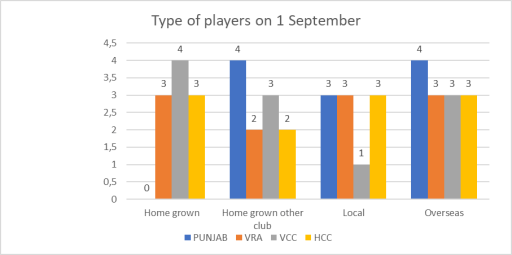
On 1 September 2024 I partly watched VCC 1 beat my beloved HCC 1. No complaints there: they were the better side, especially on the day. If one breaks down the makeup of the teams, HCC fielded 3 home-grown HCC players, 2 home-grown players that moved from other clubs, 3 local players (players who live here but are not home-grown) and 3 overseas players. VCC fielded 4 home-grown VCC players, 3 home-grown players that moved from other clubs, 1 local player and 3 overseas players. The home-grown players on a whole were quite influential, so cheers all round!

Punjab, a powerhouse in the last years, was in the Grand Final. Again, good on them. VRA had a sniff at victory but fell just short. A breakdown of these teams is as follows. Punjab fielded 0 home-grown Punjab players, 4 home-grown players that moved from other clubs, 3 local players (if Belgium is deemed local / plus a player I could not place in the other columns) and 4 overseas players. VRA fielded 3 home-grown VRA players, two home-grown players that moved from other clubs, 3 local players and 3 overseas players.

The differences between the clubs are not extreme.

The main reason Punjab does not have Punjab home-grown players is their recent rapid rise to prominence. Their efforts in junior cricket will reap benefits in due time. VCC fielded 4 VCC home-grown players on Sunday and 3 home grown players that came over from other clubs (two HCC raised and one ACC). 7 home grown players in total. Well done. Fair play!

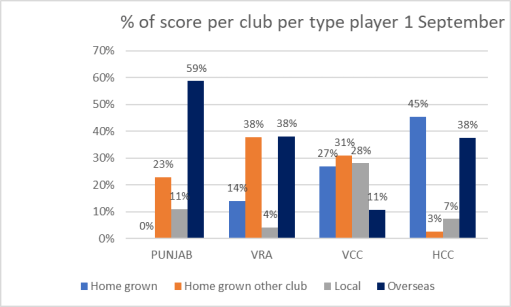
Breakdown of relative influence of types of players in last Sunday’s games:

This is only one game but it should be interesting to make a broad analysis over the whole season. Certain retired CBS statisticians might be interested to have a go at this…

Second teams

In the Eerste Klasse VRA 2 beat Punjab 2 in the Grand Final. Punjab 2 beat HCC 2 in the semifinal. The fact that all-but-one player in HCC 2 are HCC home-grown players, delights me. They beat Qui Vive 1 in the elimination final and are clearly a tight group that have a boat load of fun together. That is what it is all about.

VCC 2 might have relegated to the Eerste Klasse, but that might only be healthy for the team as a whole so that they can rebuild and play at a level that might be more fun for younger players. I would say that VCC and HCC, for now, have a bright future. The strength of VRA 2 and Punjab 2 is very promising as well, albeit that the latter team contains not a lot of home-grown players and even overseas players.

The point that I am trying to make here is that the second teams of all the semi-finalists in the Topklasse are vibrant as well. That shows a broader basis of playing talent than just the flagship team. These second teams are usually not stacked with ringers, albeit that they might have potential first team players that were pushed out by overseas players acquired for the first team. If you would add to that picture the line up of these clubs in the U17 and U15 leagues, these Topklasse semi-finalists are largely healthy clubs. They are not an empty shell.

Points system

field competitive teams with the back up of strong second elevens and talented youth. VCC survived a drain from the Dutch XI and pro’s leaving home by fielding a slew of home-grown players; so did VRA. Again, cheers all around. The four finalists had enough depth in their selection to fill the gaps.

I would say all potential champions this year were clubs with a role to play in the future of our local Game.

If we would be able to reduce the amount (and influence) of overseas players in these (and other) teams, the further development of home-grown players could be stimulated and create a more level playing field for all clubs with good intentions. I am sure that these four clubs would support that idea (as they live in relative luxury). Others might be more reluctant, but it has to be done!

Clubs have limited resources that could and should be used wisely. The club members should demand transparency from their committees regarding the finances surrounding players. Depending on sugar daddies and non-recurring donations (even in kind) is no basis for long term policy. If they suddenly leave, you are done for.

The introduction of a points system results in a reduction of overseas players, this would reduce the need to spend money on everything surrounding overseas players and could free up resources for other, more productive, causes.

I hope that this autumn and winter will provide us with ample time to develop ideas to improve the future of or local Game.

Topklasse Team of the Year 2024

Rod Lyall & Bertus de Jong 04/09/23

So, that time rolls round again when we at TKcricket nominate our Topklasse Team of the Year. It’s all a bit different this year, since the influx of overseas players recruited by the clubs changed the character of the competition (once again, we’re only concerned here with the 50-over version) to a significant degree.

RL: Whatever the clubs may have done, I think we should confine our choice of overseas players to two, as we have done in the past. There is, of course, a large field to choose from, but for my money the first name on the sheet has to be that of Voorburg’s Gavin Kaplan, who went past fifty no fewer than seven times in just ten innings in compiling his 701 runs, going on to three figures on four of those occasions. Add to that the fact that he proved a useful change bowler, and his selection is a no-brainer. The second overseas is trickier: pace spearheads Jason Ralston (Excelsior) and Cameron Fraser (Sparta) claimed 38 and 29 wickets respectively for teams in the lower reaches of the table. Ralston has a strong claim, but my choice would probably be ACC’s Izhaan Sayed, who not only had the knack of grabbing early wickets but also topped his struggling side’s batting averages.

BdJ: While I do appreciate the high-minded sentiment on the overseas question, I’d be inclined to take a Jeffersonian approach and stylishly swim with the current on this one rather than risk principled petrification. With the influx of overseas showing no signs of slowing, if we stick to our guns here we may struggle to even pick a competitive XI in a few seasons’ time. Close to half the players in the competition already hail from abroad, accounting for more than half the runs and wickets this season, so I say who are we to blow against the wind?

Nowhere is that case more convincing than at the top of the batting card. The majority of clubs went with overseas at the top of the order this season, and of Dutch-produced or Netherlands-qualified players nobody averaged over 30 opening the batting. VCC’s Michael Levitt was the best of a bad bunch with 260 runs at 28.9, a disappointing season by his own standards, followed by HCC’s Tonny Staal with 300 runs at 27.3. If one had to pick an opening pair from among the local players one would probably go for Vikram Singh and Musa Ahmad, though both had more consistent success down the order. Ahmad’s sometime opening partner and near-permanent fixture in Dutch club cricket Shoaib Minhas arguably has a stronger case for his efforts against VRA alone, hitting the match-winning century in the first qualifying semi at the Zomercomplex that secured a home final and two half centuries against the same opposition earlier in the season making sure would be played there in the first place. Jonathan Vandiar also deserves a mention as an occasional opener albeit a committed overseas, and it’s notable that Punjab are the only side with two bats in the 500-club this season. Hermes’ overseas opening combo of Ashley Ostling and Daniel Doyle Calle were the most prolific pairing at the top of the order this season, Ostling the only opener to hit 500 runs from the top of the order during the League Phase.

RL: I can’t argue with m’colleague’s analysis of the problem, but my view is pragmatic as well as ‘high-minded’: if the competition continues on its present course, it will become almost impossible to produce young Dutch players capable of holding their own on the international stage. The clubs were unhappy when the Dutch-produced contingent in the national side withered to one or two, and it’s true that some progress has been made under the two Ryans (Campbell and Cook) to restore the balance. It’s really a topic for a different discussion, but I am personally convinced that the KNCB will need to act to curb the current arms race. That way, madness lies.

Another structural problem, of course, is that some of the leading players were absent for much of the second phase, so averages are probably a better guide to performance than aggregates. I’d certainly want to go with Musa Ahmad (420 at 30.00) as one of the openers, and Singh’s 367 at 40.78 make him a credible partner, even if neither of them had the sort of season they might have wanted.

As for the rest of the top order, if we have Kaplan at three, there are three more places available in the top six, or perhaps four, depending on what we decide about a keeper. Punjab’s Saqib Zulfiqar, for instance, finished seventh in the averages behind six overseas players, and his 326 runs at 46.57 give him a strong claim. He would slot in well at four, while I’d be inclined to include Voorburg’s Noah Croes (466 at 38.83) at five, thus filling the wicketkeeping spot at the same time. That would leave room for two more batters, or batting allrounders (it’s notable that apart from Croes, all the Dutch-qualified players we’ve named so far are more than useful change bowlers). The leading contenders would be Shariz Ahmad (VRA, 331 at 41.38) and Ryan Klein (Voorburg, 356 at 39.56), both of whom have greatly improved their batting and have played crucial innings for their sides.

BdJ: While I’m inclined to agree that Something Must Be Done about the proliferation of overseas players in the league, I still feel our Team of the Year ought to reflect the competition as it is rather than as we’d like it to be. Perhaps as a compromise we could make room for those overseas now permanently based in the Netherlands and intent qualifying for the national side. That would allow us to pick the soon-to-be-Dutch-eligible Tayo Walbrugh, whose 596 runs for HBS at an average of almost 60 make him a strong runner-up to Kaplan in the batting stakes this season. A case might also be made for VRA stand-in skipper Johan Smal, who missed out on the 500 club by just five runs and was indispensable to his side’s making their run to the final despite Teja Nidamanuru’s season-ending injury early in the summer and the regular absences of Singh, Ahmad and Floyd.

Johan Smal

Croes has little competition for the keeper slot, with none of the other glovemen in the league coming close to matching his 466 runs. Nonetheless some honourable mentions can be made, Luke Scully did some fine work in the handful of games he played for VRA 1s this season, averaging 44.3 across 4 innings in the Topklasse as well as playing a crucial role in the second team’s successful promotion campaign in the Eersteklasse. In terms of pure glovemanship, it’s worth noting that Sparta’s Riley Mudford gave up just three byes over the course of the season, even if he wasn’t able to replicate his short-format form with the bat. HCC’s Yash Patel also had a fine season behind the poles, effecting five stumpings and taking 21 catches to top the dismissal tally table.

RL: An hon. ment. also for Fawad Shinwari, whose 27 victims in 14 matches took him to the top of list and helped Punjab to their title. He also raises the thorny question of where Belgian-based players fit into our discussion of the overseas issue.

Whether or not we agree that Shariz and Saqib earn a place as allrounders, both have a strong claim as wrist-spinners, especially the former, whose 21 wickets at 21.52 may have been a smaller tally than last year but came from just 14 matches. Not many slow bowlers feature prominently in the averages, but Mahesh Hans (ACC) and Leon Turmaine (VRA) both averaged a shade over 16, the latter once he’d forced his way back into the first team. Neither, perhaps, has an overwhelming claim, but if we really wanted to include a finger spinner both could be relied upon to produce a decent performance.

BdJ: It has indeed been a remarkably lean summer for the slow-bowlers, with seamers occupying the first eight spots on the wicket-taking table, with Ahmad’s 21 the best tally for a spinner. The indefatigable Lorenzo Ingram was the only finger spinner to break 20 wickets this season, though six of those came in succession running through a hapless Sparta lower order. With two slow bowlers already penciled in on the strength of their batting, I’d be inclined to make room for an extra quick given the weight of wickets this season has heavily favoured them.

On that front it’s hard to look past Jason Ralston’s 38 for Excelsior, whose 14-wicket lead over Cameron and Sayed outweighs the latters’ ability to chip in an average 20-odd runs in my book. Among Dutch and Dutch-qualified seamers the stand-out this season was newcomer Ben Fletcher with 29 wickets at under 15 for VRA, the tall left armer already attracting the attention of national selectors. Hermes’ Ralph Elenbaas also had an excellent season, eclipsing his more-celebrated brother with 25 wickets at 15.4. Sajjad Kamal also enjoyed a fine first season for Punjab picking up 24 scalps, though they came at a comparatively hefty price in terms of runs conceded. Mees van Vliet, charged with leading the VCC attack while national duty or injury kept Kingma and Klein out of the side, is next on the wicket-taking table with 23 across 16 matches, but was similarly expensive, going at an economy rate of 5.65 an over. If one were to prize miserliness over penetration in our second seamer three names jump out. The first is that of Ryan Klein, who sent down 48 overs at the cost of just 142 runs, but then of course he spent much of the season bowling off-spin rather than his usual medium pace. HCC’s Adam Leonard was the most economical of the dedicated quicks, his 19 wickets coming at 16.9 runs apiece at the rate of 3.4 per over.The last is that of last year’s TK Team of the Year skipper Martijn Snoep, who had another quietly effective season for his side picking up 18 wickets at 16.4 while going at 3.5 an over.

RL: That about covers the field, I reckon. A shout-out, though, for Kyle Klein of HBS, who claimed 18 wickets despite playing only seven matches, at an economy rate of 4.05. And in a season in which young home-grown players had regrettably few opportunities, or who seemed to have gone backwards when they did, two young seamers who enhanced their reputations were Aaditt Jain and Roman Harhangi of VOC. I still have a strong preference for picking Dutch (or at least Dutch-qualified) players over out-and-out incomers, which would lead me to give the nod to Fletcher – who also offers the bonus of being a left-armer – and Elenbaas minor over the rest of the contenders. That gives us three front-line seamers plus the incidental contributions of Kaplan and Singh, and two spinners.

Plenty of bowling, so we can afford to go back and add one more batter. Here the choice lies between adding an opener, who would have to be an overseas like Punjab’s Shoaib Minhas (see above), and including another batting allrounder, which which case the strongest claim is arguably that of Ryan Klein.

As for the captaincy, the only regular captains we’ve included are Croes and Walbrugh, and for my money the nod should go to the former, who led Voorburg with authority whenever he was available.

BdJ: The matter of the armband is a tricky question this year, with several clubs switching captains through the season and few full-time skippers having stand-out seasons. The field-promoted captain Smal is the notable was the notable exception there, probably the unluckiest to miss the cut this year and would have taken the armband too had he made it into the XI. But I’d agree that Croes is a sound second choice to lead our 2024 TK Topklasse Team of the Year…

The Team: Musa Ahmad (Punjab-Ghausia), Vikram Singh (VRA), Gavin Kaplan (Voorburg), Noah Croes (Voorburg), Tayo Walbrugh (HBS Craeyenhout), Saqib Zulfiqar (Punjab-Ghausia), Shariz Ahmad (VRA), Ryan Klein (Voorburg), Ralph Elenbaas (Hermes-DVS), Ben Fletcher (VRA), Jason Ralston (Excelsior ’20).

Previous TOTYs 2023| 2022 | 2021 | 2020 | 2019 | 2018

Things aren’t always what they seem

Rod Lyall 20/09/24

‘I saw it on TV!’ is a phrase which is likely to go down in history as a monument to the unreliability of what we see in these days of AI, and the growing body of ‘alternative facts’ with which we are increasingly surrounded.

Not everything we see on the screen, whether on television or a computer, can necessarily be taken at face value, and journalists have an obligation to try to distinguish the apparent from the real, and to tell their story as accurately as they can.

So this is by way of being a ‘mea culpa’, an acknowledgement that my first reaction to the regrettable if brief events which followed the Topklasse grand final between Punjab-Ghausia and VRA Amsterdam last Saturday did not do sufficient justice to the complexity of what took place, in those moments and in the hours which preceded them.

As I write this, I am conscious not only of the fact that what I have to go on is mostly images from a live stream, a single camera situated at some distance from the events, but also that the whole issue is  in a certain sense sub judice, in that the KNCB has disciplinary procedures which need to be allowed to run their course.

Not to mention the laws of defamation, which require one to be extremely careful in what one says about any individual.

Like the semi-final between the same two teams two weeks earlier, the grand final was a hard-fought, tense battle which went all the way down to the wire.

Unlike the semi-final, however, this was something of a gala event, with VIP tents, music, and a relatively large crowd of supporters.

It was also a game of fluctuating fortunes, VRA fighting back towards the end of their innings with a fine knock from Shariz Ahmad, and Punjab needing nearly eight an over from the last seven with six wickets down.

The hosts’ sensational victory with two deliveries to spare was a tribute to their resilience, and it came as a huge relief to their supporters and as an equally great disappointment to the visitors.

Which doubtless goes a long way towards explaining what happened afterwards, although it cannot be said to justify it.

The Spirit of Cricket preamble to the Laws and the Code of Conduct are there to ensure a fair and respectful contest, and it is the task of the onfield umpires to ensure that that is how the game is played.

And the match referee and the KNCB’s disciplinary procedures are there to take appropriate action should further measures prove necessary, as I remain convinced they are following those regrettable scenes.

What I do feel obliged to do, however, is to acknowledge that by initially focusing on  one side of the case I gave too much emphasis to the crowd’s invasion of the ground immediately following the conclusion of the game, and too little to the tensions which had built up in the course of the day.

Edwards and Chaturvedi steer Kampong into the Topklasse

Rod Lyall 15/09/24

Kampong Utrecht will be playing Topklasse cricket next season, having won the Hoofdklasse grand final against Quick Haag on Saturday in one of the most extraordinary matches of this or any other season.

Put in to bat by Quick captain Jeroen Brand, Kampong owed their massive total of 374 for six very largely to a third-wicket stand of 215 between Scott Edwards and Vikram Chaturvedi, who came together when opener Ratha Alphonse was forced to retire after ducking into a bouncer from Nathan Crudeli.

It was a remarkable climax to the season for Chaturvedi, who had played just two Hoofdklasse matches at the start of the competition and had thereafter been consigned to the seconds until he was recalled for last week’s preliminary final against Salland.

There he batted at eight and was out first ball, but now promoted to five he produced the innings of his life, outscoring Edwards and reaching his century off just 92 balls; when he was out soon afterwards, caught by Caspar Dekeling off Brand’s bowling, his 103 had included 13 fours and three sixes.

Edwards was at this point unbeaten on 99, and there were just over eight overs left.

Having posted his century Edwards cut loose, smashing another four sixes and six fours from 19 more deliveries to race to a 119-ball 159, and Kampong were able to add 75 from their final six overs.

That should, by any reasonable calculation, have put the outcome beyond doubt, but Crudeli had other ideas.

He started the reply with a four and a six, and by the end of the initial powerplay Quick had reached an improbable 94 without loss, 60 of them from the bat of Crudeli.

He went on to reach a 77-ball century, including nine fours and seven sixes, and although his opening partner Daan Vierling had gone for 32, the momentum was still with the home side.

The turning point came in the 28th over when Shashank Kumar, who had earlier come in for some fearful punishment from Crudeli, angled one across the Australian, who edged through to the keeper and departed for a 102-ball 133, including 12 fours and nine sixes.

That made it 206 for two, and although Lesley Stokkers hit a brisk 34-ball 57 before he was controversially run out, 79 were still required from the final ten overs.

That was too big an ask, and it was left to Chaturvedi to finish things off with two for 4 as Quick were all out for 322 with five overs remaining.

Punjab pull off a sensational victory

Rod Lyall 15/09/24

Exciting as the semi-final between Punjab-Ghausia and VRA Amsterdam a fortnight ago had been, it was surpassed by Saturday’s grand final between the same two teams, which not only went into the final over but which produced a stunning one-wicket victory for the Rotterdammers.

That had seemed very unlikely for much of the afternoon, as Punjab battled their way towards their challenging target of 271, well behind the required run-rate and losing wickets at inconvenient moments.

So it was, perhaps, unsurprising that when, with two deliveries to spare, Khurram Shahzad despatched Clayton Floyd over cover for the winning six, a substantial crowd of cheering Punjab supporters should have raced onto the field to salute their heroes.

What were deeply disappointing, however, were the scenes which followed, as VRA players were harassed and jostled before they could leave the ground.

Whatever the on-field background may have been and whoever might have initiated it, it was decidedly ugly, and it should have no place on a cricket field. The clubs and the KNCB need to make that clear, in both word and action, and they need to do so promptly.

An apology on the Punjab website and on social media would be a start, but after appropriate reflection there should also be tangible consequences from such unpleasant and unjustifiable scenes.

The cricket which preceded them, though, had certainly lived up to expectations.

Winning the toss, VRA began promisingly, Shirase Rasool immediately going onto the offensive and hitting Shahzad out of the attack with a succession of sixes.

Sulaiman Tariq, though, was as steady as ever at the other end, and he duly removed both openers, both caught by Saqib Zulfiqar, while Sajjad Kamal disposed of the dangerous Vikram Singh, who provided Saqib with yet another catch.

And when Johan Smal fell to Burhan Niaz in the next over VRA were suddenly 83 for four, and Punjab were threatening to take charge.

They were held up by a 97-run partnership between Elijah Eales and Shariz Ahmad, put on in 19 and a half overs, which brought their side back into the game, and after Eales was caught behind off Sikander Zulfiqar for a 61-ball 56, Shariz continued to the end, adding 61 for the eighth wicket in an unbroken stand with Luke Scully (25 not out) and finishing with 82 not out.

It was, potentially, a match-winning innings, since it set Punjab to make their highest total of the season if they were to chase successfully.

Then Ben Fletcher struck twice, dismissing first Jonathan Vandiar, brilliantly caught by Sharad Hake at short fine leg, and then his fellow-opener Shoaib Minhas by the time 21 runs were on the board, and, more worryingly for Punjab, only 23 came from the initial powerplay.

Hake replaced Eales in the attack, but after he had bowled five economical overs VRA literally suffered a damaging blow when Hake, fielding at point, was struck on the knee by a powerful cut from Musa Ahmad, and was forced to leave the field.

Almost immediately Mohsin Riaz, who had added 50 in company with Musa, fell to Hake’s successor in the attack, Vikram Singh, and although Musa and Saqib Zulfiqar were able to put on a further 83 for the fourth wicket, Punjab continued to fall behind the required rate.

With twenty overs left they needed more than seven an over, and when Saqib was caught by Smal of Shariz, departing for 39, the match was delicately poised.

Musa, who had anchored the innings since the third over, followed soon afterwards, caught behind by Scully off Shariz for 71, but Sikander Zulfiqar and Niaz contributed another half-century stand, this one coming at slightly better than a run a ball.

Even so, when Sikander was run out for 41 Punjab still required 47 from 42 deliveries, and that had become 19 from 15 when Niaz holed out to Prince at long off as he tried to hit Singh for six and departed for a vital 39.

Singh completed his over with another wicket, Fawad Shinwari magnificently caught by a diving Scully behind the stumps, and Punjab needed 11 from the last two overs.

Just four singles came from Eales’s penultimate over, so Floyd bowled the last with seven still required.

He yorked a flailing Kamal with his second ball, and so last man Tariq came to the crease with seven still needed and four deliveries to be bowled.

The next was a leg-side wide which escaped Scully’s gloves and allowed the batters to run, crucially giving Shahzad the strike.

He was content to push the next into the covers, but then he opened his shoulders to loft the ball over cover, and Punjab were champions for the second time.

Finals Day Preview

Rod Lyall & Bertus de Jong 12/09/2024

It seems a very short time ago that the Topklasse campaign got under way, and in a way it was, the T20 Cup having delayed the start of the 50-over competition until the end of May. Yet here we are, with autumn beginning to assert itself, and the final matches of an all-too-short cricket season once more with us. At this stage the forecast for Saturday is decidedly promising, so we can look forward to some excellent cricket to grace the competition’s denouement.

RL: If Punjab-Ghausia and VRA Amsterdam are able to produce a grand final anything like the semi-final they fought out a fortnight ago, neutral fans of the Topklasse could be in for a treat – and supporters of the two teams for a very tense afternoon. Whether it comes soon after 11 o’clock or at the start of the chase, the battle between VRA’s new-ball pairing of Ben Fletcher and Elijah Eales on the one hand, and Jonathan Vandiar (deployed these days as a pinch-hitting opener), Shoaib Minhas and Musa Ahmad is likely to be decisive. If those three can lay solid foundations, Punjab will be very favourably placed, with Mohsin Riaz and Saqib and Sikander Zulfiqar to follow. Then it will be up to the Amsterdammers’ spin quartet of Shariz Ahmad, Clayton Floyd, Leon Turmaine and Udit Nashier, backed up by the seam of Sharad Hake and Vikram Singh, to limit the damage.

On the other side, the Punjab attack is equally challenging, if somewhat less incisive. Khurram Shahzad has done a great job since replacing Ahmad Shafiq in the side, and his new-ball combination with veteran Sulaiman Tariq is capable of applying real pressure to VRA’s rather hit-and-miss top three of Demari Prince, Shirase Rasool and Singh. Singh, though, is capable of taking any attack apart, and VRA then have the potential trump card of Johan Smal, their leading run-scorer with 476 runs at 47.60, coming in at four. Thereafter it’s down to the allrounders: Shariz, Floyd, Eales and Nashier, and it’s a question how well they would deal with the seam of Sajjad Kamal, Sikander Zulfiqar and Burhan Niaz, not to mention Minhas’ more-than-useful spin. They did, it is true, make 265 in the semi-final, but events proved that at the Zomercomplex that is not necessarily enough.

It’s a toss-up (not, hopefully, in the sense that the toss operated in the Bos last Saturday), but if I had to call it I’d probably give the edge to Punjab – but only just!

BdJ: With so little separating the two finalists across the season, it is indeed hard to look past home advantage as a potentially decisive factor for the climactic fixture of the 2024 season. With its short boundaries and lush outfield there’s sometimes a tendency for games at the Zomercomplex to devolve into slogging contests, though Shoaib Minhas showed last week the value of getting your eye in before teeing off (not recklessly). Batting against his favoured opposition (having made at least 50 every time he’s faced VRA this season) Minhas saw off 20-odd deliveries before striking his first boundary on the way to what proved a decisive run-a-ball ton, a notable contrast to the more ebullient Vikram Singh, who went hard from the get go, hitting as many sixes as Minhas on the day but precious little else.

Singh remains a potential match-winner of course, but the visitors will likely need him to spend longer in the middle (and ideally arrive there a little later) if they’re to get to a winning score. What exactly a winning total might be be is hard to know what might be enough at the Zomercomplex of course, though Punjab have only been asked to chase 260+ twice on their home ground this season and both times it was a near-run thing.

One intriguing sub-plot for the day will will be the goings on back at VRA’s home-ground, where the two clubs’ second teams will meet in the Eersteklasse final as their respective first XIs contend for the Topklasse title. The Amstelveen faithful will doubtless recall that the last time the VRA 2s won promotion was back in 2011, the same season as first team were last crowned Topklasse Champions. A chance then either for history to repeat itself, or for Punjab to claim that rare double success.

RL: There’s another re-match, of course, in the Hoofdklasse, though this time with a change of venue, Quick Haag having earned the right to host the grand final with their surprise semi-final win over Kampong Utrecht. Kampong have revealed an unwanted vulnerability with the bat in the past couple of weeks, not only with their dismissal for 155 by Quick but also by slumping from 116 for two to 150 for eight against Salland last Saturday. The fact remains, though, that their top four of Max O’Dowd, Ratha Alphonse, Damien van den Berg and Scott Edwards, Kampong have an enviable line-up, while Shashank Kumar, Alex Roy and Co. demonstrated against Salland that they will take advantage of any sign of weakness in opposing batters. Quick, through, looked firmly in command chasing a modest target in the semi-final, Daan Vierling guiding his side to victory, and this time they will have the advantage of playing on their all-astroturf home ground at Nieuw Hanenburg. Their overseas, Nathan Crudeli and Regan Sheahan, are likely to again play a key role, but you have to think that with a place in next year’s Topklasse at stake, Kampong’s superiority on paper will this time be transferred onto the field.

BdJ: A showdown with Quick Haag may be becoming something of a rite of passage for aspiring promotees to the Topklasse, and even if Jeroen Brand’s veterans had no stated ambition to win their way back to the top flight this season they’ll doubtless be delighted to spoil Kampong’s expected ascension and go mix it with the big boys for another season or two. At least three factors will be playing in their favour on Saturday; the first of course is experience, the second home advantage, and the third the comparative lack of pressure on a side for most of whom another stint back in the Topklasse would likely be something of a last hurrah regardless.

Conversely the pressure on Kampong seemed to translate directly into nerves last week, especially for the younger members of a side for whom promotion was very much part of the plan this season. With Edwards and O’Dowd in the top order Kampong hardly lack for experienced big game players of course, and the fact remains that on paper they remain the stronger side. Yet it’s worth noting that both of Kampong’s wins over Quick this season were set up by big scores from either O’Dowd or Edwards, and if either or both were to fail on Saturday Quick still have the resources to pile on some serious pressure.

While Brand, Vierling, Stokkers, Mol and van Gigch may have more collective years under their belts than the TK team combined, there’s little sign that any of them are interested in a dignified retirement just yet. They’ve provided consistent support with the bat for Crudeli and Sheahan, and it’s really in the bowling department that Quick look outgunned in this match-up. In Kumar, Jacon, Swanepoel and Roy Kampong have four bowlers collectively averaging less than 13, while Crudeli and Brand are the only frontline Quick bowlers averaging under 20. In short, Quick will be counting in part on pressure to do the job of taking wickets for them, and the Hoofklasse title still looks like it’s Kampong’s to lose.

RL’s picks: Punjab, Kampong.
BdJ’s picks: VRA, Kampong.

VRA ease into the grand final

Rod Lyall 08/09/24

VRA Amsterdam overpowered defending champions Voorburg in a rain-shortened preliminary final in the Amsterdamse Bos on Saturday, setting up a grand final against Punjab-Ghausia in Rotterdam next week.

Leakage through the covers following overnight rain had left the pitch so wet that a start could not be made until 3 o’clock, cutting the match to 33 per overs a side.

Put in to bat, Noah Croes’s team never really got out of first gear on a pitch which favoured the bowlers, the new-ball pairing of Ben Fletcher and Elijah Eales picking up three wickets in the first nine overs for just 25 runs.

Croes himself and Ryan Klein managed to add 21 for the fourth wicket, but it took them more than seven overs, and when Shariz Ahmad removed them both in successive overs, adding the wicket of Tom de Leede into the bargain, Voorburg were in serious trouble.

Eales returned to dismiss Michael Molenaar, and although Laurens Boissevain and Mees van Vliet stayed together long enough to contribute 22 for the eighth wicket, the innings closed on 106 for nine, Shariz finishing with four for 17.

Voorburg may have felt that they had the ghost of a chance when they had both openers out with just 24 on the board, but this brought together Vikram Singh and Johan Smal, and they proceeded to settle the issue, cautiously at first but then with increasing confidence.

As the target grew nearer Singh went onto the attack, finishing the game with two sixes to reach 58 not out, while Smal made an unbeaten 28.

In the Hoofdklasse, Kampong Utrecht’s victory over Salland turned out to be  if anything even more emphatic, though not before they had slumped from a solid 116 for two to 178 all out, at one stage losing five wickets for 16 runs.

Max O’Dowd’s 34, Ratha Alphonse’s 24 and Damien van den Berg’s 44 had given them a great start, but spinners Akhil Gopinath, Elam Bharathi and Acelan Pruss got them in a tangle, Gopinath again the most successful with four for 37, and it took an enterprising little ninth-wicket stand between Tushar Sharma and Kertan Nana to get them to a relatively decent total.

Salland started their reply confidently enough, but once Pierra Jacod had removed Venkat Ganesan it all fell apart, as the Overijssel side collapsed from 28 for one to 37 for six in the space of 23 deliveries.

There was no way back from there, and although Gopinath and Sahir Malikzai staged a minor recovery as well, putting on 23 for the ninth wicket, the cause was lost, and the innings ended on 94.

Shashank Kumar did much of the damage, claiming four for 34 to bring his tally for the season to 40 (second only to Gopinath’s 44), while skipper Alex Roy took two for 8 in six extremely economical overs as Kampong turned the screw.

Kampong will now take on Quick Haag at Nieuw Hanenburg next Saturday to determine which side plays in the Topklasse next season.

A piece of history will be made that day when the same two clubs are involved in the grand finals of the Topklasse and the Eerste Klasse, Punjab-Ghausia 2 having beaten HCC 2 by 37 runs on Saturday to set up a meeting with VRA 2 in what is in effect the third division.

Qualifying Finals Preview

Bertus de Jong and Rod Lyall  07/09/2024

Just two games to go in this year’s Topklasse, three teams still in the running to claim the title. Punjab Rotterdam, having looked increasingly dominant all season, were tested to the limit by VRA last week but clung on for a one-wicket win to claim their place in next week’s Grand Final, along with hosting rights at the Zomercomplex. VRA will have to bounce back quickly from that disappointment if they’re to see off defending champions Voorburg at the Amsterdamse Bos on Sunday in this week’s eliminator semi-final and book a place in the final at the second attempt.

Meanwhile at the business end of the Hoofklasse champions-presumptive Kampong suffered a shock defeat to Quick Haag in the first semi-final, and will now have to face off against a resurgent Salland in the second to book a place in the final at Nieuw Hanenburg.

BdJ: League phase runners-up VRA owe their double shot at a place in the final in large part to the strength of their bench, with sometime second-teamers such as Luke Scully, Leon Turmaine, and Thomas Iles stepping up more than ably when injury or national duty deprived the Amsterdammers of first choice players. Similarly Johan Smal has again proved an able stand-in captain with Teja Nidamanuru sidelined for most of the season. Their most significant challenge on Saturday may simply be coming back from such an agonising loss at the Zomercomplex, having come so close to earning a week off and a home final. VRA have not lost a game at home since mid July, though it should be noted that owing to the vagaries of the schedule they’ve only played two matches at the Bos in that time.  Nonetheless they’ve battled their way to the final three in impressive fashion, newcomer Ben Fletcher has proved as effective a spearhead as his new-ball predecessors at the Bos, such as Fred Klaassen and Quirijn Gunning, and one wouldn’t bet against the left arm seamer following them in donning the orange. The slow-bowling section of course already boasts a couple of current internationals, Shariz Ahmad and Clayton Floyd, along with the stalwart Turmaine and promising Udit Nashier comprising arguably the strongest spin attack in the competition. The somewhat hit-and-miss top order (Smal excepted) is perhaps also a concern as while VRA can bat as deep as 9 or 10, they often line up with just three or four players for whom batting is their primary discipline, and Smal is the only one with an average north of fifty this season.

Voorburg by contrast boast three, though top-scorer Gavin Kaplan has now of course returned to South Africa. Compounding the loss of Kaplan, pace spearhead Viv Kingma remains in doubt owing to a heel injury, while leggie Flip Boissevain – the stand-out in VCC win over HCC in the eliminator last week – has headed back to New Zealand. VCC don’t have the depth of experience on the bench that VRA can call upon, but youngsters such as Cedric de Lange and Alejo Nota have at times played crucial roles when needed, not least in that win against HCC. Of course one might argue that Voorburg will be under extra pressure come Saturday after taking the call to prioritise the Topklasse title defense last week and call up the pair to the firsts again, leaving their weakened seconds to fend for themselves in a relegation showdown away at Dosti, which would cost them their place in the Hoofklasse. Despite the return of Michael Levitt and Ryan Klein from international commitments it’s likely VCC will be fielding a smattering of youngsters again come Saturday, though they will be more seasoned now than at the beginning of the summer. Should VCC win through to the final again this season, it will be thanks in no small part to the efforts of those youngsters. That said VRA won comfortably when last the two met, even if conditions at the Bos are unlikely to provide quite the same assistance to VRA’s spinners as that Westvliet deck, though given Boissevain’s absence and VRA’s wealth of slow-bowling options they may be tempted to prepare something similar, weather permitting.

RL: These sides last met in the 50-over finals in 2021, and such is the whirligig of time that only half-a-dozen players from that game (at most) are likely to play on either side in this one. On that occasion Voorburg won before going on to lose to Punjab in the grand final, so both sides will be hoping that there is a different outcome this year. Among the VRA top order Vikram Singh’s appearances have of course been limited by international commitments, and his 304 runs so far at 38.00, with a couple of half-centuries, represent a reasonable rather than outstanding return. He batted at three last week – now, seemingly, his normal position in the national side – to allow room for Demari Prince and Shirase Rasool to open, although it must be acknowledged that neither has had a stellar season in that role. The shaky top order is compensated, though, by the value of Shariz Ahmad, and at times Clayton Floyd, further down. For the visitors, the emergence of Ryan Klein as a middle-order batter has been one of the season’s more significant features, and what may have been at first a response to his absence from the attach has turned into a real asset, potentially for the Dutch side as well as for Voorburg. The other returnees, Levitt and Croes, could of course prove to be trump cards, and Levitt actually contributed more with the ball against HCC than he did with the bat. Both are capable of batting VRA out of the game, and the Amsterdammers will need to get them early if they are to advance to a rematch against Punjab-Ghausia.

BdJ: Down in the Hoofdklasse Kampong’s apparent procession to promotion was dramatically arrested at Maarschalkerweerd last week by the veterans of Quick Haag, the dogged efforts of national skipper Scott Edwards in vain as the rest of the Kampong batting line-up  (Damien van den Berg’s entertaining early hitting excepted) wilted under pressure. To secure a rematch with Quick they’ll first have to get past Salland, who despite only managing a fourth-place finish in the league phase could be a tricky proposition should Kampong produce another such a batting performance. Yet while Salland’s bowling attack has been their principal strength this season – German left-arm spinner Akhil Gopinath currently leading the Hoofdklassse wicket-taking tally by some distance – they took a fair drubbing the last time they had to bowl at a full strength Kampong line-up. Meanwhile Salland themselves have passed 200 only once this season, and indeed have barely made 200 for 20 wickets across their two matches against Kampong. In short, both on paper and precedent Salland will be massive underdogs when they head to Maarschalkerweerd, with little but momentum in their favour. That said, pressure can do funny things, and there will only be one side under any kind of pressure on Saturday.

RL: All of the above. Further, Salland’s capacity for dramatic batting collapses extends back into their recent Topklasse experience as well: they only managed to top 200 three times in sixteen attempts in 2023, and that was with the now-departed Victor Lubbers in the side. As far as Kampong’s sub-par effort against Quick is concerned, the tone was set by the dismissal of Max O’Dowd off the third ball of the game, followed by that of Ratha Alphonse two overs later, and Salland will do extremely well to replicate that sort of start. The fact that the match is to be played at Thurlede (the football season having made Maarschalkerweerd unavailable) will doubtless encourage the bowlers on both sides, a not-insignificant factor for Kampong, who will have been disturbed by the inability of their attack to make much impression on Quick’s top order. The switch of venue means extra travelling for the side from Overijssel (and points east), but they will no doubt think that worth it if they are able to pull off another surprise and give themselves a shot at an early return to the top flight.

BdJ’s picks: VRA, Kampong

RL’s picks: Voorburg, Kampong.

HCC vs VCC at De Diepput | Topklasse Eliminator | 01.09.24